Makassar, 23 Agustus 2026/FoNE-RG-A package may look like the least exciting part of a food product, but for dry foods such as bread premix, it can determine whether nutrients stay protected or slowly disappear during storage. A study from Hasanuddin University and the University of Tasmania shows that the choice of packaging can make a major difference.
The scientific article behind this story is titled “The Effect of Packaging Type on The Shelf Life of Fresh Bread Premix Flour Based on Modified Flour.” It was published in BIO Web of Conferences, Volume 96, Article 01022, by EDP Sciences on 27 March 2024. The study was written by Wa Ode Linra Julyanti, Febby Suzanna Duka, Andi Nur Faidah Rahman, and Tuflikha Primi Putri.
The researchers studied a ready-to-use fresh bread premix made partly from modified rice flour. Such premixes are designed to make food preparation faster, simpler, and more practical for consumers. The mixture contained pre-cooked rice flour and germinated rice flour, ingredients valued for nutrients such as B vitamins, iron, and gamma-aminobutyric acid, better known as GABA. Because flour easily absorbs moisture from the air, the team wanted to know which packaging could best protect its quality during storage.
Three common packaging materials were compared: polypropylene (PP), high-density polyethylene (HDPE), and aluminium foil. The principle is simple. Moisture and oxygen can enter a package and gradually damage food quality. The less easily they pass through the packaging, the better the product is protected.
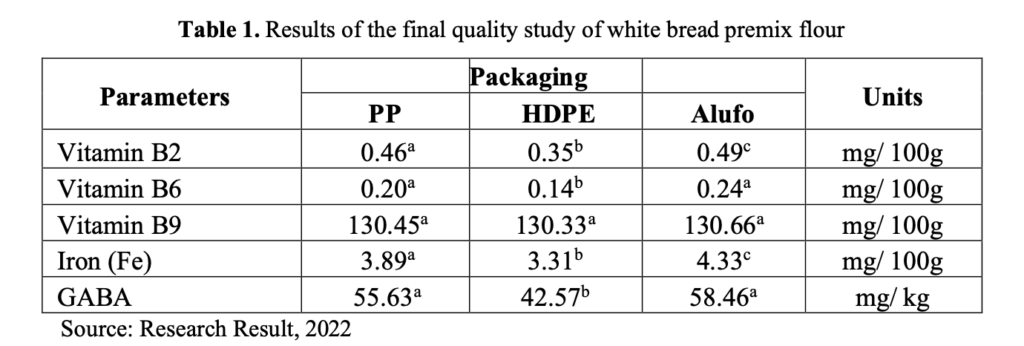
The results clearly favored aluminium foil. It preserved vitamin B2, vitamin B6, iron, and GABA better than the other materials. For example, the initial GABA level was 62.28 mg/kg. By the critical storage point, GABA had fallen by only 6.13% in aluminium foil, compared with 10.67% in PP and 31.64% in HDPE. Aluminium foil also showed the lowest permeability to water vapor, helping the premix take longer to reach critical moisture levels.
The detailed shelf-life estimates tell the same story. At 70% relative humidity, the predicted shelf life was 1.7 years in PP, 1.0 year in HDPE, and 7.4 years in aluminium foil. As humidity increased, shelf life became shorter, showing how strongly the surrounding environment influences dry food stability.
This research connects directly with Sustainable Development Goal 3 (SDG 3): Good Health and Well-Being. Nutritious food is valuable only if its quality can be maintained until it reaches consumers. Packaging that better protects vitamins, minerals, and functional compounds can help reduce nutrient losses during storage and support the availability of safe, stable food products.
The lesson is easy to understand: good food needs good protection. Packaging is not simply a wrapper for marketing. It is part of food technology itself. Choosing the right material can help preserve quality, extend shelf life, and make nutrient-rich food more dependable for consumers.
Reference: 10.1051/bioconf/20249601022
Contact Person: +6282192267099
Andi Nur Faidah Rahman
andinurfaidahrahman@unhas.ac.id