


ROADMAP
Research Sub-Theme
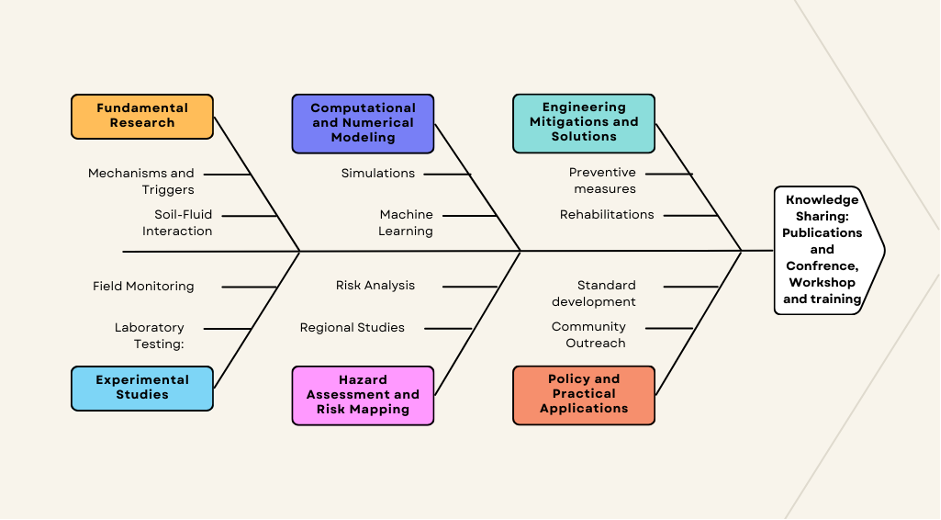
Mechanisms and Triggers
- Investigating how liquefaction triggers flowslides in various soil types and geomorphic settings.
- Exploring the role of pore water pressure build-up, seismic events, and static liquefaction.
Numerical and Analytical Modeling
- Developing computational models to simulate the onset and progression of flowslides.
- Coupling liquefaction dynamics with slope stability models.
Experimental Studies
- Laboratory-scale testing using devices like dynamic triaxial, centrifuge models, or shaking tables.
- Field experiments to monitor real-world case studies, such as embankment failures or natural slope collapses
Risk Assessment and Mapping
- Creating regional or site-specific hazard maps that incorporate liquefaction and flowslide risks.
- Assessing the vulnerability of critical infrastructure (e.g., dams, pipelines, or highways).
Mitigation Techniques
- Exploring soil improvement techniques (e.g., compaction, grouting).
- Studying early-warning systems for areas prone to liquefaction-induced flowslides.