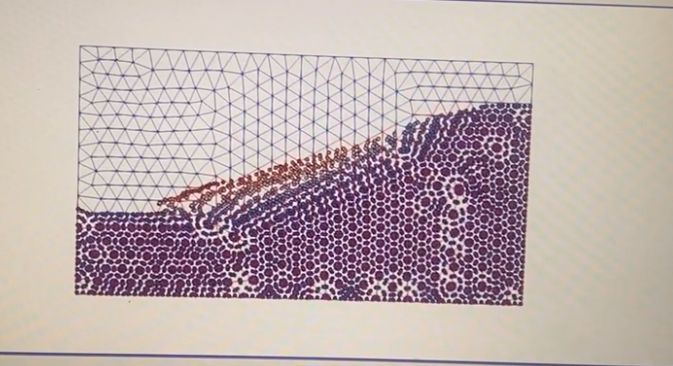
Our Research Group has explored the possibility of using hybrid FEM (dynamics of slope) with OpenSees and Anura3D to model seismic induced liquefaction on a slope, driving long distance flow slide. OpenSees (Open System for Earthquake Engineering Simulation) is an open-source software framework primarily used for simulating the behavior of structures and geotechnical systems during seismic events. It’s widely used by engineers and researchers to perform advanced analysis of structures under dynamic loading, including earthquakes, soil-structure interaction, and other geotechnical-related problems. OpenSees was developed by the Pacific Earthquake Engineering Research (PEER) Center at the University of California, Berkeley. The development started in the late 1990s under the leadership of Professor Filippou and other faculty members, including Professor Krawinkler. Over time, the software has evolved with contributions from researchers, engineers, and developers across the world.
Anura3D is an open-source software developed for geotechnical applications, specifically using the Material Point Method (MPM) for simulating soil and material behavior under various conditions. The main focus of Anura3D is on geotechnical engineering problems, such as landslides, soil dynamics, slope stability, and other related phenomena that require the modeling of large deformations, which traditional methods like Finite Element Method (FEM) can struggle with. Anura3D was developed as part of research at UPC (Universitat Politècnica de Catalunya) in Barcelona, Spain. The software was created by a team led by Dr. Amit Prakash, who was affiliated with UPC. The development of Anura3D was aimed at addressing the challenges of simulating large deformations and complex geotechnical behaviors using the Material Point Method (MPM).
Coupled Finite Element Method (FEM) and Material Point Method (MPM) is an advanced approach used in geotechnical engineering to model and simulate complex behaviors in soil and structures under dynamic loading, such as during earthquakes, landslides, or large deformations. The combination of both methods aims to take advantage of the strengths of each approach, overcoming their individual limitations.
Brent Sordo, Ellen Rathje, Krishna Kumar, Sequential Hybrid Finite Element and Material Point Method to Simulate Slope Failures, Computers and Geotechnics, Volume 173, 2024,106525,