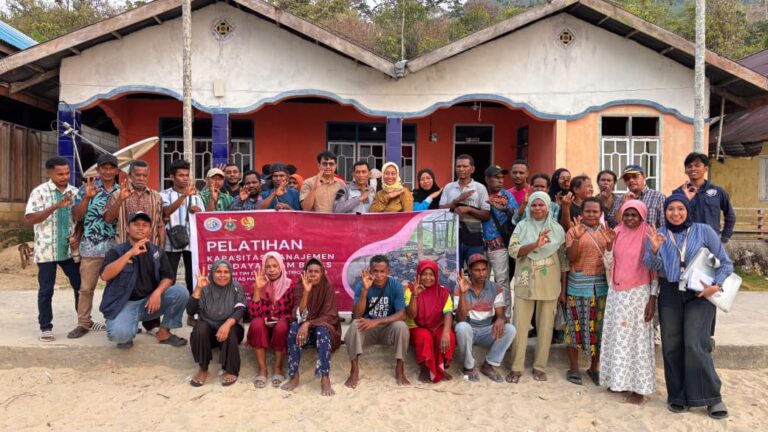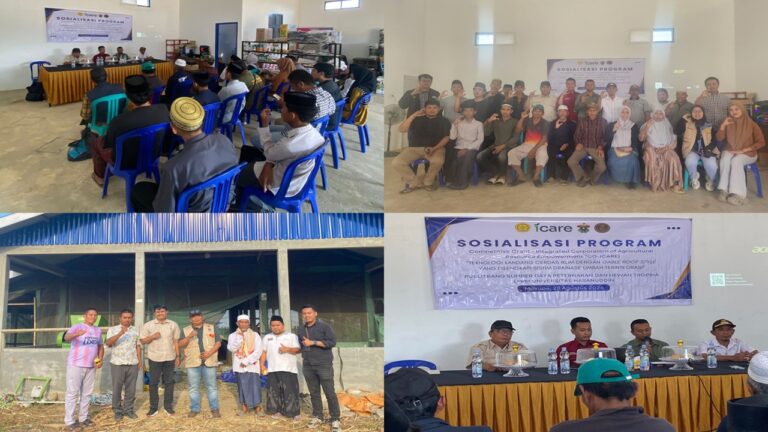
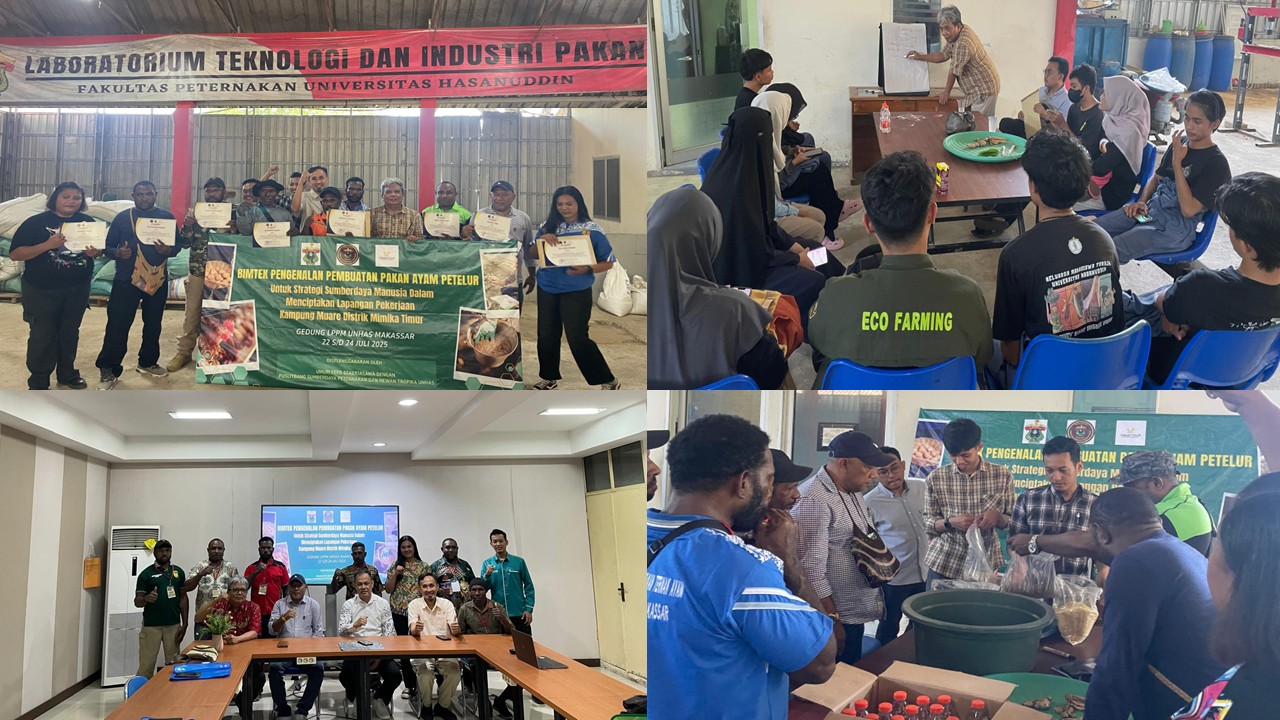

The Center for Research and Development of Livestock Resources and Tropical Animals, Universitas Hasanuddin, conducted a Technical Training on Feed Production for Laying Hens as part of an effort to strengthen human resource capacity in feed technology and poultry production. The activity was held on 22–25 July 2025, involved 10 poultry farmers, and was organized to support the Human Resource Development Strategy for Creating Employment Opportunities in Muare Village, East Mimika District, Mimika Regency, Central Papua Province.
The main objective of the activity was to improve farmers’ knowledge and practical skills in identifying feed ingredients, evaluating the physical quality of feed materials, formulating rations, processing and mixing feed, and applying appropriate packaging, storage, feed safety, and production cost management practices for laying hens. Through these competencies, participants were expected to gain a stronger foundation for applying feed technology in poultry enterprises and developing livelihood and employment opportunities based on livestock production.
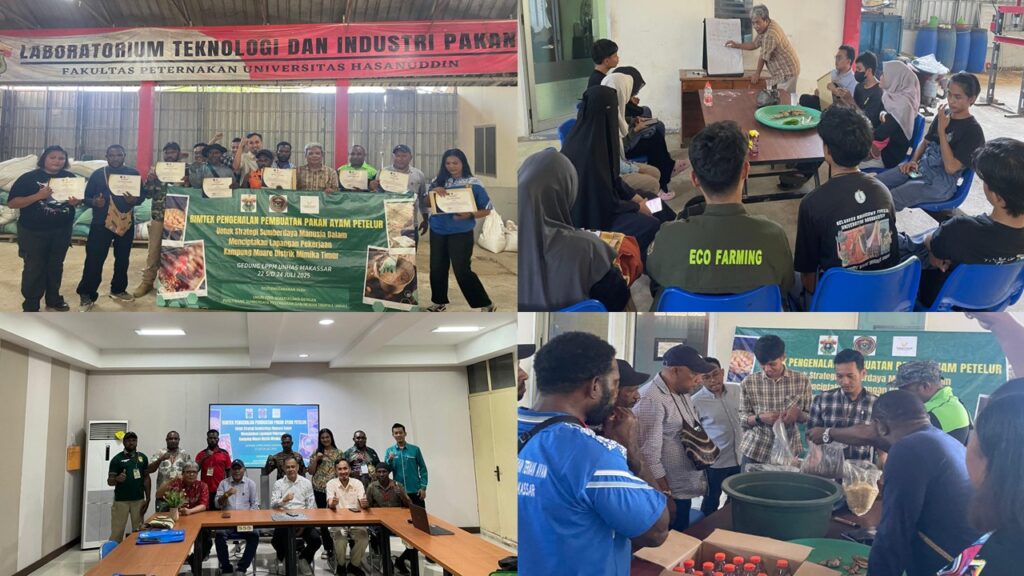
The training was conducted at the Center for Research and Development of Livestock Resources and Tropical Animal Resources (Puslitbang Sentro), Universitas Hasanuddin, and the Feed Technology and Industry Laboratory, Faculty of Animal Science, Universitas Hasanuddin. These facilities provided an integrated learning environment that connected research, technology development, and practical application in animal feed production.
The program combined classroom-based learning, technology introduction, practical training, and an industrial field visit. Learning materials included feed ingredients, feed additives and supplements, the potential and quality of local feed resources, basic nutrition of laying hens, feed additives and phytobiotics, feed quality assessment, and ration formulation techniques. This approach enabled participants to understand the relationship between feed quality, nutritional requirements, ration formulation, and laying hen productivity.
Participants were also introduced to key feed manufacturing processes, including particle size reduction using grinding equipment, feed mixing, packaging, storage, feed safety, production hygiene, and feed production cost analysis. The formulation sessions were complemented by an introduction to the Pearson Square method and its application in developing rations for laying hens.
During the practical sessions, participants directly practiced identifying feed ingredients and evaluating their physical characteristics, grinding feed materials, formulating and mixing rations, packaging feed, and applying appropriate storage techniques. The hands-on approach was intended to ensure that participants not only understood the concepts of feed technology but also developed basic skills that could be applied in field-level production.
The training involved academics and practitioners from the Faculty of Animal Science, Universitas Hasanuddin, including Prof. Dr. Ir. Jasmal A. Syamsu, M.Si., IPU, ASEAN Eng., Prof. Dr. Ir. Sri Purwanti, S.Pt., M.Si., IPU, ASEAN Eng., Dr. Abdul Alim Yamin, S.Pt., M.Si., and Ichlasul Amal, S.Pt,M.Si together with other instructors with expertise in feed production and technology.
As part of the effort to strengthen participants’ understanding of the feed industry, the program concluded with a field visit to PT Japfa Comfeed Indonesia, Makassar, on 25 July 2025. The visit provided participants with direct exposure to industrial feed production and helped them understand the relationship between human resource competencies, feed technology, quality control, and employment opportunities.
The activity contributes to SDG 4 (Quality Education) through practical, skills-based learning that strengthens participants’ technical competencies. It also supports SDG 1 (No Poverty) by developing knowledge and skills that can contribute to improved livelihoods, entrepreneurship, and employment opportunities in the livestock sector. In addition, collaboration among the university, farmers, and the feed industry contributes to SDG 17 (Partnerships for the Goals) by strengthening cooperation in knowledge transfer, technical capacity building, and practical learning.
Through this activity, feed technology is positioned not only as an academic field but also as a practical instrument for strengthening human capacity, supporting livestock enterprise development, and creating opportunities for sustainable, livestock-based livelihoods in Muare Village, Mimika Regency.