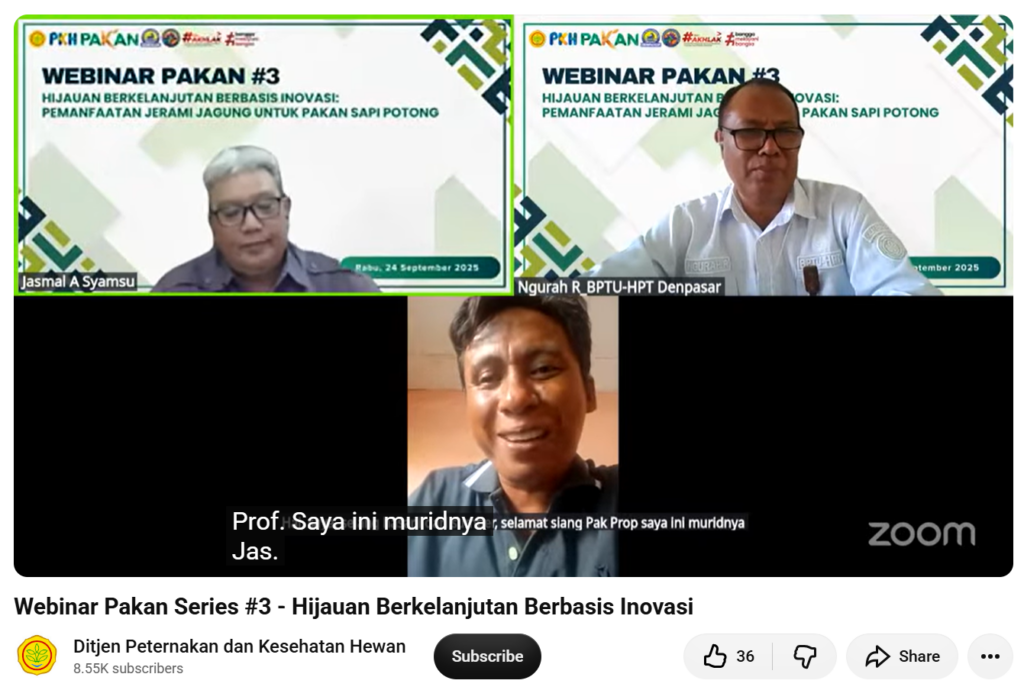
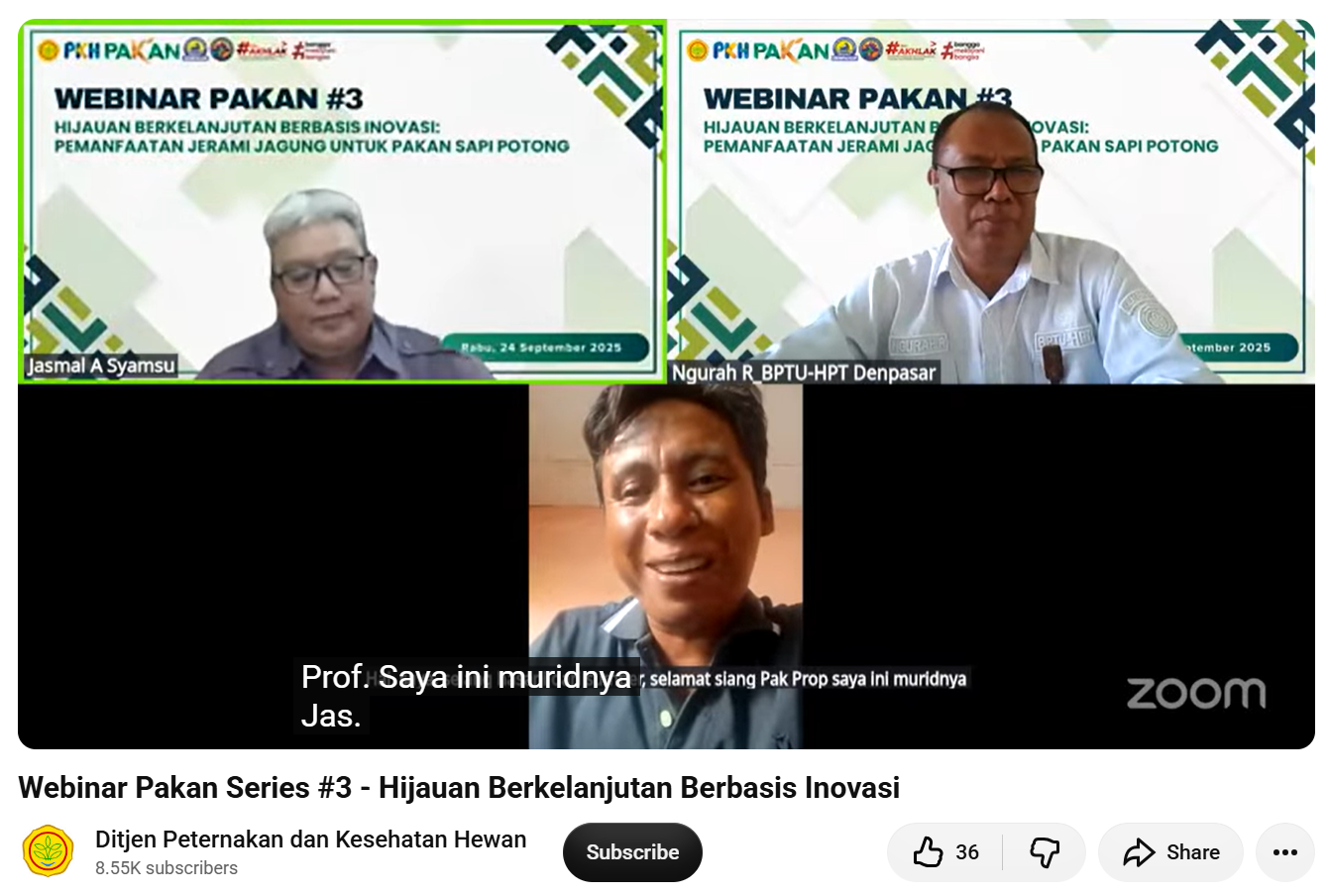

On September 24, 2025, the Denpasar Center for Superior Livestock Breeding and Forage (BPTU-HPT Denpasar) successfully organized a Feed Webinar in collaboration with the Directorate of Feed, Directorate General of Livestock and Animal Health (DGLAH). The webinar was held under the theme “Sustainable Forage Based on Innovation: Utilization of Corn Stover for Beef Cattle Feed.”
The webinar aimed to strengthen participants’ understanding of feed quality and sustainable feed management while promoting the utilization of locally available agricultural resources. In particular, the activity highlighted the potential of corn stover as an alternative feed resource for beef cattle when supported by appropriate processing technologies.
The webinar attracted strong interest, with 776 participants attending online from various backgrounds, including farmers, academics, practitioners, and members of the general public interested in livestock development and feed technology. The high level of participation reflected growing interest in sustainable approaches to livestock feed production and the utilization of agricultural by-products.
The event was officially opened by Director of Feed, Ir. Tri Melasari, S.Pt., M.Si. The main presentation was delivered by Prof. Dr. Ir. Jasmal A. Syamsu, M.Si., IPU, from the Faculty of Animal Science, Hasanuddin University (UNHAS), Makassar. He presented strategies and opportunities for utilizing corn stover as a feed resource for beef cattle, emphasizing the importance of appropriate processing to improve its utilization and value.
The session was moderated by drh. I Gusti Putu Ngurah Raka, Head of the Denpasar Center for Superior Livestock Breeding and Forage (BPTU-HPT Denpasar). The webinar began at 9:00 a.m. Central Indonesia Time (WITA) and featured an interactive discussion and question-and-answer session. Participants actively raised questions concerning feed selection, processing, and management practices that can support livestock health and productivity.
The discussion highlighted that corn stover, which is often considered an agricultural residue, can be converted into a useful feed resource through appropriate technologies. Such utilization can increase the value of agricultural by-products, improve resource efficiency, and provide practical benefits for livestock farmers, particularly in areas where corn production generates substantial amounts of crop residue.
The webinar also emphasized the importance of collaboration among government institutions, academics, practitioners, and farmers to ensure that feed innovations are relevant to local conditions and can be effectively implemented at the farm level. Knowledge exchange and cross-sector collaboration are essential for translating technological innovations into practical solutions for sustainable livestock production.
The activity contributes to several Sustainable Development Goals (SDGs). It supports SDG 1 (No Poverty) by promoting more efficient livestock production and the utilization of locally available agricultural resources, which can help strengthen the economic resilience of smallholder farmers. The webinar also advances SDG 4 (Quality Education) by facilitating knowledge sharing and capacity building among farmers, academics, practitioners, and other stakeholders. Finally, the collaboration among the BPTU-HPT Denpasar, the Directorate of Feed, Hasanuddin University, farmers, academics, and other stakeholders reflects SDG 17 (Partnerships for the Goals) by strengthening cross-sector collaboration and knowledge exchange to advance sustainable livestock development.
The webinar concluded with a shared commitment to strengthen innovation and collaboration in sustainable feed management. The utilization of corn stover is expected to contribute to improved feed availability, greater efficiency in livestock production, and more responsible use of agricultural resources, supporting the broader development of a resilient and sustainable livestock sector in Indonesia.