
MAKASSAR, Indonesia July 27 2026/f-analysis/ – Many people imagine advanced mathematics as a world of symbols far removed from everyday life. Yet one of its central goals is surprisingly practical: finding clearer ways to understand complicated structures. This idea lies at the heart of the research article “On the n-inner product spaces from the perspective of its quotient spaces,” published in the Bulletin of the Karaganda University. Mathematics Series by Karaganda National Research University named after Academician Ye.A. Buketov on July 26, 2026. The study was written by Harmanus Batkunde, Muh Nur, and Meilin Imelda Tilukay.
The paper explores n-inner product spaces, a generalization of familiar inner product spaces used to measure length, angle, and geometric relationships. In ordinary geometry, an inner product helps determine whether two directions are close, perpendicular, or far apart. In an n-inner product space, these relationships are examined using several reference vectors simultaneously, making the structure richer but also more difficult to study.
To make the problem more manageable, the researchers use quotient spaces. A useful way to imagine this is to think of a large building observed through several windows. Each window hides some details but reveals a particular view. One window may not show the entire building, but a carefully selected collection of windows can provide enough information to understand its overall structure.
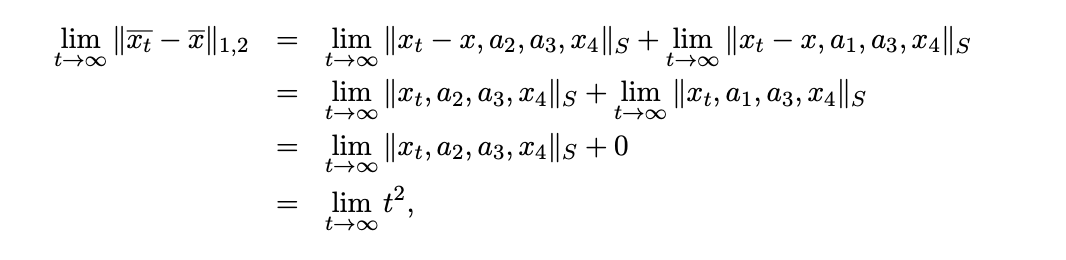
The authors begin with a set of n linearly independent vectors. By removing selected vectors and forming quotient spaces, they create several classes of simpler spaces. Each quotient space is then equipped with its own inner product and induced norm. These tools allow the original n-inner product space to be examined through smaller and more familiar mathematical structures.
The study focuses on important topological properties, including weak convergence, strong convergence, weak and strong Cauchy sequences, and completeness. Its key finding is that definitions based on different classes of quotient spaces are equivalent. In practical terms, researchers may choose different mathematical viewpoints without changing the final conclusion about whether a sequence converges or behaves consistently.
Another important contribution is analytical efficiency. The paper shows that it is not always necessary to use every quotient space in a class. A smaller collection may be sufficient, provided that the selected quotient spaces collectively cover all reference-vector indices. The minimum number required is at least the ceiling of n divided by m, where m indicates the class being used. This finding reduces repetition and creates a more economical analytical framework.
This research contributes directly to Sustainable Development Goal 4: Quality Education by enriching advanced mathematical knowledge and supporting clearer approaches to teaching and studying abstract analysis. It also reflects Sustainable Development Goal 17: Partnerships for the Goals, as the research resulted from collaboration between academics from Pattimura University and Hasanuddin University.
Although highly theoretical, the study demonstrates an important scientific principle: complex problems can often be understood more effectively by breaking them into simpler, connected perspectives.
Reference
DOI:
https://doi.org/10.31489/2026m2/65-79
Contact:
Dr. Muh. Nur, S.Si., M.Si
+6282187050898
muhammadnur@unhas.ac.id