

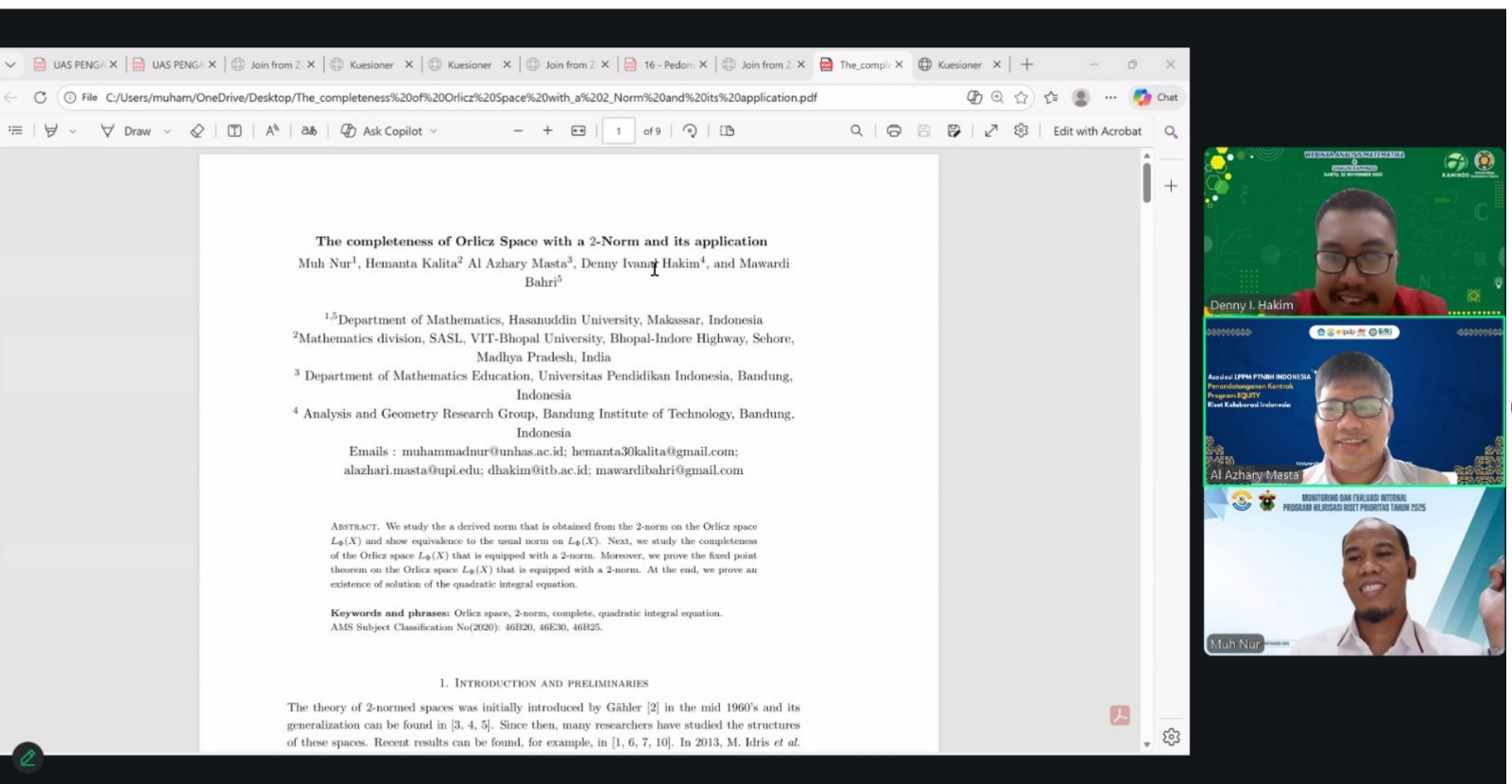

On November 29, 2025, the Functional Analysis Theoretical Research Group (F-Analysis TRG) convened a highly focused virtual session titled the “Research Collaboration and Conference Exploration Meeting.” Hosted efficiently via Zoom, this exclusive academic gathering brought together a dedicated core of just four participants. Despite the small group size, the impact of the meeting was profound, as it united brilliant mathematical minds from the F-Analysis TRG with esteemed collaborators from the Bandung Institute of Technology (ITB) and the Indonesia University of Education (UPI).
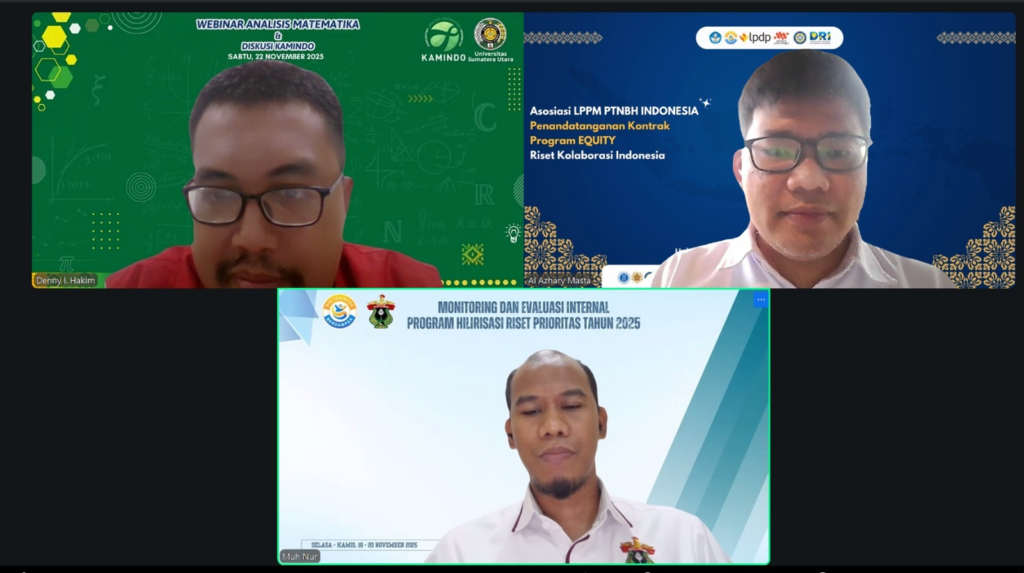
The primary objective of this strategic meeting was twofold: to engage in advanced research discussions surrounding functional analysis and to lay the rigorous groundwork for an upcoming international conference. Functional analysis, while seemingly abstract to the general public, is a vital branch of mathematics that studies spaces of functions. It provides the essential, invisible architecture required to understand everything from complex quantum systems to modern data science algorithms. By exploring these intricate mathematical frameworks, researchers can develop new methodologies to solve highly complex, real-world problems that traditional calculations cannot address.
This commitment to elevating academic discourse and pushing the boundaries of human knowledge directly supports SDG 4: Quality Education. By meticulously planning an international conference and sharing specialized research insights, the F-Analysis TRG and its university partners are actively democratizing access to elite mathematical education. They are cultivating a robust academic environment that empowers the next generation of university students and researchers, ensuring that high-level scientific literacy continues to thrive and expand.
Furthermore, the practical applications of functional analysis extend far beyond the virtual classroom, playing a surprisingly critical role in addressing global socioeconomic inequalities. The mathematical models refined through these academic discussions are fundamentally necessary for optimizing resource distribution, stabilizing economic systems, and forecasting unpredictable market behaviors. By identifying equilibrium within complex economic networks, this rigorous mathematical research indirectly but firmly supports SDG 1: No Poverty. It equips forward-thinking policymakers with the precise, data-driven analytical tools required to design effective interventions that can sustainably uplift vulnerable communities.
Ultimately, unlocking these sophisticated mathematical solutions requires profound cooperation, bringing us directly to SDG 17: Partnerships for the Goals. This virtual meeting was a shining testament to the power of cross-institutional synergy. By bridging the distinct expertise of researchers from ITB, UPI, and the strong academic foundation of the Mathematics Department, this intimate gathering of exactly four participants beautifully demonstrated that solving intricate global challenges fundamentally relies on unified, cross-disciplinary collaboration.
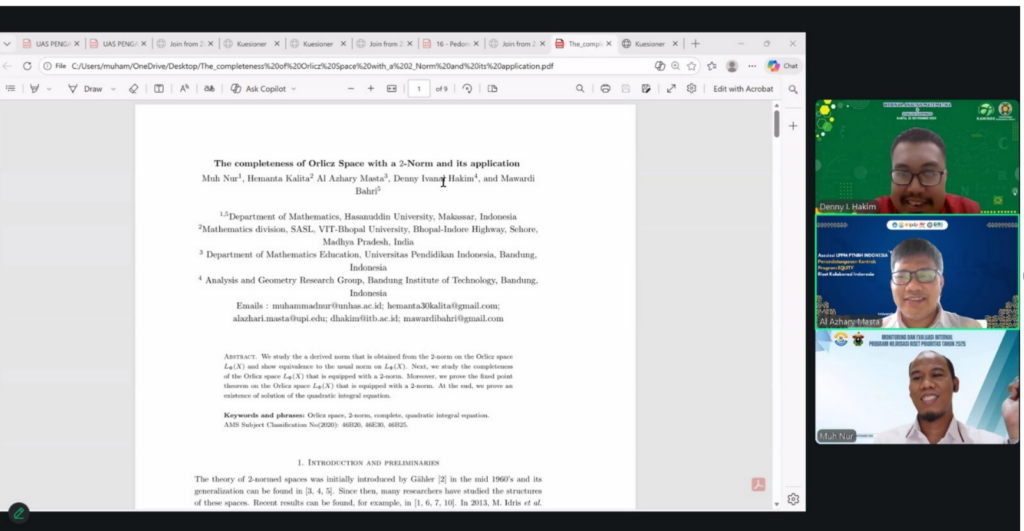
As the strategic meeting seamlessly concluded, the strategic pathway toward a highly successful international conference was clearly established. The collaborative efforts of the F-Analysis TRG and its esteemed national partners continue to prove that abstract mathematics is not merely a theoretical pursuit, but rather a robust foundational pillar critically essential for driving sustainable, worldwide development, scientific progress, and long-term technological innovation.


