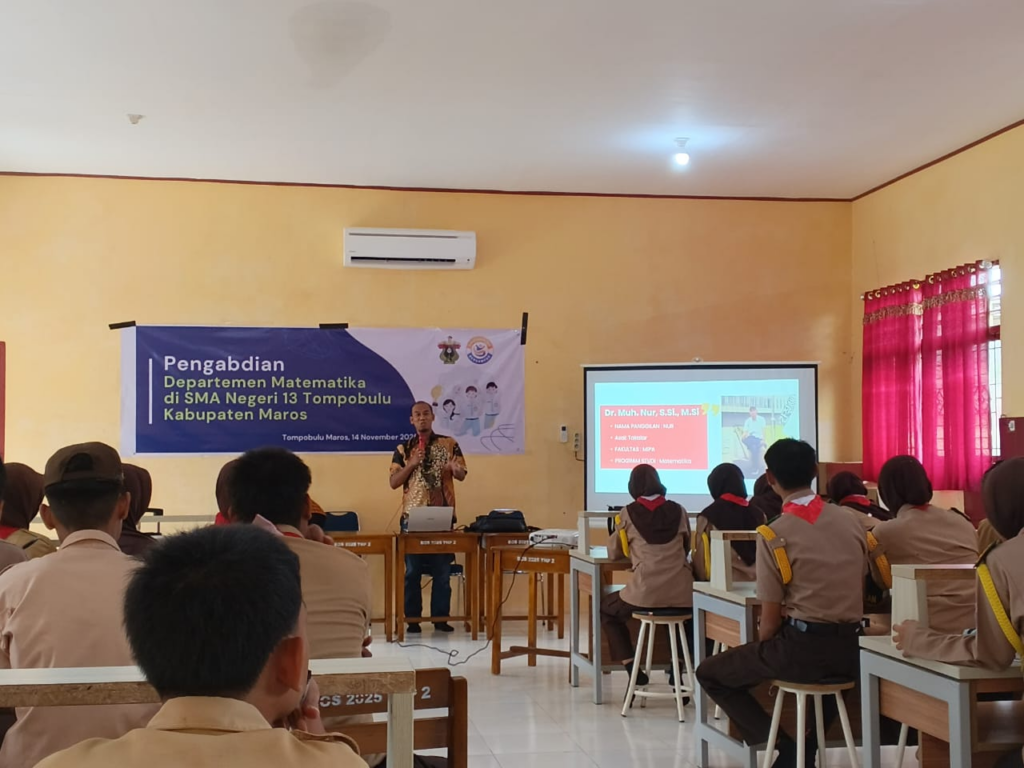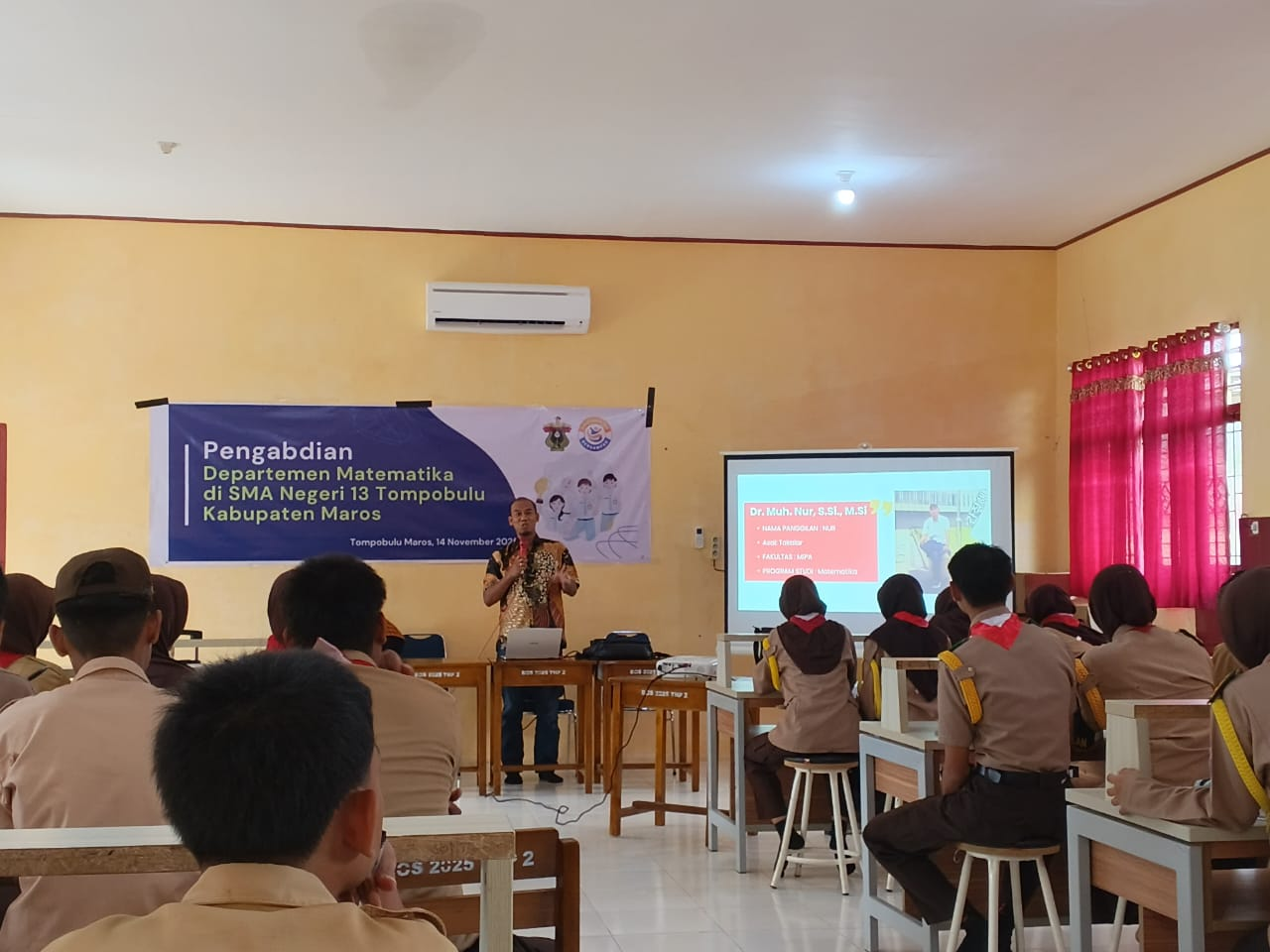

On November 14th, the Department of Mathematics successfully organized a community service program (Pengabdian Masyarakat) at SMAN 13 Tompobulu, Maros Regency. The event featured Dr. Muh. Nur, S.Si., M.Si., as the main speaker, who shared valuable insights with the students.
This initiative aims to bridge the gap between academic theory and practical application, fostering a deeper interest in mathematics among high school students. The session was attended by enthusiastic students who actively engaged in the presentation and discussions.
The primary audience for this enlightening session comprised highly enthusiastic 12th-grade students of SMAN 13 Tompobulu. Approaching a critical transition phase in their academic journey, these senior students are on the verge of entering higher education or the professional workforce. The core objective of this initiative was to seamlessly bridge the often-intimidating gap between abstract academic theory and tangible practical application. By demonstrating how mathematical equations govern real-world phenomena—from economic forecasting to advanced technological algorithms—the session effectively fostered a much deeper, more grounded interest in mathematics, proving that the subject extends far beyond mere classroom memorization.
This proactive educational outreach is deeply interconnected with global development targets, most notably championing SDG 4: Quality Education. By bringing elite, university-level perspectives directly to a regional high school, the Department of Mathematics actively democratizes access to high-quality academic inspiration. This crucial initiative ensures that students in Maros Regency receive equitable, lifelong learning opportunities, equipping these 12th graders with the robust analytical mindset and advanced problem-solving tools absolutely required to thrive in an increasingly competitive, data-driven modern world.
Furthermore, the practical implications of fostering strong mathematical literacy hold a transformative societal impact, strongly supporting SDG 1: No Poverty. In today’s rapidly evolving global economy, advanced mathematical competency is the fundamental bedrock for lucrative, high-demand careers in technology, engineering, and the sciences. By reshaping how these senior students perceive and approach complex problem-solving, the university empowers them to pursue higher education and skilled professions. This intellectual empowerment serves as a vital, data-driven intervention, providing communities with the intellectual capital necessary to achieve sustainable economic independence and uplift their overall socio-economic status.
Ultimately, realizing such ambitious educational transformation fundamentally relies on collaborative synergy, which brings us directly to SDG 17: Partnerships for the Goals. This successful community service program served as a brilliant testament to the undeniable power of cross-institutional alliances. By firmly linking the academic rigor of the higher education sector with the foundational learning environment of SMAN 13 Tompobulu, the event demonstrated that advancing educational equity fundamentally requires unified, multi-sectoral partnerships.
As the highly engaging discussion concluded, the enthusiastic participation of the students reaffirmed that collaborative academic outreach is a robust foundational pillar for long-term societal progress and scientific innovation.