
MAKASSAR, Indonesia Mar 12 2026/f-analysis/ – Have you ever wondered how your GPS knows exactly where you are, or how architects ensure that a skyscraper doesn’t topple over? At the heart of these daily miracles is a concept called orthogonality—the mathematical way of saying things are “square” or at a perfect right angle. While we learn about simple 90-degree angles in school, the modern world operates in complex “normed spaces”. These are abstract mathematical playgrounds where standard rules of geometry are stretched and reshaped to handle massive amounts of data and multi-dimensional problems.
A groundbreaking study by researchers Muh Nur from Hasanuddin University and Harmanus Batkunde from Pattimura University has introduced a new way to look at these abstract corners. Their paper, published in the Journal of Interdisciplinary Mathematics, explores a fresh concept called Dg-orthogonality and the Dg-angle. These concepts provide a more sophisticated toolkit for modern science by moving beyond traditional one-dimensional measurements.
The Magic of Dg-Angles
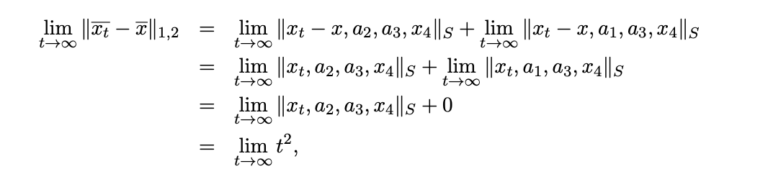
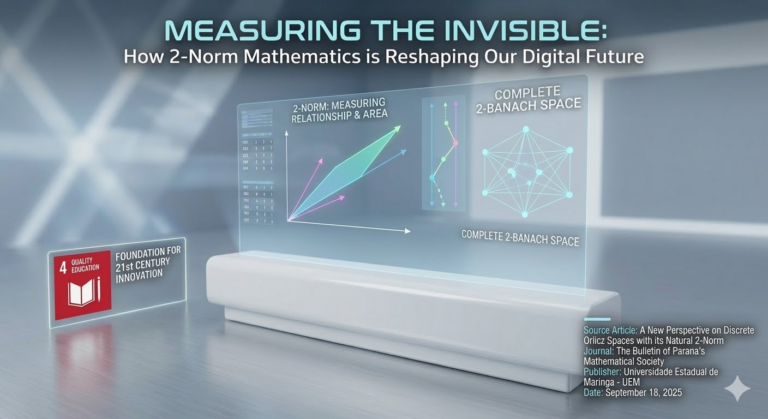
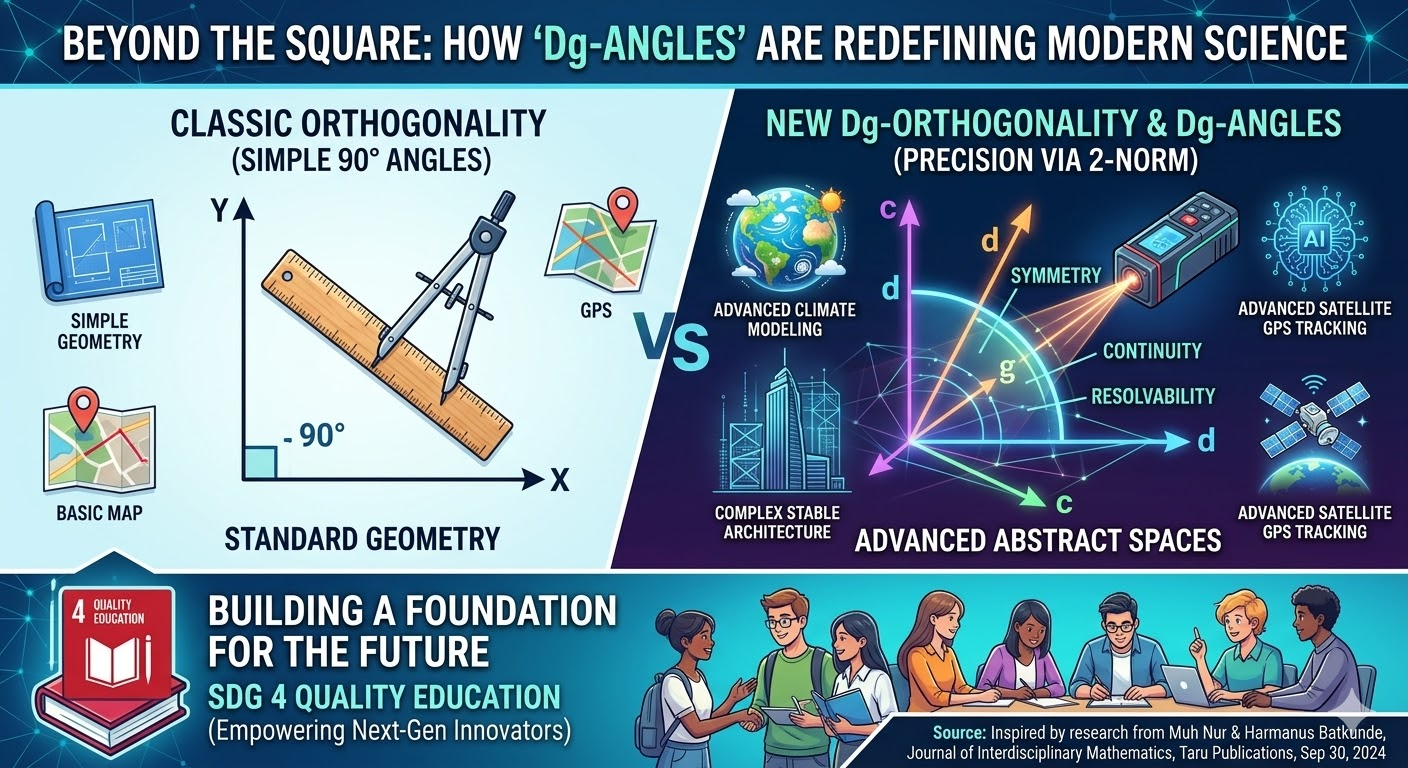
In the past, mathematicians used standard “norms” to measure distance and “g-orthogonality” to define when two vectors are perpendicular. However, as data becomes more complex, these standard measures can fall short. The researchers found that by using something called a 2-norm—a specific function that measures the relationship between pairs of vectors—they could create a more nuanced way to measure these interactions. Imagine trying to measure the corner of a room with a standard wooden ruler versus a high-tech laser level; the new Dg-orthogonality provides that sophisticated “laser” for abstract mathematical spaces.
The study proves that this new method is far more than just a theoretical exercise; it has a deep relationship with existing mathematical rules. The researchers demonstrated that Dg-angles possess vital properties such as nondegeneracy, symmetry, homogeneity, and resolvability. This means the angles remain stable, predictable, and consistent even as the variables change. Such stability is absolutely crucial for computer algorithms that need to process massive datasets—like those used in facial recognition or stock market predictions—without “crashing” due to mathematical inconsistencies.
Building a Foundation for the Future
You might ask, “Why does this abstract math matter to the average person?” This research is a direct contribution to SDG 4: Quality Education. By expanding the boundaries of what we know about functional analysis and geometry, this work provides the high-level “grammar” that future scientists, data analysts, and engineers will use to build better technology. Providing students and researchers with advanced tools like the Dg-angle ensures that the next generation of innovators is equipped to solve the world’s most complex technical challenges.
By refining how we calculate angles in complex systems, we pave the way for more precise climate modeling, safer infrastructure, and more reliable artificial intelligence. Mathematics is the invisible scaffolding of our modern world, and thanks to the notion of Dg-orthogonality, that scaffolding just got significantly stronger.
Reference
DOI:
https://doi.org/10.47974/JIM-1752
Contact:
Dr. Muh. Nur, S.Si., M.Si
+6282187050898
muhammadnur@unhas.ac.id