
Description
Empowering Remote Communities: The Future of Clean Water at the Edge
Imagine living in a place where the simple act of pouring a glass of water is a gamble. In remote regions like Gariuai Village in Timor-Leste, this isn't a hypothetical scenario—it’s a daily reality. Traditional water treatment systems are often too expensive, too complex, or too reliant on chemicals that harm the environment. However, a groundbreaking international collaboration is changing the narrative by blending ancient nature with futuristic artificial intelligence.
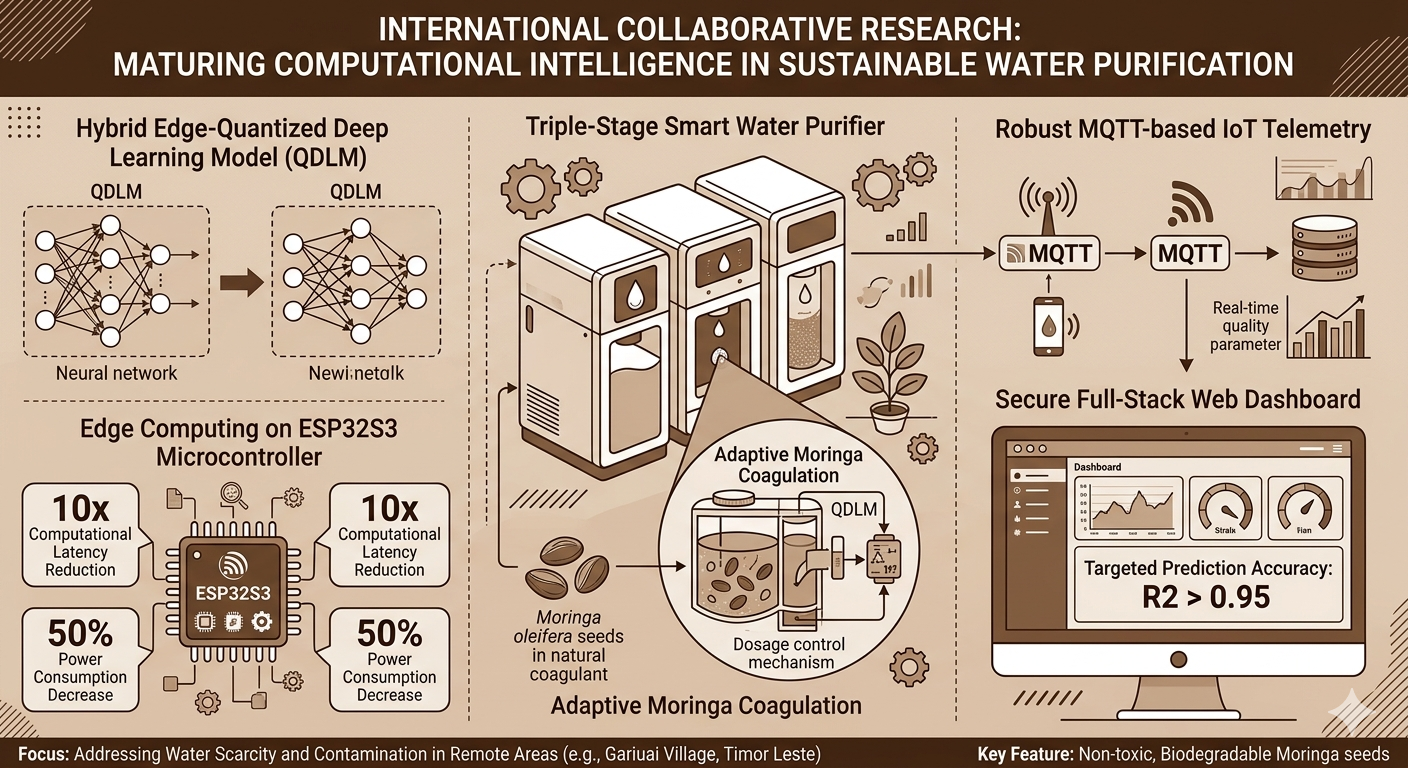
At the heart of this research is the Triple-Stage Smart Water Purifier. This isn't just a filter; it’s a high-tech guardian designed to thrive where the internet and power grids fail. The secret lies in a "Hybrid Edge-Quantized Deep Learning Model." While that sounds like science fiction, the goal is simple: giving a tiny, low-cost computer chip (the ESP32S3) the "brainpower" to make complex decisions locally. By using Edge Computing, the system doesn't need to send data to a distant cloud server. This results in a 10x reduction in latency and cuts power usage by 50%, ensuring the device stays running on minimal battery or solar power in the most isolated corners of the world.
What truly sets this project apart is its "green" soul. Instead of using harsh synthetic chemicals to clean the water, the system governs an Adaptive Moringa Coagulation process. It uses crushed seeds from the Moringa oleifera tree—a natural, biodegradable miracle plant—to bind and remove impurities. The AI ensures that just the right amount of seed extract is used based on the water’s current state, achieving a stunning prediction accuracy of R2 > 0.95$.
This research is a direct contribution to SDG 6: Clean Water and Sanitation. While the prompt mentions several goals, the most vital link here is to Sustainable Development Goal 6, which aims to ensure the availability and sustainable management of water and sanitation for all. By providing a low-cost, high-efficiency solution that doesn't rely on toxic chemicals, we are protecting local ecosystems while saving lives.
Furthermore, the system is fully connected via a secure Web Dashboard. Through MQTT-based IoT telemetry, researchers and local leaders can monitor water quality in real-time from anywhere in the world. This transparency ensures that the water isn't just clean today, but stays clean for generations to come.
By miniaturizing "big" AI into "small" hardware, this project proves that cutting-edge technology doesn't have to be exclusive to wealthy cities. It belongs in the hands of those who need it most. We are not just building a purifier; we are building a bridge to a healthier, more sustainable future where clean water is a right, not a luxury. Through this marriage of botanical wisdom and digital intelligence, the dream of global water security is moving one step closer to reality, starting from the small village of Gariuai to the rest of the world.
Related Publications
-
Akbar, N.I.M. and Tahir, Z., 2023. Performance analysis of Fog architecture to monitor solar panel for smart home. 2023 International Seminar on Intelligent Technology and Its Applications (ISITIA).
-
Nasruddin, U., Tahir, Z. and Wardi, W., 2024. Comparison of satellite and conventional networks using edge computing for monitoring system of IoT base. 2024 7th International Seminar on Research of Information Technology and Intelligent Systems (ISRITI).
-
Tahir, Z., Niswar, M., Wardi, W., Prayogi, A., Wardhani, T.P.M. and Nainggolan, L.N., 2024. Analysis of offline-first app technology in Raspberry Pi edge computing for post-disaster hospital situation. University of Bahrain.
-
Tahir, Z., Ilham, A.A., Alimuddin, A.P., Suyuti, M.Z.A. and Charina, 2022. Reliable and low-cost digital transformation technology using progressive web apps in fog computing architecture for small and medium industries in Indonesia. International Conference on Emerging Internetworking, Data & Web Technologies.
-
Tahir, Z., Syarif, S., Wardhani, T.P.M. and Safaqdillah, M.A., 2024. Dust-induced power loss in solar plants: a real-time web application for degradation prediction using decision trees and random forests regressions. 2024 International Conference on Intelligent Cybernetics Technology (ICICT).
-
Tahir, Z., Ilham, A.A., Niswar, M. and Fauzy, A.A., 2021. Progressive web apps development and analysis with angular framework and service worker for e-commerce system. 2021 IEEE International Conference on Computing (ICOCO), pp. 192-195.
-
Tahir, Z., Niswar, M., Aswad, I. and Amzar, M.F., 2023. A comprehensive examination of the webp utilizing javascript and react library. 2023 IEEE International Conference on Communication, Networks and Satellite (COMNETSAT).
-
Niswar, M., Tahir, Z. and Wey, C.Y., 2022. Design and implementation of IoT-based aeroponic farming system. 2022 IEEE International Conference on Cybernetics and Computational Intelligence (CyberneticsCom).
-
Tahir, Z., Ilham, A.A., Niswar, M., Adnan, A., Zainuddin, Z., Paundu, A.W., Wardi, W. and others, 2024. Sosialisasi penerapan teknologi monitoring tanaman hidroponik di PPMI Shohwatul Is'ad Kabupaten Pangkep. JURNAL TEPAT: Teknologi Terapan untuk Pengabdian Masyarakat, 6(2), pp. 436-443.
Description
Eco-Tech Revolution: Weaving the Future of Sustainable Textiles with AI and IoT
The world of fashion and textiles is standing at a crossroads. For centuries, traditional methods like "ecoprinting"—a technique that uses natural leaves and flowers to dye fabrics—have been celebrated for their beauty and eco-friendly roots. However, these manual processes are often unpredictable. A slight change in temperature or a few minutes too long in the steamer can result in inconsistent colors and wasted materials. This is where the Smart Ecoprint Automation System steps in, transforming an ancient art form into a high-tech, precision industry.
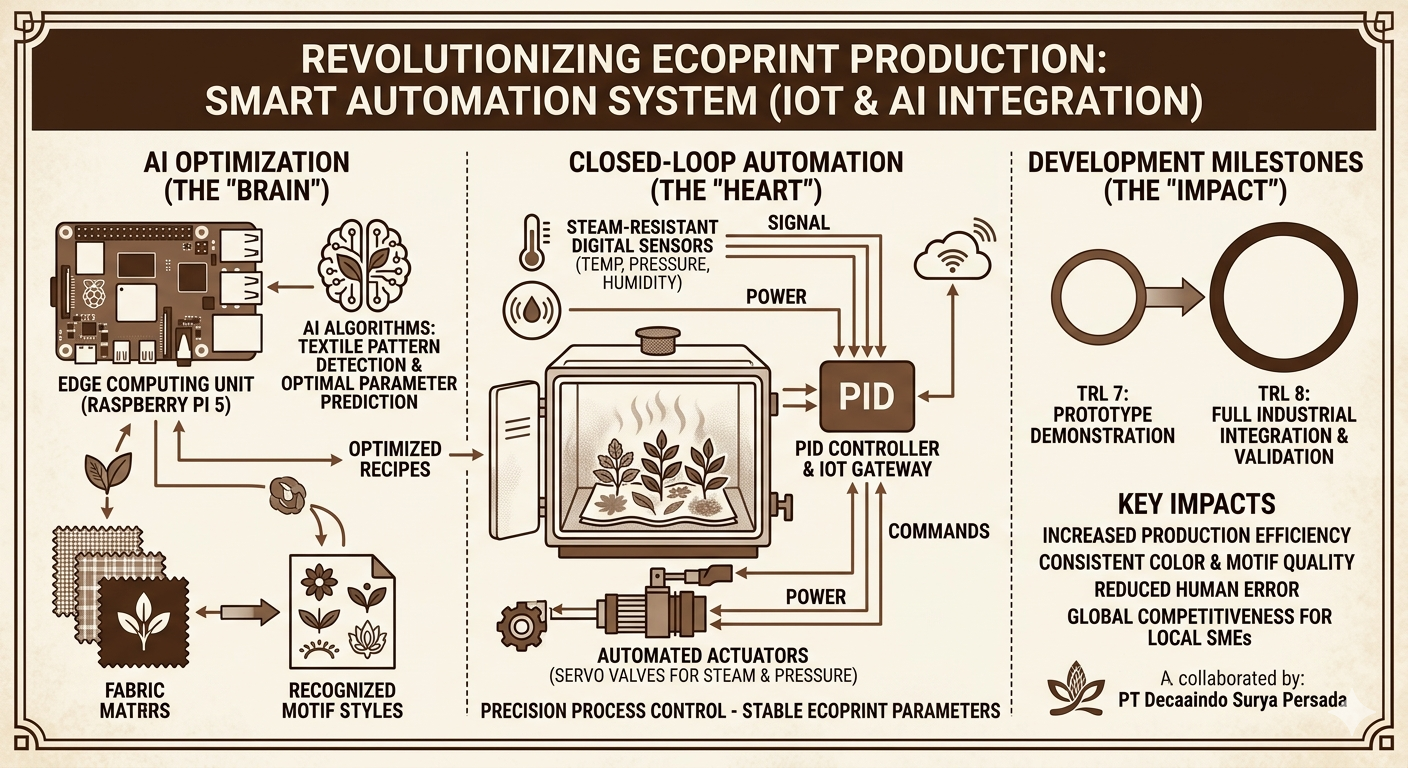
At its core, this research is about bringing "brains" to the steaming process. Imagine a system where you no longer have to guess if the temperature is right. By integrating the Internet of Things (IoT), we have developed a precision closed-loop control mechanism. Using specialized steam-resistant digital sensors and a PID controller, the system acts like a master craftsman that never sleeps. It automatically manages actuators and servo valves to maintain perfect steaming parameters. The result? A stable, "set-it-and-forget-it" environment that produces flawless textiles without the need for constant human intervention.
But we didn't stop at automation. To truly revolutionize the craft, we integrated Artificial Intelligence (AI) powered by Edge Computing on a Raspberry Pi 5. This allows the system to "see" and "think" locally. The AI algorithms are designed to detect and suggest optimal production patterns based on the specific type of fabric being used—whether it is silk, cotton, or linen. By analyzing these variables in real-time, the system overcomes the age-old problem of inconsistent motifs and color fading, ensuring every piece of fabric meets global quality standards.
This innovation directly supports the United Nations' Sustainable Development Goal 17 (SDG 17): Partnerships for the Goals. No great leap in technology happens in a vacuum. Our project is currently transitioning from Technical Readiness Level (TRL) 7 to TRL 8, moving out of the laboratory and into the real world. This is made possible through a strategic collaboration with PT Decaaindo Surya Persada. By bridging the gap between academic research and industrial application, we are creating a blueprint for how local Small and Medium Enterprises (SMEs) can compete on a global stage.
Through this partnership, we are empowering local artisans with industrial-grade tools. This synergy ensures that traditional Indonesian heritage is not lost to modernization but is instead elevated by it. By enhancing production efficiency and reducing waste, we are making sustainable fashion commercially viable. We are proving that high-tech solutions like AI and IoT are not just for giant factories; they are the keys to unlocking the potential of local communities, ensuring they have the resources and the global competitiveness to thrive in a digital age. This is the future of fashion: sustainable, smart, and collaborative.
Related Publications:
-
Reliable and Low-Cost Digital Transformation Technology Using Progressive Web Apps in Fog Computing Architecture for Small and Medium Industries in Indonesia Z Tahir, AA Ilham, AP Alimuddin, MZA Suyuti, Charina International Conference on Emerging Internetworking, Data & Web (2022)
-
Comparison of Satellite and Conventional Networks Using Edge Computing for Monitoring System of IoT Base U Nasruddin, Z Tahir, W Wardi 7th International Seminar on Research of Information Technology and Intelligent Systems (2024)
-
Analysis of Offline-First App Technology in Raspberry Pi Edge Computing for Post-Disaster Hospital Situation Z Tahir, M Niswar, W Wardi, A Prayogi, TPM Wardhani, LN Nainggolan University of Bahrain (2024)
-
Fog computing concept implementation in work error detection system of the industrial machine using support vector machine (svm) J Rusman, Z Tahir, AEU Salam International Seminar on Research of Information Technology and Intelligent Systems (2019)
-
Detection of Industrial Machine Work Errors using LVQ Neural Network M Rasyid, Z Tahir, S Syafaruddin 1st International Conference on Science and Technology, ICOST (2019)
-
Digital Image Processing for Detecting Industrial Machine Work Failure with Quantization Vector Learning Method MR Rasyid, Z Tahir Jurnal Pekommas (2019)
-
Artificial Neural Network Approach for Maintenance Strategy of Machinery in Small and Medium Industries Z Tahir, I Nurtanio, A Suyuti, F Alhari, M Rafrin, S Kobayashi, PK KM International Conference on Innovation, Management and Industrial Engineering (2015)
-
A hybrid maintenance management model in decision support system for small and medium food processing industries Z Tahir Universiti Teknikal Malaysia Melaka (2010)
-
Maintenance decision support system in small and medium industries: an approach to new optimization model Z Tahir, AS Prabuwono, MA Burhanuddin IJCSNS (2008)
-
A Review of Optimization Models and Techniques for Maintenance Decision Support Systems in Small and Medium Industries Z Tahir, P Anton Satria, MA Burhanuddin, H Akbar Makassar International Conference on Electrical Engineering and Informatics (2008)
Description
Revolutionizing Workplace Wellness: How AI is Safeguarding the Future of Indonesian Workers
The rapid industrial growth in Indonesia brings an often-overlooked challenge: the physical strain on the hardworking individuals driving this progress. From factory floors to modern office spaces, millions of workers face the daily risk of musculoskeletal disorders—painful conditions affecting the back, neck, and limbs caused by poor posture and repetitive movements. Traditionally, checking if a worker is sitting or standing "correctly" required manual observation by experts, a process that is slow, subjective, and often inaccurate. However, a groundbreaking research project is set to change this narrative by bringing high-tech solutions to the front lines of occupational health.
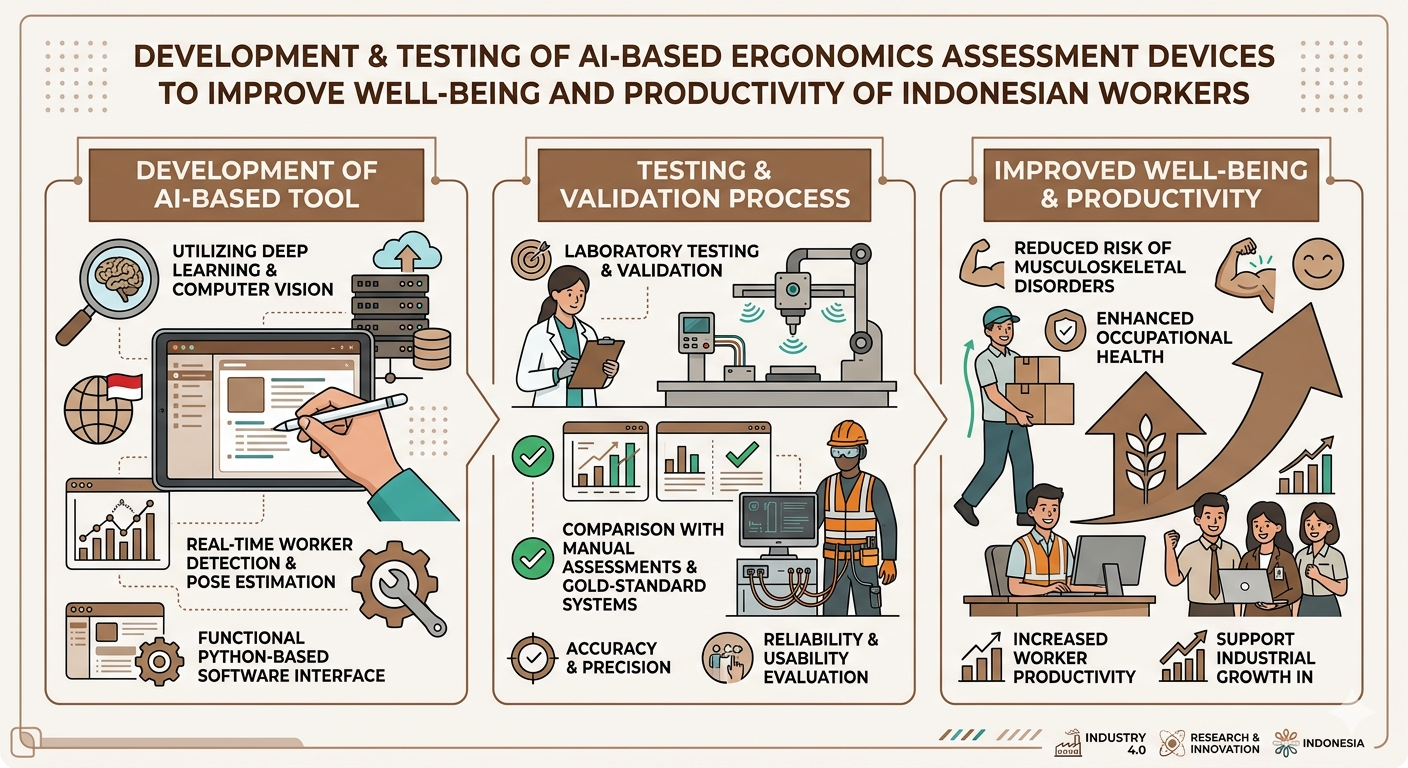
This research aims to develop and test a cutting-edge, Artificial Intelligence (AI)-based ergonomic assessment tool specifically designed to enhance the well-being and productivity of the Indonesian workforce. Imagine a system that acts like a "digital guardian," watching over workers not to micromanage them, but to ensure they stay healthy and injury-free. By utilizing advanced deep learning and computer vision technologies, such as YOLO (You Only Look Once) for rapid worker detection and MediaPipe for human pose estimation, this device can "see" and understand human movement like never before.
The technology works by automatically identifying key posture landmarks—such as the alignment of the spine, shoulders, and knees—and calculating joint angles in real-time. It then processes this data through sophisticated ergonomic risk algorithms to provide an instant health score. To make this high-level science accessible, the project involves transforming these complex mathematical models into a user-friendly, Python-based software interface. This means that occupational health practitioners won't need to be computer scientists to use it; they will have a functional, intuitive tool that provides objective data at the touch of a button.
A critical phase of this research is rigorous laboratory testing. The AI system's performance is being evaluated against "gold-standard" motion capture systems to ensure its validity and reliability. This ensures that the AI’s advice is just as accurate as—if not better than—traditional manual assessments. By replacing guesswork with precise data, we can identify risks before they turn into chronic injuries, keeping workers on the job and out of the hospital.
Importantly, this initiative is a direct contribution to global progress. By prioritizing the health of the labor force, this research aligns with SDG 3: Good Health and Well-being. Ensuring that industrial growth does not come at the cost of human physical health is essential for a sustainable future. When workers are healthy, they are more productive, their families are more stable, and the national economy thrives. Ultimately, this research provides a smarter, more objective way to reduce the risk of workplace injuries, ensuring that Indonesia's path to industrial excellence is paved with the safety and well-being of its most valuable asset: its people.
Related Publications:
-
Detecting Indiscriminate Disposal of Waste Using Computer Vision S Mujaddid, Z Zainuddin, Z Tahir 2021 International Seminar on Machine Learning, Optimization, and Data Science (ISMODE), 2022
-
The waste detection system of shrimp feeding with a waterproof camera using yolo algorithm Z Zainuddin, J Tuluran, A Achmad, IS Areni, Z Tahir Journal of Physics: Conference Series 2312 (1), 012083, 2022
-
Pattern recognition of human activity based on smartphone data sensors using SVM multiclass A Alman, A Lawi, Z Tahir 1st International Conference on Science and Technology, ICOST 2019, 2019
-
Evaluation of concentration levels in learning using zoom meeting by applying the histogram of oriented gradients (HOG) method and support vector machine (SVM) classification H Syarif, Z Zainuddin, Z Tahir 2022 8th International Conference on Education and Technology (ICET), 207-212, 2022
-
Identification of Object-Based Residential Density Using the Mask R-CNN Method Y Ekawaty, Z Zainuddin, S Syarif, Z Tahir 2025 3rd International Conference on Artificial Intelligence and Machine Learning, 2025
-
Fog computing concept implementation in work error detection system of the industrial machine using support vector machine (svm) J Rusman, Z Tahir, AEU Salam 2019 International Seminar on Research of Information Technology and Intelligent Systems, 2019
-
Digital Image Processing for Detecting Industrial Machine Work Failure with Quantization Vector Learning Method MR Rasyid, Z Tahir Jurnal Pekommas 4 (2), 131-136, 2019
-
Detection of Industrial Machine Work Errors using LVQ Neural Network M Rasyid, Z Tahir, S Syafaruddin 1st International Conference on Science and Technology, ICOST 2019, 2019

Description
Empowering Communities: A Digital Shield for Disaster Resilience
In an era where the climate is changing rapidly and natural uncertainties are becoming the "new normal," information is no longer just power—it is a lifeline. Imagine a scenario where a sudden flash flood or an earthquake strikes. In those critical first minutes, the difference between chaos and safety often lies in how quickly and accurately information flows. This research introduces a transformative web-based reporting platform designed to be the ultimate digital shield for disaster mitigation, ensuring that when disaster strikes, we are not just reacting, but responding with precision.
At its core, this system is about breaking down the walls of communication. Traditionally, disaster data is often trapped in silos—held by separate government agencies, emergency responders, or local volunteers. This platform acts as a unified digital hub, a "one-stop shop" for disaster intelligence. By leveraging the ubiquity of the internet, it allows for real-time reporting from the field. Whether it is a local resident reporting a rising river level via their smartphone or a rescue team updating their status, the information is instantly synchronized. This acceleration of response times is vital; in disaster management, every second saved is a potential life protected.
Furthermore, this platform is built with the philosophy of "Radical Transparency." For too long, the public has been a passive recipient of news, often waiting hours for official broadcasts. This system flips the script by providing the public with direct, real-time access to verified information. By seeing what the authorities see, citizens can make informed decisions—knowing which routes are safe, where the nearest shelters are located, and how to stay out of harm's way. This fosters a sense of collective resilience, turning a vulnerable population into an informed, proactive community.
Significantly, this initiative is deeply rooted in global sustainability efforts. By creating a robust infrastructure for information sharing and multi-stakeholder collaboration, this research directly contributes to Sustainable Development Goal 17: Partnerships for the Goals. This specific SDG emphasizes the importance of strengthening the means of implementation and revitalizing global partnerships for sustainable development. Disaster mitigation is a challenge too large for any single entity to tackle alone. Our platform bridges the gap between technology developers, government bodies, non-governmental organizations, and the general public. It creates a collaborative ecosystem where technology serves as the glue for international and local cooperation, ensuring that resources are shared efficiently and knowledge is used to protect the most vulnerable.
In conclusion, this web-based reporting platform is more than just a technical tool; it is a commitment to a safer future. By streamlining coordination and democratizing access to data, we are building a world where information travels faster than disaster. Through the lens of SDG 17, we are proving that when we connect our data, our resources, and our people, we create a network of safety that is truly unbreakable.
List publications:
-
Assessment of Post-Disaster Concerns using Social Network Analysis and Machine Learning: A Study of 2018 Palu Disaster TPM Wardhani, S Samaddar, H Tatano, Z Tahir, S Roy 2024 International Conference on Information and Communication Technologies (ICT)
-
Analysis of Offline-First App Technology in Raspberry Pi Edge Computing for Post-Disaster Hospital Situation Z Tahir, M Niswar, W Wardi, A Prayogi, TPM Wardhani, LN Nainggolan University of Bahrain, 2024
-
Deep learning approach in seismology: Enhancing earthquake forecasting using K-means clustering and LSTM networks TPM Wardhani, Z Tahir, E Warni, MAFI Oemar, MA Kayyum Journal of Information and Communication Technology 24 (1), 29-51, 2025
-
The Study on Automated HTML5 Offline Services to Overcome Low Reliability of Network Connectivity for Web-based Decision Support System Applications Z Tahir 2016
-
A reliable offline web system for small and medium industries Z Tahir, AR Dasmito, M Niswar MATEC Web of Conferences 331, 06007, 2020
-
Reliable and Low-Cost Digital Transformation Technology Using Progressive Web Apps in Fog Computing Architecture for Small and Medium Industries in Indonesia Z Tahir, AA Ilham, AP Alimuddin, MZA Suyuti, Charina International Conference on Emerging Internetworking, Data & Web, 2022
-
The Analysis of Automated HTML5 Offline Services (AHOS) Z Tahir, T Inamoto, Y Higami, S Kobayashi 2015 International Conference on Intelligent Informatics and Biomedical Sciences (ICIIBMS)
Description
The Smart Campus Revolution: How IoT is Redefining Sustainability in Education
Imagine walking through a university corridor where the lights dim automatically as you leave a room, or an air conditioning system that adjusts its cooling power based on the number of people in a lecture hall. This isn’t a scene from a sci-fi movie; it is the reality of Smart Energy Management powered by the Internet of Things (IoT). In the modern era, campuses are no longer just centers of learning; they are becoming living laboratories for a greener, smarter future.
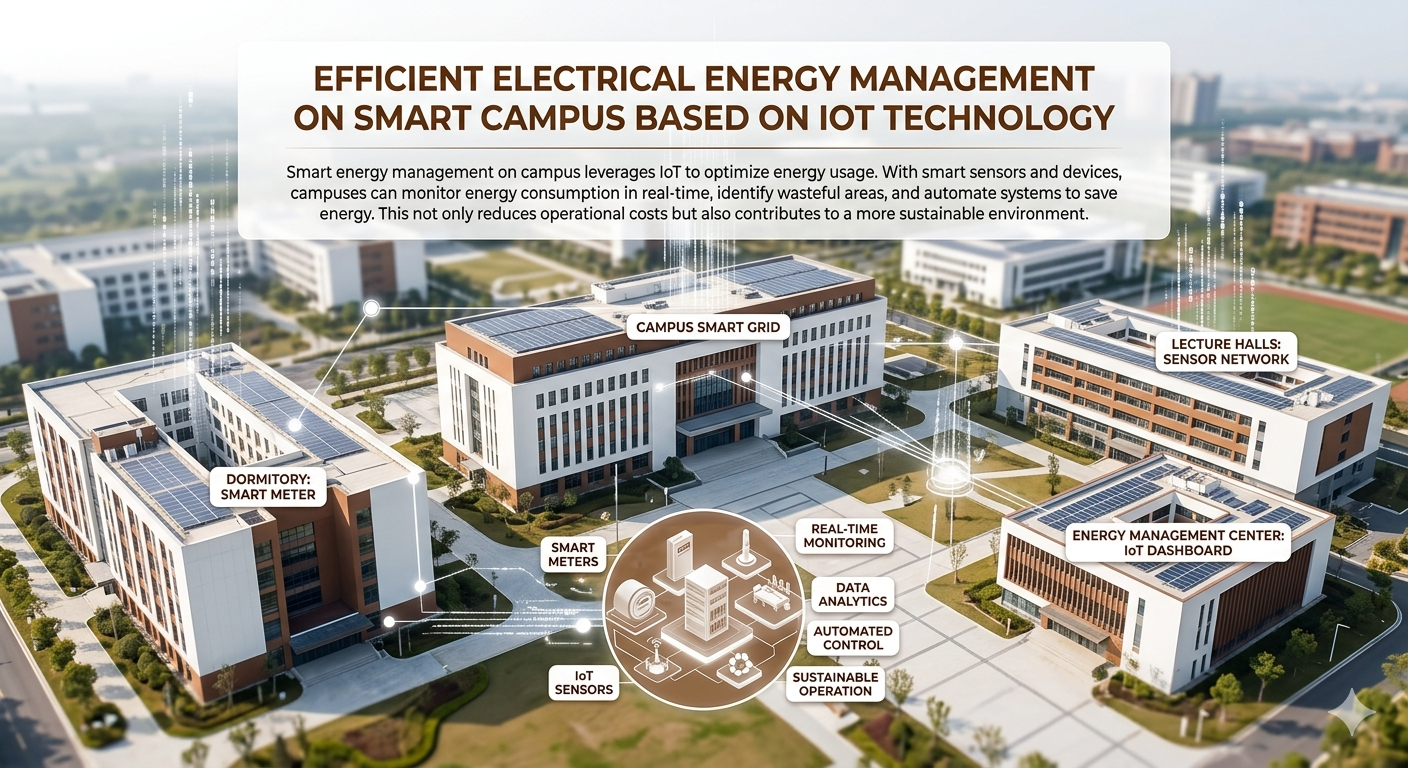
At its core, this research focuses on transforming traditional campus infrastructure into an intelligent ecosystem. By deploying a network of smart sensors and interconnected devices, a university can gain a "sixth sense" regarding its energy pulse. Traditionally, energy management was reactive—we only knew how much power was used when the bill arrived at the end of the month. With IoT, the approach becomes proactive. These devices monitor energy consumption in real-time, sending data to a centralized dashboard that identifies exactly where energy is being wasted. Whether it’s an empty laboratory with the lights blasting or a cooling system working overtime in a chilly room, the system "sees" it all and can automate adjustments instantly.
The implications of this technology go far beyond just saving money on electricity bills. While reducing operational costs is a significant benefit that allows institutions to reallocate funds toward scholarships or better research facilities, the true victory lies in its environmental impact. This is where our research finds its heartbeat within the global agenda for a better world.
Specifically, this initiative is a direct contribution to Sustainable Development Goal 7 (SDG 7): Affordable and Clean Energy. By optimizing how we use every kilowatt, we are fostering an environment that prioritizes energy efficiency and the transition to more sustainable consumption patterns. It is about ensuring that our educational hubs lead by example, proving that technology can be the ultimate tool for environmental stewardship.
Furthermore, a smart campus serves as a powerful educational tool. When students and faculty can see real-time data about their carbon footprint, it triggers a behavioral shift. It turns "sustainability" from an abstract concept into a tangible, daily practice. We are essentially building a culture of mindfulness, where the next generation of leaders learns that efficiency is not just a technical requirement, but a moral imperative.
In conclusion, leveraging IoT for energy management is a journey toward a more resilient and sustainable academic environment. By integrating smart sensors and automated systems, we are not just cutting costs; we are cutting our carbon footprint and paving the way for a future where technology and nature exist in harmony. Through the lens of SDG 7, this research proves that a smarter campus is the first step toward a smarter, cleaner planet for everyone.
List Publications:
-
Dust-Induced Power Loss in Solar Plants: A Real-Time Web Application for Degradation Prediction Using Decision Trees and Random Forests Regressions Z Tahir, S Syarif, TPM Wardhani, MA Safaqdillah 2024 International Conference on Intelligent Cybernetics Technology (ICICYT), 2024.
-
Comparison of Satellite and Conventional Networks Using Edge Computing for Monitoring System of IoT Base U Nasruddin, Z Tahir, W Wardi 2024 7th International Seminar on Research of Information Technology and Intelligent Systems (ISRITI), 2024.
-
Performance Analysis of Fog Architecture to Monitor Solar Panel for Smart Home NIM Akbar, Z Tahir 2023 International Seminar on Intelligent Technology and Its Applications (ISITIA), 2023.
-
Electric load forecasting for Internet of Things smart home using hybrid PCA and ARIMA algorithm HW Rotib, MB Nappu, Z Tahir, A Arief, MYA Shiddiq International Journal of Electrical and Electronic Engineering, 2021.
-
ANN-Fuzzy Logic Control based Real-Time MPPT Control of PV Modules A Suyuti, Z Muslimin, Z Tahir International Workshop on Modern Research Method in Electrical Engineering, 2013.
-
Three Layered Feed-Forward Neural Network based Estimation of Output Power and Energy on Photovoltaic (PV) Modules Syafaruddin, Wardi, Gassing, Z Muslimin, Z Tahir, E Karatepe, T Hiyama Makassar International Conference on Electrical Engineering and Informatics (MICEEI), 2012.
-
Application of Microcontroller ATmega8535 for Hybrid Photovoltaic–Thermal (PV/T) A Ahmad, T Waris, Z Tahir, D Yulianto International Journal of Engineering and Technology (IJET), 2013.
-
ANN-Fuzzy Logic Control based Real-Time MPPT Control of PV Modules Z Muslimin, Z Tahir, E Karatepe, T Hiyama, 2013.
Description
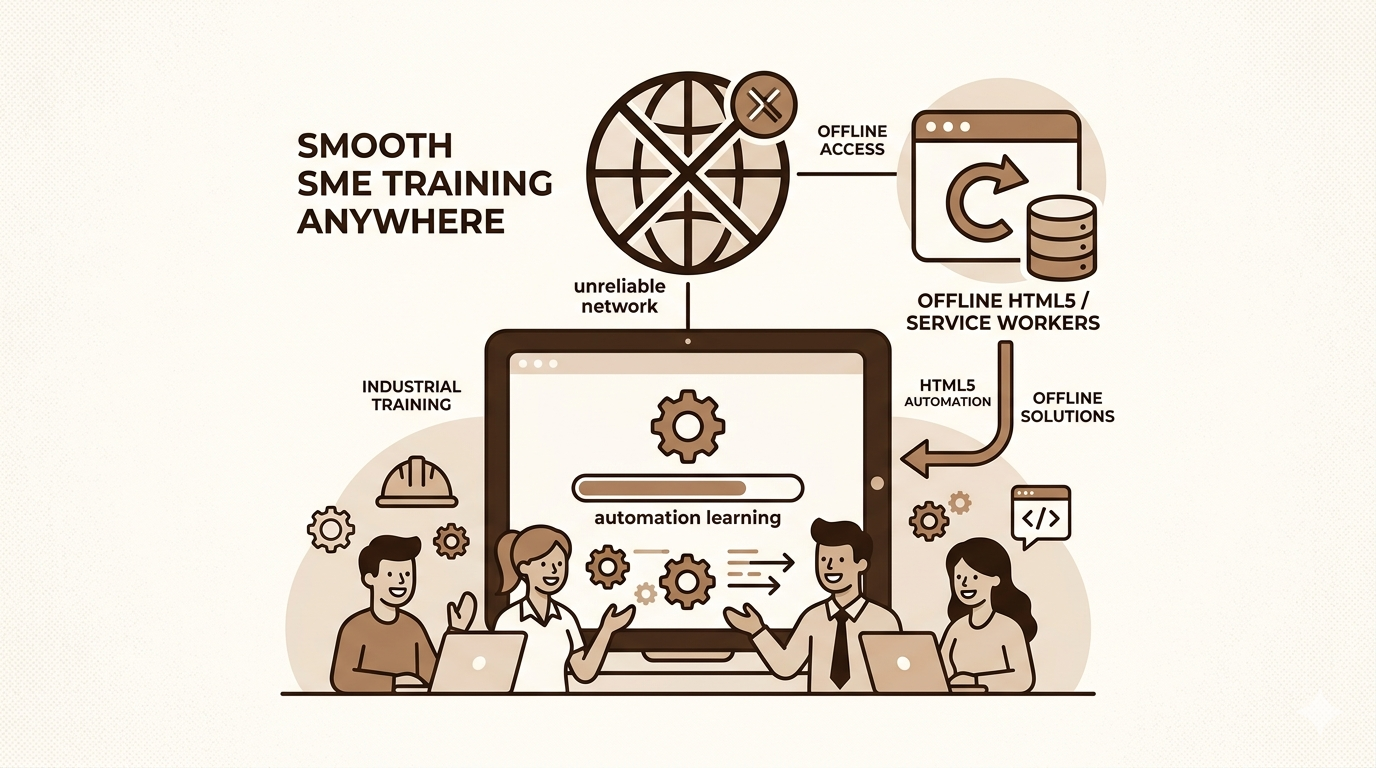
Empowering the Heart of Rural Commerce: Training Without Borders
In the modern era, we often take for granted the invisible threads that connect us to the world: the internet. For many of us, a flickering Wi-Fi signal is a minor inconvenience. However, for Small and Medium Enterprises (SMEs) located in rural or remote areas, a "poor connection" is more than just a nuisance—it is a digital wall that halts progress, stunts growth, and limits the potential of hardworking local communities.
This research addresses a critical gap in digital equity. While the world moves toward sophisticated cloud-based learning management systems, rural SMEs are often left behind because their infrastructure cannot support the heavy data demands of these platforms. When an employee in a remote village tries to access a training module to improve their skills, a buffering screen isn't just a technical glitch; it is a lost opportunity for economic advancement.
Our solution reimagines how web applications behave in challenging environments. By leveraging the power of HTML5 and Service Workers, we have developed a resilient web application that effectively "defies" the unstable network.
Think of a Service Worker as a smart, tireless digital assistant living inside your browser. This assistant works behind the scenes to intercept network requests. When the internet is active, it quietly downloads and stores essential training materials. The moment the connection drops, the Service Worker takes over, serving the content from a local cache seamlessly. For the user, the experience remains uninterrupted. They can continue their automated learning journey, take assessments, and interact with the interface as if they were in the middle of a high-tech city. This is not just a website; it is an intelligent, self-sustaining ecosystem designed for the reality of rural life.
This research is deeply rooted in the United Nations’ vision for a better world. Specifically, this project is a direct contribution to Sustainable Development Goal 4 (SDG 4): Quality Education.
While SDG 4 is often associated with traditional schooling, its broader mission is to ensure inclusive and equitable quality education and promote lifelong learning opportunities for all. By removing the "internet barrier," we are democratizing access to professional development. We believe that a weaver in a remote forest or a farmer managing a small cooperative deserves the same quality of training as a corporate executive in a skyscraper.
By facilitating continuous, automated learning, we empower SME employees to upgrade their skills, improve their productivity, and eventually increase their standard of living. This technological intervention ensures that "Quality Education" is not a privilege reserved for those with fiber-optic cables, but a right accessible to anyone with a basic smartphone and the will to learn.
By bridging the digital divide, we are doing more than just fixing a "web page." We are building the digital resilience of rural communities. When SMEs thrive through better-trained staff, entire local economies stabilize. This project proves that high-level computer science—specifically the implementation of service workers and offline-first architectures—has a very human face. It is about ensuring that in our race toward a high-tech future, the heart of our rural communities is never left in the dark. Through this innovation, the path to knowledge remains open, stable, and smooth, regardless of the strength of the signal.
Related publications:
-
Reliable and Low-Cost Digital Transformation Technology Using Progressive Web Apps in Fog Computing Architecture for Small and Medium Industries in Indonesia Z Tahir, AA Ilham, AP Alimuddin, MZA Suyuti, Charina International Conference on Emerging Internetworking, Data & Web (2022)
-
Progressive web apps development and analysis with angular framework and service worker for e-commerce system Z Tahir, AA Ilham, M Niswar, AA Fauzy 2021 IEEE International Conference on Computing (ICOCO), 192-195 (2021)
-
A reliable offline web system for small and medium industries Z Tahir, AR Dasmito, M Niswar MATEC Web of Conferences 331, 06007 (2020)
-
Analysis of Offline-First App Technology in Raspberry Pi Edge Computing for Post-Disaster Hospital Situation Z Tahir, M Niswar, W Wardi, A Prayogi, TPM Wardhani, LN Nainggolan University of Bahrain (2024)
-
The Study on Automated HTML5 Offline Services to Overcome Low Reliability of Network Connectivity for Web-based Decision Support System Applications Z Tahir (2016)
-
The Analysis of Automated HTML5 Offline Services (AHOS) Z Tahir, T Inamoto, Y Higami, S Kobayashi 2015 International Conference on Intelligent Informatics and Biomedical (2015)
-
A comprehensive examination of the webp utilizing javascript and react library Z Tahir, M Niswar, I Aswad, MF Amzar 2023 IEEE International Conference on Communication, Networks and Satellite (2023)
Description
The Digital Pulse: How Fog Computing is Revolutionizing the Smart Industry
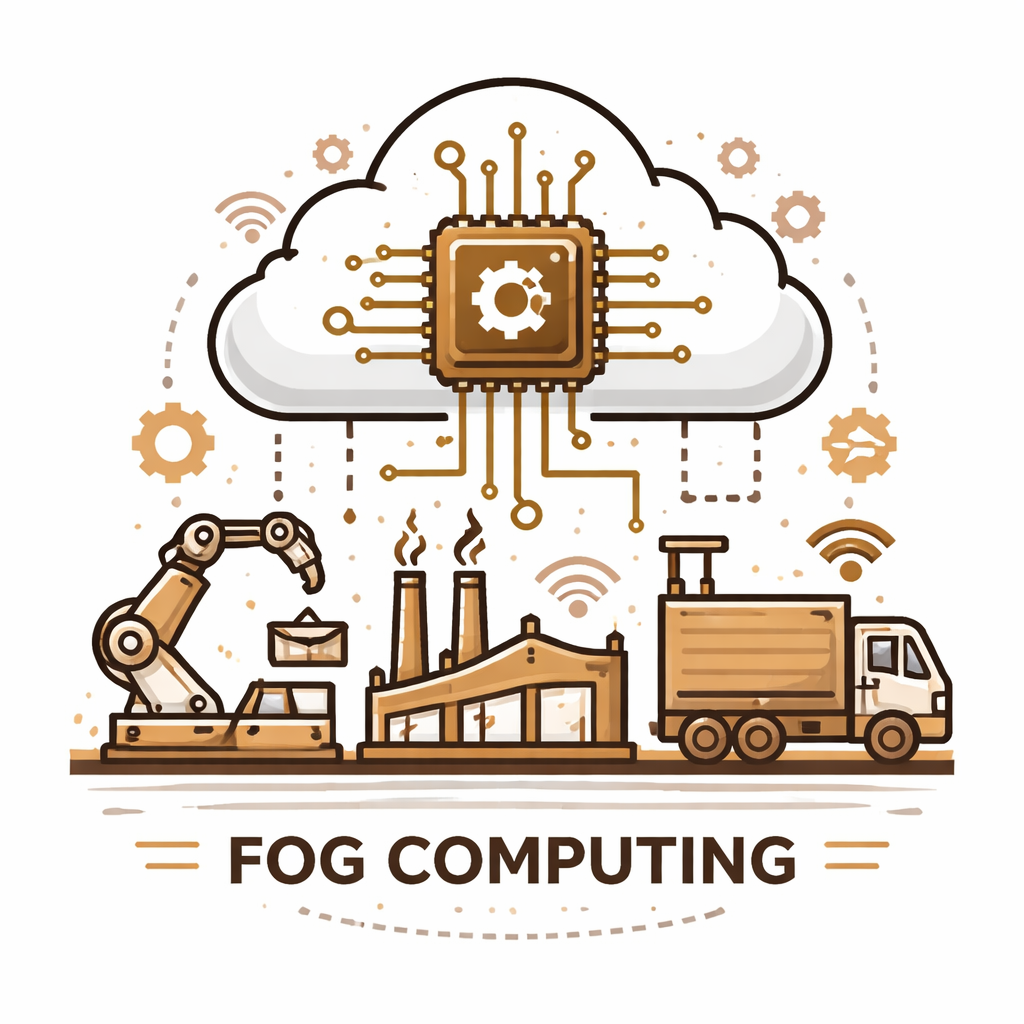
Imagine a massive factory where thousands of machines talk to each other every second. In the traditional digital world, all that information travels to a far-away "Cloud"—a massive data center located hundreds or even thousands of miles away. By the time the instruction comes back, a critical moment might have passed. This "lag" is the enemy of efficiency. This research dives into a game-changing solution called Fog Computing, a technology that is bringing the brain of the operation closer to the muscles of the industry.
At its core, Fog Computing is about proximity. If Cloud Computing is a distant library, Fog Computing is the smartphone in your pocket. It processes data right where it is created—on the factory floor, inside a delivery truck, or within a smart warehouse. By doing this, we reduce the time it takes for systems to react, making industrial processes not just faster, but significantly smarter and more reliable.
But why does this matter to the average person? This study isn't just about faster machines; it is about building a sustainable future. This research explicitly aligns with SDGs 17: Partnerships for the Goals. In an increasingly interconnected world, no single industry can thrive in isolation. Fog Computing acts as the digital "glue" that allows different sectors—from manufacturing to global logistics—to collaborate more effectively. By creating a standardized, high-speed communication framework, we enable international partnerships where technology and data can be shared seamlessly across borders, helping developing nations leapfrog into the fourth industrial revolution.
In the manufacturing sector, Fog Computing allows for "predictive maintenance." Instead of a machine breaking down and stopping production for days, the "Fog" detects a tiny vibration or a slight rise in temperature and fixes the issue before it starts. This means less waste, lower costs, and more consistent product quality. In the world of logistics, it means smarter supply chains that can reroute themselves in real-time to avoid traffic or bad weather, ensuring that essential goods reach their destination on time and with a smaller carbon footprint.
Furthermore, by optimizing these industrial processes, we are fostering global stability. SDGs 17 emphasizes the importance of systemic issues, such as enhancing policy coherence for sustainable development. Our research explores how decentralized data processing can empower local industries to compete on a global scale, ensuring that the benefits of high-tech innovation are distributed fairly.
In conclusion, this study is a journey into the "middle layer" of the digital universe. By investigating Fog Computing, we are not just looking at code and hardware; we are looking at the future of how humanity produces, moves, and shares resources. It is a vital step toward a smarter, more connected, and more collaborative global society where technology serves as a bridge between today’s challenges and tomorrow’s sustainable achievements.
Related Publications:
-
Reliable and Low-Cost Digital Transformation Technology Using Progressive Web Apps in Fog Computing Architecture for Small and Medium Industries in Indonesia Z Tahir, AA Ilham, AP Alimuddin, MZA Suyuti, Charina International Conference on Emerging Internetworking, Data & Web (2022)
-
Performance Analysis of Fog Architecture to Monitor Solar Panel for Smart Home NIM Akbar, Z Tahir 2023 International Seminar on Intelligent Technology and Its Applications (2023)
-
Fog computing concept implementation in work error detection system of the industrial machine using support vector machine (svm) J Rusman, Z Tahir, AEU Salam 2019 International Seminar on Research of Information Technology and (2019)
-
Analysis of Offline-First App Technology in Raspberry Pi Edge Computing for Post-Disaster Hospital Situation Z Tahir, M Niswar, W Wardi, A Prayogi, TPM Wardhani, LN Nainggolan University of Bahrain (2024)
-
Comparison of Satellite and Conventional Networks Using Edge Computing for Monitoring System of IoT Base U Nasruddin, Z Tahir, W Wardi 2024 7th International Seminar on Research of Information Technology and (2024)
-
Artificial Neural Network Approach for Maintenance Strategy of Machinery in Small and Medium Industries Z Tahir, I Nurtanio, A Suyuti, F Alhari, M Rafrin, S Kobayashi, PK KM The International Conference on Innovation, Management and Industrial (2015)
-
Detection of Industrial Machine Work Errors using LVQ Neural Network M Rasyid, Z Tahir, S Syafaruddin 1st International Conference on Science and Technology, ICOST (2019)
-
Digital Image Processing for Detecting Industrial Machine Work Failure with Quantization Vector Learning Method MR Rasyid, Z Tahir Jurnal Pekommas 4 (2), 131-136 (2019)
-
Analisis Manajemen Perawatan Mesin Industri dengan Menggunakan Jaringan Saraf Tiruan Feed Forward-Back Propagation A Suyuti, Z Tahir, F Alhari, M Rafrin Prosiding Seminar Nasional Teknik Informatika (SNATIKA) (2013)
-
A hybrid maintenance management model in decision support system for small and medium food processing industries Z Tahir Universiti Teknikal Malaysia Melaka (2010)
Description
The Future of Factories: How Smart Eyes and Sensors are Revolutionizing Industry
Have you ever wondered how the everyday products we rely on—from the smartphones in our pockets to the food on our tables—are actually made? Behind the scenes, massive industrial machines work tirelessly around the clock. However, like any complex machine, they are prone to wear, tear, and sudden breakdowns. When a factory machine stops unexpectedly, it creates a "downtime" ripple effect that leads to wasted resources, higher costs, and economic instability. This is where our latest research enters the spotlight, acting as a "digital doctor" for the heart of the industry.
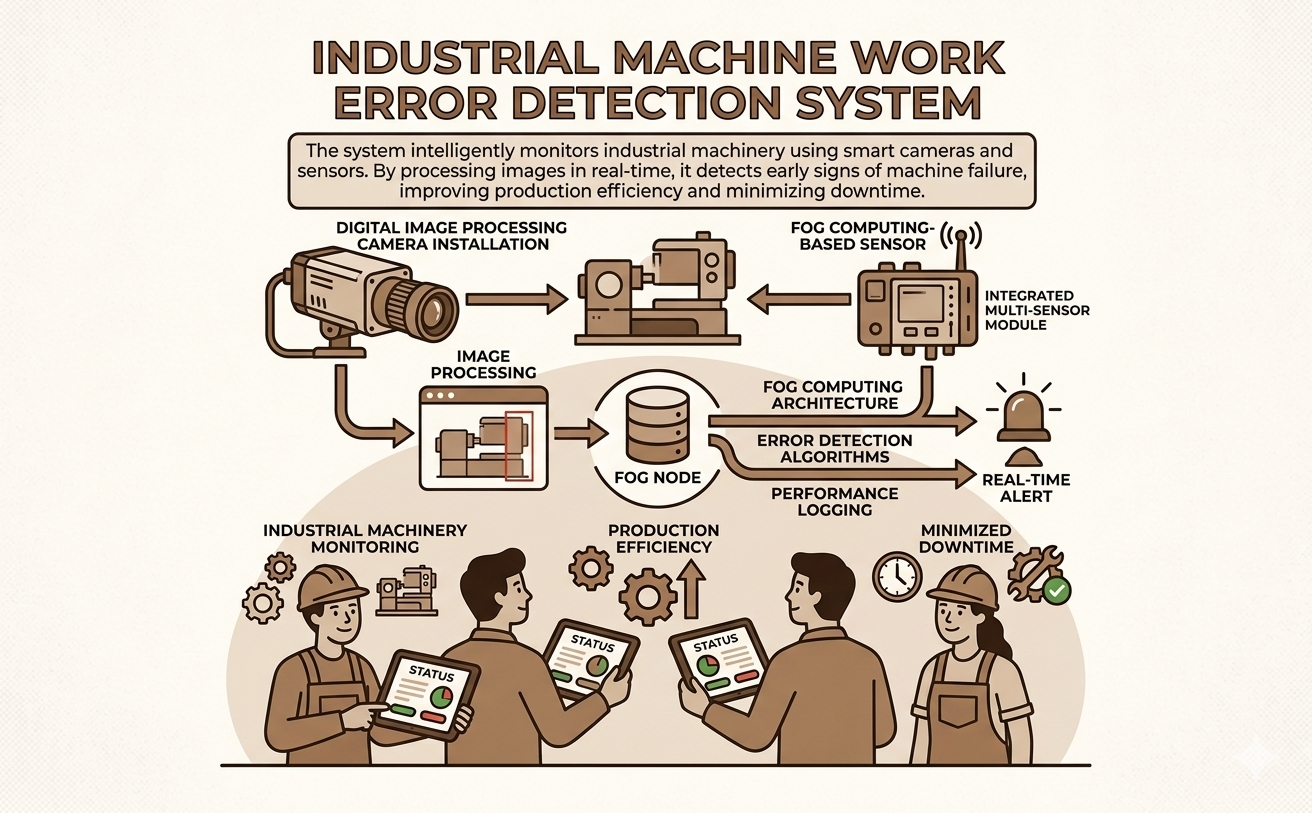
Our research introduces an intelligent monitoring system designed to keep the wheels of production turning smoothly. Think of it as giving industrial machinery its own set of "eyes" and a "brain." By utilizing state-of-the-art smart cameras and high-precision sensors, the system creates a 24/7 surveillance network dedicated to machine health. These cameras don't just record video; they "see" patterns and anomalies that are invisible to the human eye. Whether it’s a tiny vibration that shouldn't be there or a slight change in the heat signature of a motor, our system catches it all in real-time.
The real magic happens through advanced image processing. As the smart cameras capture live data, the system analyzes every frame instantly. If a gear starts to slip or a belt shows signs of fraying, the intelligent software flags it immediately. This allows factory managers to fix a small problem before it turns into a catastrophic failure. It is the difference between a quick five-minute tune-up and a week-long factory shutdown. By minimizing downtime and maximizing production efficiency, we are making the manufacturing process faster, cheaper, and much more reliable.
Beyond the technical achievements, this research carries a profound social and global responsibility. This project is deeply committed to supporting the United Nations Sustainable Development Goals, specifically SDG 1: No Poverty. You might ask, how does a factory sensor help end poverty? The connection is clearer than it seems. Economic stability begins with consistent industrial productivity. When factories operate efficiently without frequent breakdowns, they lower the cost of goods, making essential products more affordable for everyone. Furthermore, a stable industry protects the jobs of thousands of workers who depend on these machines for their livelihoods. By reducing the massive financial losses caused by industrial inefficiency, we help build a more resilient economy that provides steady income and opportunities for the global workforce.
In conclusion, this research isn't just about cameras and code; it is about creating a smarter, more sustainable world. By bridging the gap between artificial intelligence and heavy industry, we ensure that the backbone of our modern economy stays strong. As we refine this technology, we move closer to a future where industrial waste is a thing of the past and economic growth is accessible to all, ensuring that progress truly benefits everyone, everywhere.
Related publications:
-
Fog computing concept implementation in work error detection system of the industrial machine using support vector machine (svm) J Rusman, Z Tahir, AEU Salam 2019 International Seminar on Research of Information Technology and Intelligent Systems (ISRITI), 2019
-
Digital Image Processing for Detecting Industrial Machine Work Failure with Quantization Vector Learning Method MR Rasyid, Z Tahir Jurnal Pekommas 4 (2), 131-136, 2019
-
Pengolahan Citra Digital untuk Mendeteksi Kesalahan Kerja Mesin Industri dengan Metode Learning Vector Quantization R Rasyid, Z Tahir, N Syafaruddin Jurnal Pekommas 4 (2), 133, 2019
-
Detection of Industrial Machine Work Errors using LVQ Neural Network M Rasyid, Z Tahir, S Syafaruddin 1st International Conference on Science and Technology, ICOST, 2019
-
Artificial Neural Network Approach for Maintenance Strategy of Machinery in Small and Medium Industries Z Tahir, I Nurtanio, A Suyuti, F Alhari, M Rafrin, S Kobayashi, PK KM The International Conference on Innovation, Management and Industrial Engineering, 2015
-
Analisis Manajemen Perawatan Mesin Industri dengan Menggunakan Jaringan Saraf Tiruan Feed Forward-Back Propagation (Studi Kasus PT. Semen Bosowa Maros) A Suyuti, Z Tahir, F Alhari, M Rafrin Prosiding Seminar Nasional Teknik Informatika (SNATIKA), 2013
-
Analisis Sistem Cerdas Pengambilan Keputusan untuk Perawatan Mesin dengan Penggabungan Metode Algoritma Genetika dan Decision Making Grid A Ahmad, Z Tahir, NI Mulyasari, A Bustamin Seminar Nasional Aplikasi Teknologi Informasi, 2013
-
Framework for Self-Maintenance Machine MA Burhanuddin, Z Tahir, AS Prabuwono 2009
-
Image processing algorithm in machine vision approach for industrial inspection H Akbar, AS Prabuwono, Z Izzah, Z Tahir Proc. the 1st Makassar International Conference on Electrical Engineering and Informatics, 2008
Description
Tech for Humanity: How Smart Apps are Saving Lives in Times of Crisis
In an era where our lives are inextricably linked to the digital world, a major disaster can instantly plunge us into a "digital dark age." When earthquakes, floods, or storms strike, the first thing to fail is often our communication infrastructure. Paradoxically, this is exactly when we need information the most—to find help, locate loved ones, or access medical advice. This is where a groundbreaking research project steps in, bridging the gap between high-end technology and the urgent needs of people on the ground.
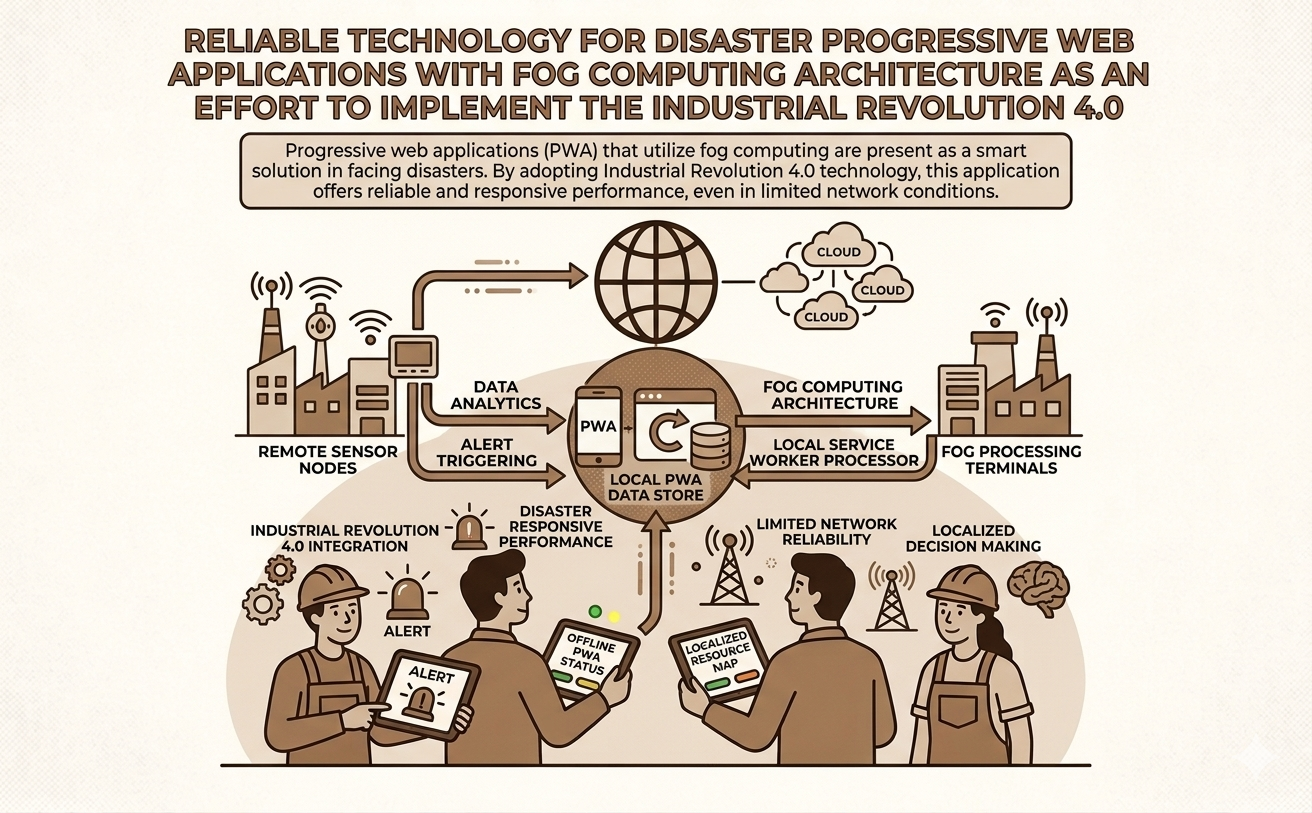
At the heart of this innovation are Progressive Web Applications (PWA) combined with Fog Computing. While that may sound like technical jargon, the concept is beautifully simple. Think of a PWA as a "super-app" that you don’t need to download from an app store; it works directly in your web browser but feels like a powerful, installed app. Now, pair that with Fog Computing—a technology that brings the "brain" of the internet closer to your physical location rather than relying on a distant server across the ocean.
By adopting the principles of the Industrial Revolution 4.0, this research offers a smart solution for disaster resilience. Traditional apps often "freeze" or fail when the internet is slow. However, this PWA is designed to be "offline-first." It caches essential data so that even if the network is patchy or completely down, the application remains functional. It is reliable, responsive, and, most importantly, ready to serve when every second counts.
One of the most vital aspects of this research is its alignment with global goals for a better world. Specifically, this innovation is a direct contribution to Sustainable Development Goal 3 (SDG 3): Good Health and Well-being. In a disaster scenario, health is the first thing at risk. By ensuring that medical protocols, emergency contact information, and health-tracking tools remain accessible even without a stable internet connection, this technology directly helps in reducing casualties and managing health crises effectively. It ensures that displaced populations can still access life-saving information, thereby protecting the well-being of the most vulnerable.
This research proves that the Industrial Revolution 4.0 is not just about robots or fancy gadgets; it is about human-centric design. It is about creating a safety net made of code and connectivity that stays strong even when the physical world is in chaos. By making technology "smarter" and more local through Fog Computing, we are building a future where no one is left digitally stranded during their hour of greatest need. This is more than just a research project; it is a digital lifeline for humanity.
Related publications:
-
Analysis of Offline-First App Technology in Raspberry Pi Edge Computing for Post-Disaster Hospital Situation Z Tahir, M Niswar, W Wardi, A Prayogi, TPM Wardhani, LN Nainggolan University of Bahrain, 2024
-
Assessment of Post-Disaster Concerns using Social Network Analysis and Machine Learning: A Study of 2018 Palu Disaster TPM Wardhani, S Samaddar, H Tatano, Z Tahir, S Roy 2024 International Conference on Information and Communication Technologies, 2024
-
Reliable and Low-Cost Digital Transformation Technology Using Progressive Web Apps in Fog Computing Architecture for Small and Medium Industries in Indonesia Z Tahir, AA Ilham, AP Alimuddin, MZA Suyuti, Charina International Conference on Emerging Internetworking, Data & Web, 2022
-
Performance Analysis of Fog Architecture to Monitor Solar Panel for Smart Home NIM Akbar, Z Tahir 2023 International Seminar on Intelligent Technology and Its Applications, 2023
-
Comparison of Satellite and Conventional Networks Using Edge Computing for Monitoring System of IoT Base U Nasruddin, Z Tahir, W Wardi 2024 7th International Seminar on Research of Information Technology and, 2024
-
A comprehensive examination of the webp utilizing javascript and react library Z Tahir, M Niswar, I Aswad, MF Amzar 2023 IEEE International Conference on Communication, Networks and Satellite, 2023
-
Progressive web apps development and analysis with angular framework and service worker for e-commerce system Z Tahir, AA Ilham, M Niswar, AA Fauzy 2021 IEEE International Conference on Computing (ICOCO), 192-195, 2021
-
A reliable offline web system for small and medium industries Z Tahir, AR Dasmito, M Niswar MATEC Web of Conferences 331, 06007, 2020
-
The Study on Automated HTML5 Offline Services to Overcome Low Reliability of Network Connectivity for Web-based Decision Support System Applications Z Tahir 2016
-
The Analysis of Automated HTML5 Offline Services (AHOS) Z Tahir, T Inamoto, Y Higami, S Kobayashi 2015 International Conference on Intelligent Informatics and Biomedical, 2015
Description
Bridging the Digital Divide in Disasters: How Smart Technology Saves Lives
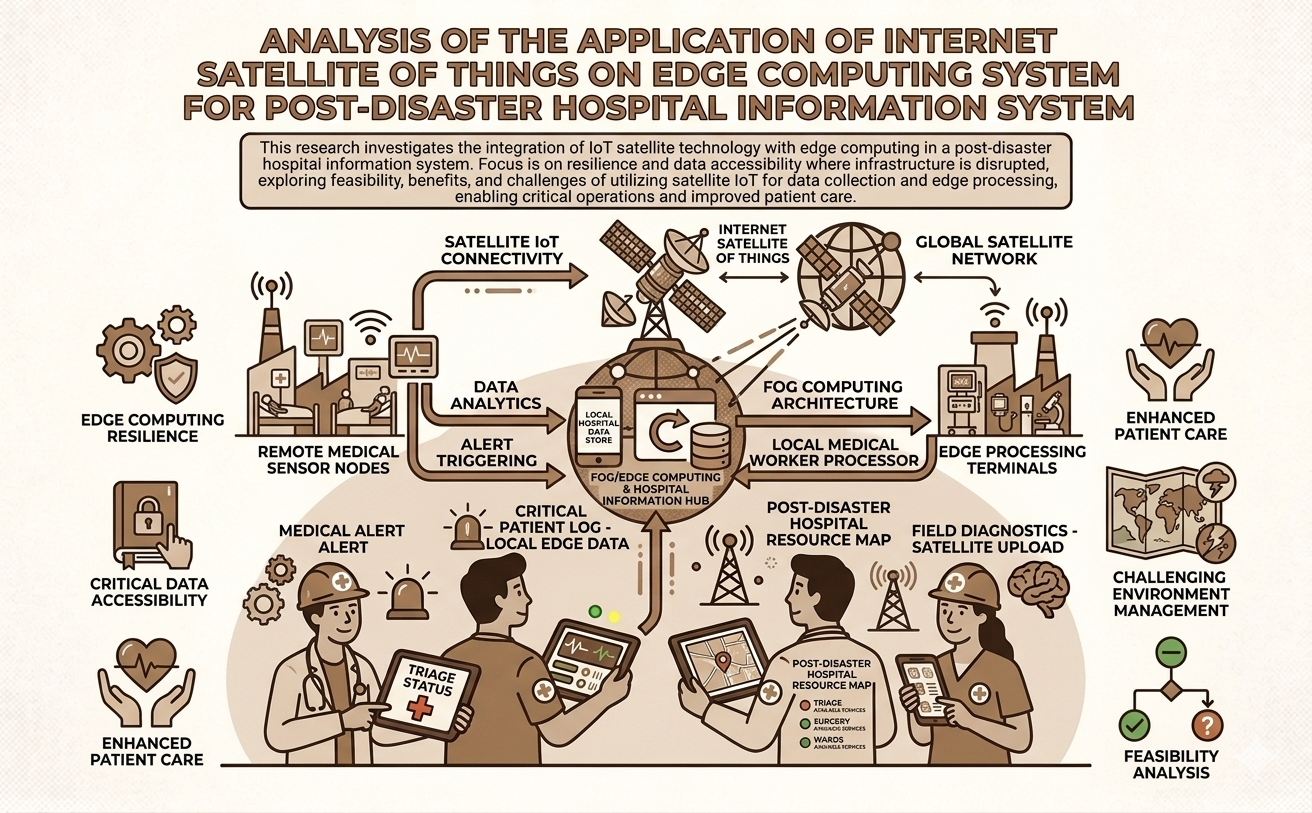
In the chaotic aftermath of a natural disaster, the first casualty is often communication. When earthquakes, floods, or storms strike, the traditional internet infrastructure we rely on—cell towers, fiber optic cables, and power grids—frequently collapses. For hospitals and emergency responders, this digital blackout is more than an inconvenience; it is a matter of life and death. This research explores a transformative solution to this problem by combining the power of Progressive Web Applications (PWA), Fog Computing, and Satellite IoT (Internet of Things) to create a resilient, "disaster-proof" information system.
At its heart, this study is about bringing the intelligence of the cloud closer to the ground. Traditional systems rely on distant servers, but in a crisis, that distance creates delays or total failure. By adopting Industrial Revolution 4.0 technologies, we utilize "Fog Computing." Think of the fog as a local cloud that hovers right over the disaster zone. It processes critical data on-site, ensuring that hospital staff can access patient records and medical updates instantly, even if the main internet backbone is severed. This is complemented by PWA technology, which allows medical software to work offline and load instantly on any device, providing a reliable and responsive user experience under the most extreme pressures.
Furthermore, this research investigates the integration of Satellite IoT. When terrestrial networks vanish, space-based connectivity becomes our lifeline. By using small, efficient satellites to link medical devices and sensors, we can maintain a steady flow of data from the field to the hospital. This ensures that even in remote or devastated environments, the "edge" of the network remains active, enabling critical operations and continuous patient care.
This innovation directly supports the United Nations’ Sustainable Development Goal 3: Good Health and Well-being. By ensuring that healthcare systems remain functional during the worst possible moments, we protect the most vulnerable populations and reduce preventable deaths. A hospital that can "talk" to its devices and staff during a disaster is a hospital that saves more lives.
The beauty of this approach lies in its accessibility. We are not just building complex machines; we are creating a smart, integrated ecosystem that adapts to the environment. It is a shift from fragile, centralized systems to a flexible, distributed network. By analyzing the feasibility and benefits of this integration, this research provides a blueprint for future-ready cities. We are proving that through high-tech collaboration between space technology and local computing, we can build a world where a broken cable no longer means a broken healthcare system. In an era of increasing climate unpredictability, these smart solutions are not just upgrades—they are essential tools for human resilience.
Related Publications:
-
Analysis of Offline-First App Technology in Raspberry Pi Edge Computing for Post-Disaster Hospital Situation Z Tahir, M Niswar, W Wardi, A Prayogi, TPM Wardhani, LN Nainggolan University of Bahrain, 2024
-
Comparison of Satellite and Conventional Networks Using Edge Computing for Monitoring System of IoT Base U Nasruddin, Z Tahir, W Wardi 2024 7th International Seminar on Research of Information Technology and Intelligent Systems (ISRITI), 2024
-
Assessment of Post-Disaster Concerns using Social Network Analysis and Machine Learning: A Study of 2018 Palu Disaster TPM Wardhani, S Samaddar, H Tatano, Z Tahir, S Roy 2024 International Conference on Information and Communication Technologies (ICOIACT), 2024
-
A reliable offline web system for small and medium industries Z Tahir, AR Dasmito, M Niswar MATEC Web of Conferences 331, 06007, 2020
-
The Study on Automated HTML5 Offline Services to Overcome Low Reliability of Network Connectivity for Web-based Decision Support System Applications Z Tahir 2016
-
The Analysis of Automated HTML5 Offline Services (AHOS) Z Tahir, T Inamoto, Y Higami, S Kobayashi 2015 International Conference on Intelligent Informatics and Biomedical Sciences (ICIIBMS), 2015
-
Performance Analysis of Fog Architecture to Monitor Solar Panel for Smart Home NIM Akbar, Z Tahir 2023 International Seminar on Intelligent Technology and Its Applications (ISITIA), 2023
-
Evaluasi Kinerja Jaringan Sensor Nirkabel IEEE 802.15.4 Pemantau Denyut Nadi Pasien M Niswar, AA Ilham, RS Sadjad, Z Muslimin, A Suyuti, I Amirullah, T Waris, ... 2013