
MAKASSAR, August 17 2026 / DEPADIS – Public policy is often presented as a process designed to serve all. However, in practice, some groups find it much harder to make their experiences heard. This is particularly true for transgender women, who may face social stigma, discrimination, and limited opportunities to participate in formal decision-making processes. When their voices are missing from policy discussions, policies may fail to address the realities of their everyday lives.
These issues are explored in the article “Transgender Women as a Subaltern Group in Public Policy Formulation in South Sulawesi.” This article was presented at the World Conference on Governance and Social Sciences 2025 (WCGSS 2025) and published by Atlantis Press on March 13, 2026. This study offers an important perspective on the position of transgender women in public policy processes and the challenges they face in making their interests visible within the government and society.
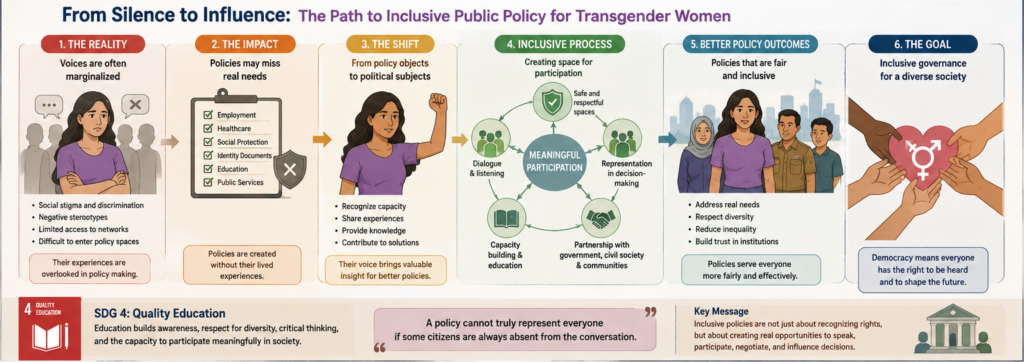
The concept of subalternity helps explain this situation. In simple terms, a subaltern group is one whose voice and interests tend to remain marginalized within dominant social, political, and institutional structures. Being legally recognized as a citizen does not automatically mean that every citizen has the same ability to influence public policy decisions.
Barriers to healthcare for transgender women may exist at several levels. Social stigma can discourage people from speaking publicly about their experiences with the disease. Negative stereotypes can affect how others perceive their concerns. Limited access to political and institutional networks can also make it difficult to participate in policy discussions in the field. Consequently, policies concerning employment, healthcare, social protection, identity documents, education, and public services may be developed without sufficiently considering their lived experiences.
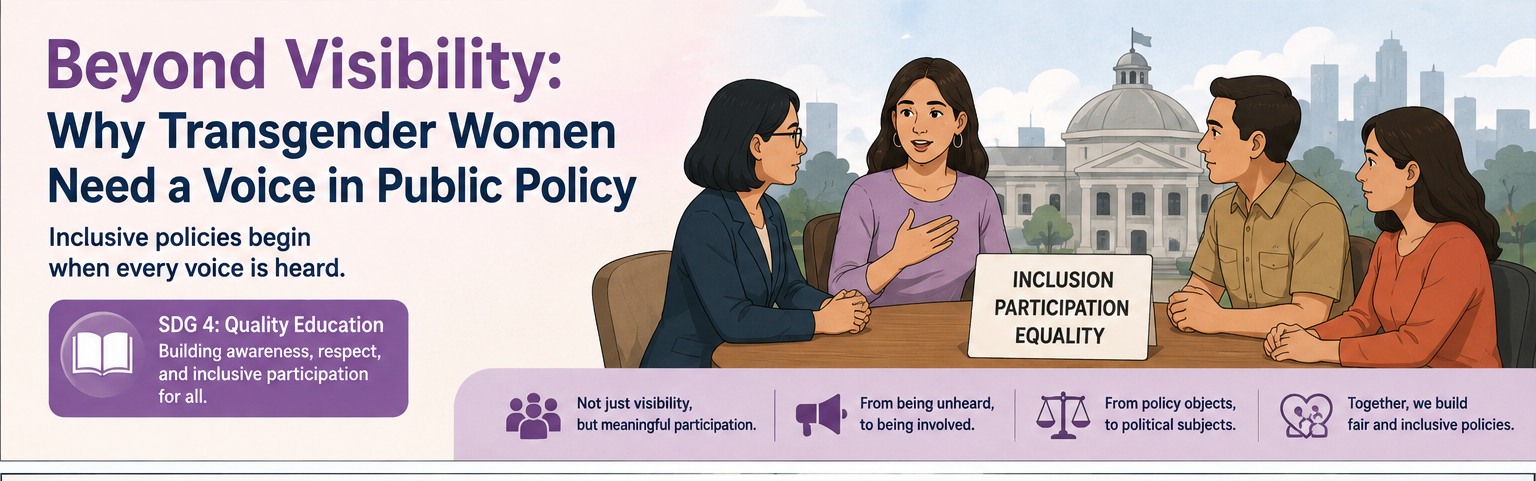
This does not mean that transgender women should be treated as policy objects. They should be recognized as political subjects and citizens with the capacity to contribute to policymaking. Their experiences can provide valuable information about the gaps between formal regulations and what actually happens in society.
Therefore, the challenge is not simply to increase the visibility of transgender women. What matters is creating meaningful opportunities for them to speak, participate, negotiate, and influence the decisions that affect their lives. Public institutions, civil society organizations, and communities play important roles in creating safer and more inclusive spaces for participation.
This perspective is closely connected to SDG 4: Quality Education. Education is not limited to formal schooling; it also involves developing social awareness, critical thinking, respect for diversity, and the capacity to participate meaningfully in society. Strengthening public understanding of gender diversity and citizenship can help reduce prejudice and create a more inclusive environment for marginalized groups.
The broader lesson is simple: a policy cannot truly claim to represent everyone if some citizens are consistently absent from conversations. Inclusive governance requires institutions to listen to groups whose voices have been historically marginalized.
Ultimately, the experience of transgender women in South Sulawesi reminds us that democracy is not only about formal rights. It is also about having a genuine opportunity to be heard. When marginalized citizens become active participants rather than silent recipients of policy, public policy can move closer to its fundamental purpose of serving a diverse society fairly and inclusively.
Reference DOI: 10.2991/978-2-38476-545-4_5
Contact:
Prof. Dr.phil. Sukri, M.Si
+628291280594
sukritamma@unhas.ac.id