
As the global population grows, farmers face a simple but difficult question: How can we produce more food from limited farmland without putting greater pressure on the environment? For maize, one possible answer may lie not in expanding farmland, but in arranging plants more intelligently and choosing varieties that can thrive when grown closer together.
This idea was investigated in the scientific article “Canopy Architectural and Physiological Traits for Optimizing Maize Yield under High Planting Density,” published in the journal Frontiers in Sustainable Food Systems (Front. Sustain. Food Syst.) by Frontiers Media SA on 31 October 2025. The study, led by Muhammad Azrai and colleagues, explored how maize architecture and physiological characteristics influence grain production under different planting densities.
The researchers tested 13 maize hybrids at the Bajeng Experimental Station in Indonesia. They compared three planting densities: approximately 71,000 plants per hectare, 81,000 plants per hectare, and a much denser population of 95,000 plants per hectare. The goal was to discover whether simply putting more plants into the same field would automatically produce more maize.
The answer was surprisingly clear: more plants do not always mean more grain.
The intermediate density of around 81,000 plants per hectare produced the highest average yield, reaching 12.85 tons per hectare. In comparison, the standard density produced 11.54 tons per hectare, while the intensive density yielded 11.79 tons per hectare. When maize plants become too crowded, they compete more strongly for sunlight, water, nutrients, and growing space. Beyond an optimum point, this competition can cancel out the benefits of having more plants in the field.
Plant architecture also matters. Maize plants with relatively upright leaves can allow sunlight to penetrate deeper into the crop canopy. This means that lower leaves have a better opportunity to capture light for photosynthesis. However, the study reminds us that successful high-density maize production requires balance: leaves should be upright enough to reduce excessive shading, but plant architecture must still support efficient light capture and grain production.
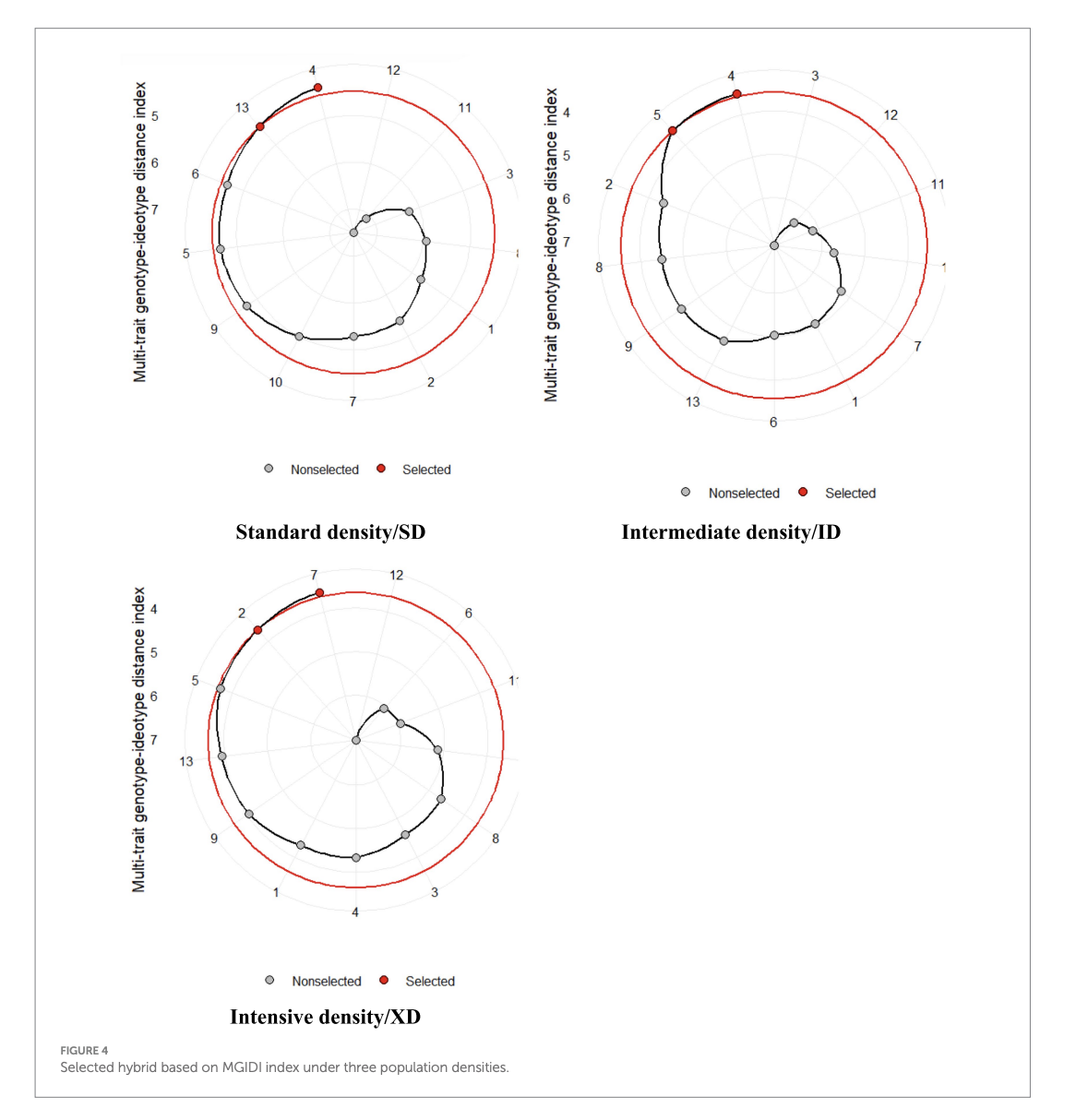
Using a multi-trait selection method called MGIDI, the researchers identified hybrids G4, G2, and G5 as promising performers across different planting densities. This approach allows breeders to consider several important characteristics simultaneously rather than selecting plants based only on yield.
These findings connect strongly with Sustainable Development Goal 15 (SDG 15): Life on Land. Producing more maize efficiently from existing agricultural land can support sustainable land use by reducing pressure to expand cultivation into other terrestrial ecosystems. Instead of asking only how many plants can fit into a field, sustainable agriculture must ask a better question: What combination of plant density, crop architecture, and genetics can make every hectare work smarter?
The future of maize production may therefore depend not simply on planting more—but on planting smarter.