
Marine parks are usually drawn on paper first — a line around the prettiest or most obviously important-looking reef, based on what surveys can see from a boat or a dive. But coral doesn’t spread by staying put. It spawns, releases larvae into the current, and those larvae drift — sometimes for days, sometimes for dozens of kilometres — before settling somewhere new. A reef that looks unremarkable on the surface might secretly be feeding dozens of others downstream. A new study asked: does Indonesia’s protection map actually match where the coral larvae are really going?
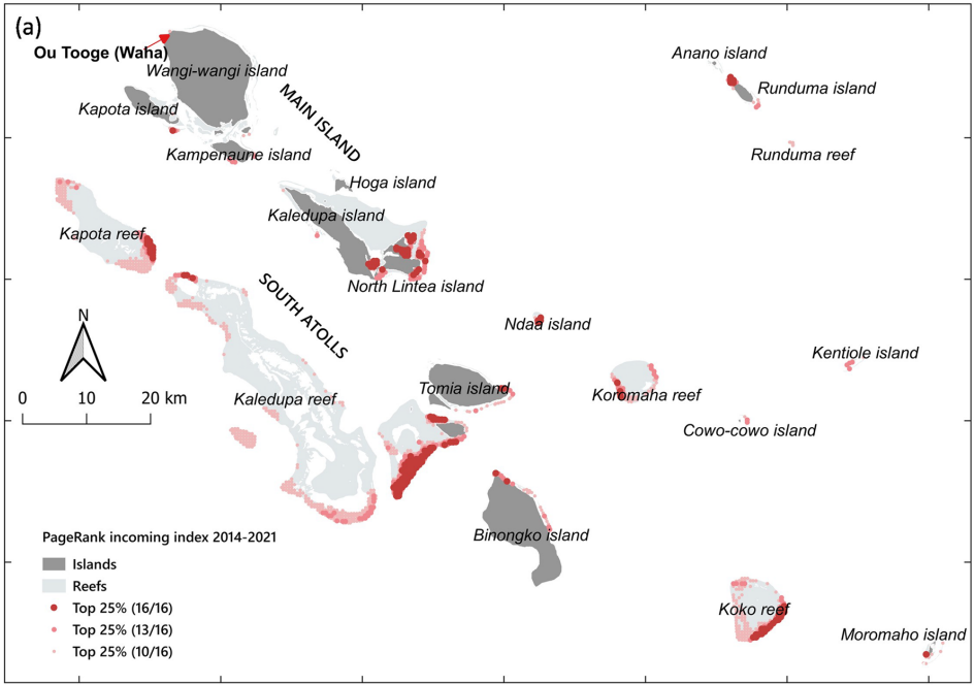
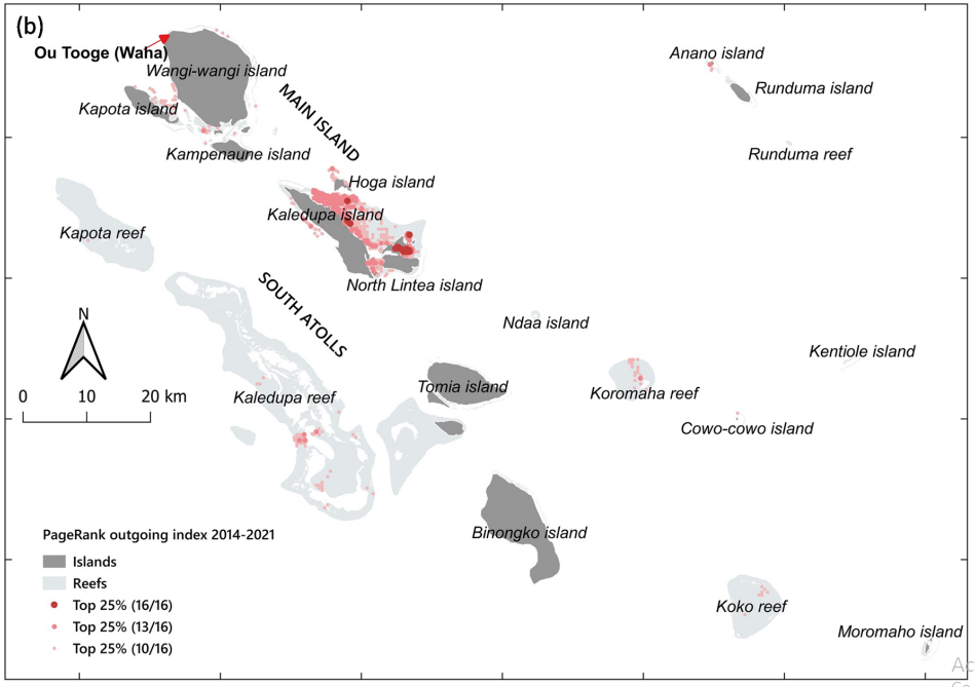
The research, “Assessing coral reef conservation planning in Wakatobi National Park (Indonesia) from larval connectivity networks,” was published in the journal Coral Reefs by Springer, appearing online on 29 November 2023. A team from UCLouvain in Belgium working with Universitas Hasanuddin focused on Wakatobi National Park, one of the richest patches of ocean on Earth, sitting at the heart of the Coral Triangle with nearly 400 coral species and close to 600 fish species.
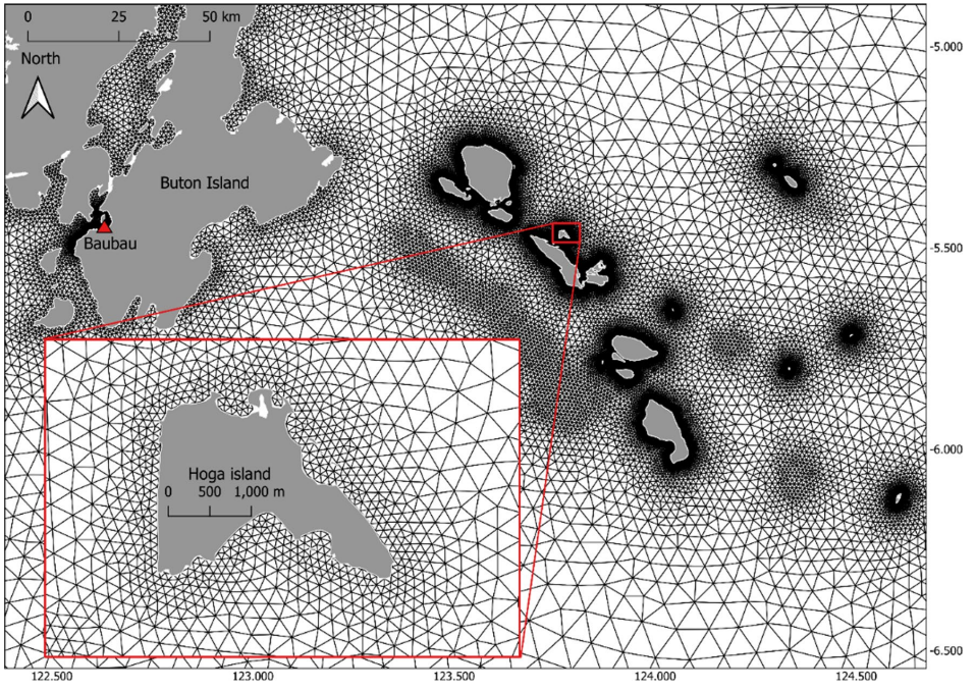
Using an ocean current model fine enough to resolve features under 100 metres across, the researchers simulated eight years of coral spawning for two Acropora species, tracking where their larvae would realistically drift and settle. They then used the same kind of ranking algorithm that powers Google search — PageRank — to identify which reefs act as reliable larval “exporters,” which are dependable “importers,” and which combine both roles well enough to deserve priority protection or restoration.
The results are a wake-up call. Most of the reefs currently sitting inside Wakatobi’s protected zones turned out to be only moderate players in the larval network — not the reefs doing the heavy lifting of repopulating the park after disturbances. Meanwhile, several high-value reefs near Wangi-Wangi and Kaledupa islands, ranked in the top 25 percent for supplying larvae elsewhere, sit entirely outside protection. Even more striking: Ou Tooge-Waha, the site chosen for an active coral restoration project since 2017, scored consistently low as a larval supplier to the rest of the park — meaning years of restoration effort may be planted in a spot with limited ripple effect elsewhere.
The stakes reach beyond one national park. Getting marine protection right is central to SDG 14 (Life Below Water), and since healthy reefs buffer coastlines and the islands people build homes on, the findings also touch SDG 15 (Life on Land)‘s broader concern for resilient ecosystems. The modelling techniques behind this study — biophysical simulation, network science applied to ocean currents — represent exactly the kind of advanced training captured by SDG 4 (Quality Education), built through a partnership between a Belgian university and Indonesian marine scientists that exemplifies SDG 17 (Partnerships for the Goals).
None of this means Wakatobi’s existing protections are worthless — but it does mean the boundaries drawn in 2003 may need redrawing before Indonesia’s 2030 deadline for expanding marine protected areas. Sometimes the most important reef in a network isn’t the one that looks the healthiest. It’s the one quietly sending baby coral to everywhere else.
References:
DOI: https://doi.org/10.1007/s00338-023-02443-y
Contact:
Prof. Dr. Ir. Jamaluddin Jompa, M.Sc.
j.jompa@unhas.ac.id