
Makassar, March 3, 2026 – A research team from the Thematic Research Group (TRG) on Coral Reef Rehabilitation and Sustainability, Hasanuddin University, has recently completed a scientific expedition to assess the environmental suitability and restoration potential of coral reef communities in marginal habitats. The activity, conducted throughout 2025, encompassed surveys at three marginal locations—the waters of Makassar, Pangkep, and Bone—as well as two control sites for comparison: Lanjukang Island in the Spermonde Archipelago and Taka in Bone Gulf.
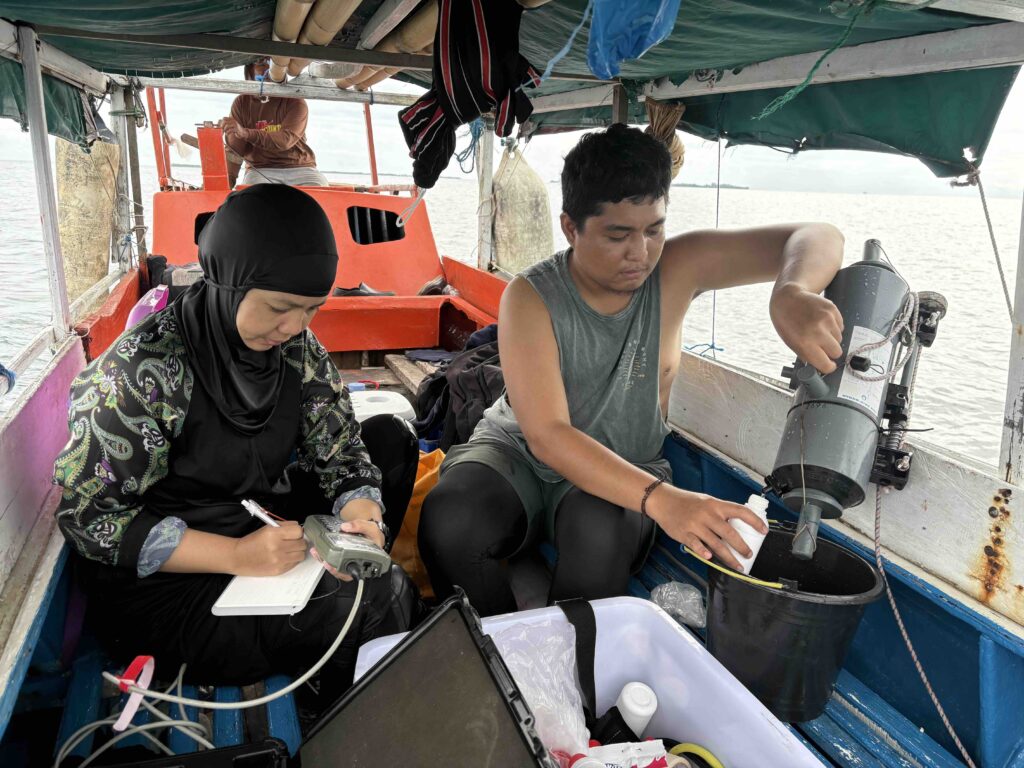
The team, led by Funty Septiyawati Polapa (doctoral student in Fisheries Science, Unhas) and Professor Jamaluddin Jompa, carried out a series of comprehensive field measurements and observations. Activities included in-situ water quality data collection, satellite imagery analysis for mapping Total Suspended Solid (TSS) distribution, substrate composition surveys using the Line Intercept Transect (LIT) method, and coral community censuses to the family level.
Activity Focus: Understanding Environmental Tolerance Limits
This research activity was designed to answer a fundamental question: to what extent do marginal habitats—existing at the very edge of environmental tolerance limits for corals—still possess the potential to support coral life and serve as targets for restoration? A multidisciplinary approach integrating satellite data, direct field measurements, and ecological community analysis became the hallmark of this scientific expedition.
Water Quality Parameters: Measuring Environmental Pressure
Throughout the survey period, the research team measured six key water quality parameters at each location using a Hanna water quality meter and laboratory analysis of water samples. These parameters included temperature, salinity, dissolved oxygen (DO), pH, and nitrate and phosphate concentrations.
Measurement results showed significant variation between locations:
- Water temperature recorded a wide range, with the Makassar location showing the highest temperature (31.0 ± 0.6 °C), indicating chronic thermal stress, while the Pangkep location was the coolest (27.4 ± 0.7 °C).
- The highest dissolved oxygen (DO) was recorded at the Lanjukang control site (6.80 ± 0.16 mg/L), while in Bone Gulf, the marginal site (Bone) actually had higher DO values than its control site (Taka).
- pH values at all locations were alkaline (8.04-8.08), still within the ideal range for coral life.
- Nitrate and phosphate concentrations were generally low at all sites, indicating that eutrophication is not the primary driver of marginal conditions in this region.
Total Suspended Solids (TSS) Mapping: Revealing Extreme Sedimentation Gradients
One of the core activities in this expedition was the analysis of TSS distribution using Sentinel-2 satellite imagery through the Google Earth Engine (GEE) platform. TSS data became the primary focus because chronic sedimentation was identified as the most dominant environmental limiting factor.
The analysis revealed a very clear gradient from extreme hyper-turbid conditions to more moderate conditions:
- The three marginal sites (Makassar, Pangkep, and Bone) showed chronic hyper-turbid conditions throughout the year. Their annual TSS ranges reached 124.5-1290.2 mg/L, 128.4-1420.5 mg/L, and 134.6-1707.6 mg/L, respectively. The Bone site even showed very high TSS stability throughout the year, consistently above 130 mg/L.
- Control sites showed much lower TSS levels: Lanjukang (20-30.8 mg/L) and Taka (45-70.2 mg/L). However, the upper limits at both control sites still approach or exceed the local “high turbidity” threshold (60 mg/L), underscoring the pervasiveness of sedimentation stress in the wider region.
The TSS concentrations recorded at the marginal sites are among the highest ever documented for coral-inhabited waters globally, comparable only to extreme nearshore environments such as reefs off the Amazon plume or highly urbanized coasts. This persistently hyper-turbid condition forms the primary environmental criterion defining the marginal classification and is identified as the dominant driver shaping coral community structure and limiting restoration potential.
Substrate Cover and Coral Community Surveys: Reading Signs of Adaptation
The next activity was a survey of substrate composition using the LIT method along 50-meter transects at depths of 3-6 meters. The results showed striking differences between locations:
- Makassar, Pangkep, and Bone were dominated by very high sand cover (47.62%, 55.63%, and 55.91%, respectively), with silt also found at the Bone location. These conditions are generally considered suboptimal for coral recruitment and growth due to the lack of stable hard substrate and the risk of sediment smothering.
- Lanjukang as a control site showed interesting dynamics. Although it had the highest live coral cover (29.93%), this site also had relatively high dead coral and rubble cover (9.85% and 19.29%). This indicates that even control sites experience intense physical disturbance.
- Taka faced a different ecological pressure, namely very high competition with algae (21.09%), which can inhibit new coral recruitment.
Coral community surveys to the family level revealed patterns consistent with environmental pressure:
- Dominance of sediment-tolerant families: Poritidae was the most dominant family at all locations, especially at sites with the highest sedimentation pressure. At the Bone site, Poritidae reached 22 colonies out of a total of 35 recorded colonies.
- Presence of sensitive families: Acroporidae, which are generally sensitive to environmental pressure, were still found at the Lanjukang (17 colonies) and Taka (46 colonies) control sites, but were very rare at marginal sites.
- Colony counts: There was a pattern of decreasing colony numbers with increasing environmental pressure. Bone recorded the lowest number of colonies (35 colonies), while Taka as a control site recorded the highest number (184 colonies).
Interactive Discussions: Formulating Implications for Restoration
Throughout the expedition, the research team regularly held discussions to interpret field findings and formulate practical implications for restoration efforts. Several key points that emerged include:
- No one-size-fits-all approach: The success of restoration in marginal habitats heavily depends on a site-specific approach that considers the unique environmental conditions at each location.
- Selection of tolerant species: Restoration at locations with high sedimentation pressure (Makassar, Pangkep, Bone) must prioritize the use of coral species from families proven to be sediment-tolerant, especially Poritidae.
- Substrate stabilization: At locations with high rubble cover like Lanjukang, substrate stabilization efforts are needed before coral transplantation can be carried out effectively.
- Competitor management: At locations with high algal competition pressure like Taka, the selection of tolerant species needs to be accompanied by water quality management to control algal growth.
- Stressor mitigation: At locations with dual pressures like Makassar (high temperature and extreme TSS), restoration will likely require stressor mitigation first before interventions can be undertaken.
Closing: The Long Road to Science-Based Restoration
This scientific expedition has successfully collected a rich multidisciplinary dataset, ranging from satellite data to direct field observations. This activity has not only produced a better understanding of the condition of marginal habitats in South Sulawesi but also provided a solid scientific foundation for designing more effective and sustainable restoration strategies.
The research team hopes that the results of this expedition can serve as a basis for developing coral reef restoration programs in this region, as well as becoming a model for similar approaches in other marginal habitats in Indonesia. By understanding environmental tolerance limits and harnessing the strengths of resilient taxa, restoration efforts can be designed not just to survive, but to thrive amidst the challenges of climate change.
Acknowledgments
This research activity was supported by a grant from Hasanuddin University under the Thematic Research Group (TRG) scheme, contract number 01210/UN4.22/PT.01.03/2025. The research team extends its highest appreciation to all parties who contributed to the smooth running of this expedition, including local governments, fishing communities at the research locations, and all field assistants who worked with high dedication.Contact:
TRG Coral Reef Rehabilitation and Sustainability Research Team
Hasanuddin University, Makassar, Indonesia