

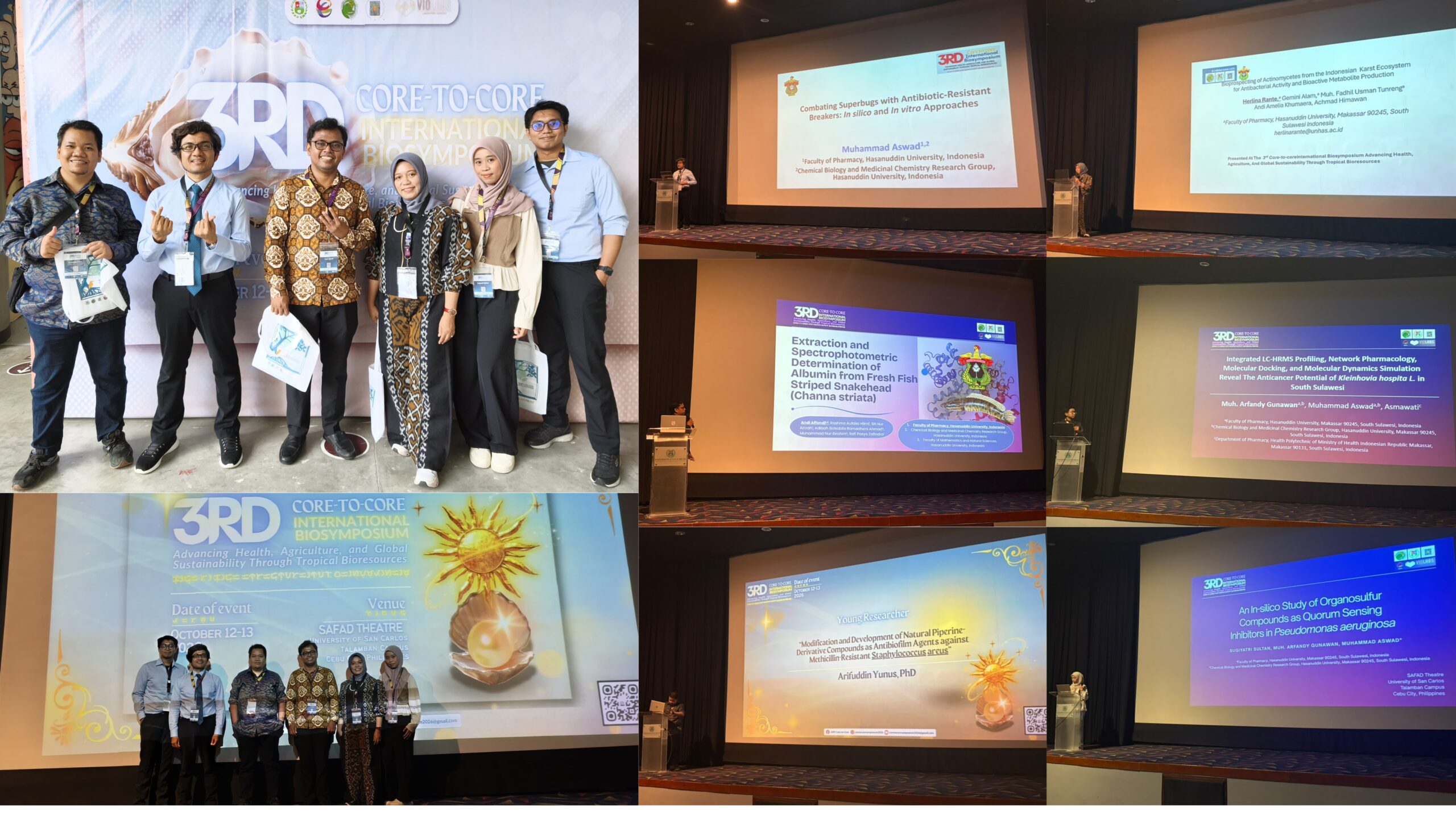

Cebu City, Philippines – October 15, 2026 – Researchers and doctoral students from the Chemical Biology and Medicinal Chemistry Research Group (TRG), Hasanuddin University, Indonesia, participated in the 3rd Core-to-Core International Biosymposium, held on October 12–13, 2026, at SAFAD Theatre, University of San Carlos, Cebu City, Philippines. The symposium carried the theme “Advancing Health, Agriculture, and Global Sustainability through Tropical Bioresources.”
The international scientific event was organized in collaboration with the Hiroshima Research Centre for Healthy Aging (HiHA), Japan, and the Japan Society for the Promotion of Science (JSPS), Japan. It brought together researchers, academics, practitioners, and industry experts from Vietnam, the Philippines, Japan, South Korea, and Indonesia to exchange scientific knowledge, establish research collaborations, and explore innovative approaches to global challenges. With a strong emphasis on tropical biodiversity, the symposium provided an international platform for transforming bioresources into impactful solutions for health, agriculture, and global sustainability.
Representing Hasanuddin University, members of TRG Chemical Biology and Medicinal Chemistry Research Group delivered oral presentations highlighting their research in medicinal chemistry, antimicrobial resistance, natural product bioprospecting, pharmaceutical analysis, and computational drug discovery.
Professor Muhammad Aswad, leader of the TRG Chemical Biology and Medicinal Chemistry Research Group and a lecturer at Faculty of Pharmacy Hasanuddin University, was invited as a speaker. He presented his research entitled “Combating Superbugs with Antibiotic-Resistance Breakers: In Silico and In Vitro Approaches.” His presentation highlighted research strategies for addressing antimicrobial resistance through the investigation of compounds that may help overcome bacterial resistance and improve the effectiveness of antimicrobial agents.
Another invited speaker from Hasanuddin University, Professor Herlina Rante, a Lecturer at Faculty of Pharmacy Hasanuddin University, presented “Bioprospecting of Actinomycetes from the Indonesian Karst Ecosystem for Antibacterial Activity and Bioactive Metabolite Production.” Her presentation emphasized the potential of actinomycetes from Indonesia’s distinctive karst ecosystems as sources of antibacterial compounds and bioactive metabolites for future pharmaceutical development.
In addition to the invited speakers, other members of the research group contributed through oral presentations showcasing the diversity of their ongoing research. Andi Affandi, M.Sc., a member of the group and lecturer at Faculty of Pharmacy Hasanuddin University, presented “Extraction and Spectrophotometric Determination of Albumin from Fresh Striped Snakehead (Channa striata).” This research focused on the extraction and analytical determination of albumin from a tropical freshwater fish, highlighting the relevance of bioresources to pharmaceutical and biochemical applications.
Muh. Arfandy Gunawan, M.Sc., a researcher at TRG Chemical Biology and Medicinal Chemistry Research Group, presented “Integrated LC-HRMS Profiling, Network Pharmacology, Molecular Docking, and Molecular Dynamics Simulation Reveal the Anticancer Potential of Kleinhovia hospita L. in South Sulawesi.” His presentation demonstrated an integrated computational and chemical-profiling approach to investigating the potential anticancer properties of Kleinhovia hospita L., a medicinal plant found in South Sulawesi, Indonesia. The study highlighted how metabolite profiling and computational methods can support the identification and prioritization of potential bioactive compounds and their cancer-associated molecular targets.
The research group was also represented by doctoral students who presented studies on antimicrobial drug discovery and bacterial virulence mechanisms. Arifuddin Yunus, a Ph.D. student, presented “Modification and Development of Natural Piperine-Derived Compounds as Antibiofilm Agents against MRSA.” His research explored the development of piperine-derived compounds as potential strategies for addressing biofilm-associated infections caused by methicillin-resistant Staphylococcus aureus (MRSA).
Meanwhile, Sugiatry Sultan, also a Ph.D. student, presented “An In Silico Study of Organosulfur Compounds as Quorum-Sensing Inhibitors in Pseudomonas aeruginosa.” The study investigated organosulfur compounds as potential inhibitors of bacterial quorum sensing, a cell-to-cell communication system involved in the regulation of virulence and other bacterial behaviors. This work reflects the growing interest in alternative antimicrobial strategies that target bacterial communication and pathogenicity.
The participation of TRG Chemical Biology and Medicinal Chemistry Research Group in the symposium reflects the research group’s multidisciplinary approach to pharmaceutical and biomedical sciences. By integrating natural product exploration, medicinal chemistry, analytical techniques, in silico investigations, and in vitro evaluation, the group seeks to advance the discovery and development of bioactive compounds relevant to human health.
Beyond the scientific presentations, the symposium offered opportunities to exchange ideas with international researchers, explore potential collaborative projects, and strengthen scientific networks across institutions and countries. Such interactions are essential for advancing collaborative research and translating scientific findings into practical innovations.
The participation of Hasanuddin University researchers in the 3rd Core-to-Core International Biosymposium demonstrates the university’s continued commitment to international research collaboration, scientific excellence, and the sustainable utilization of Indonesia’s tropical biodiversity. Through the contributions of its researchers and doctoral students, TRG Chemical Biology and Medicinal Chemistry Research Group continues to strengthen its role in advancing bioactive compound discovery and innovative pharmaceutical research for global health challenges.


