


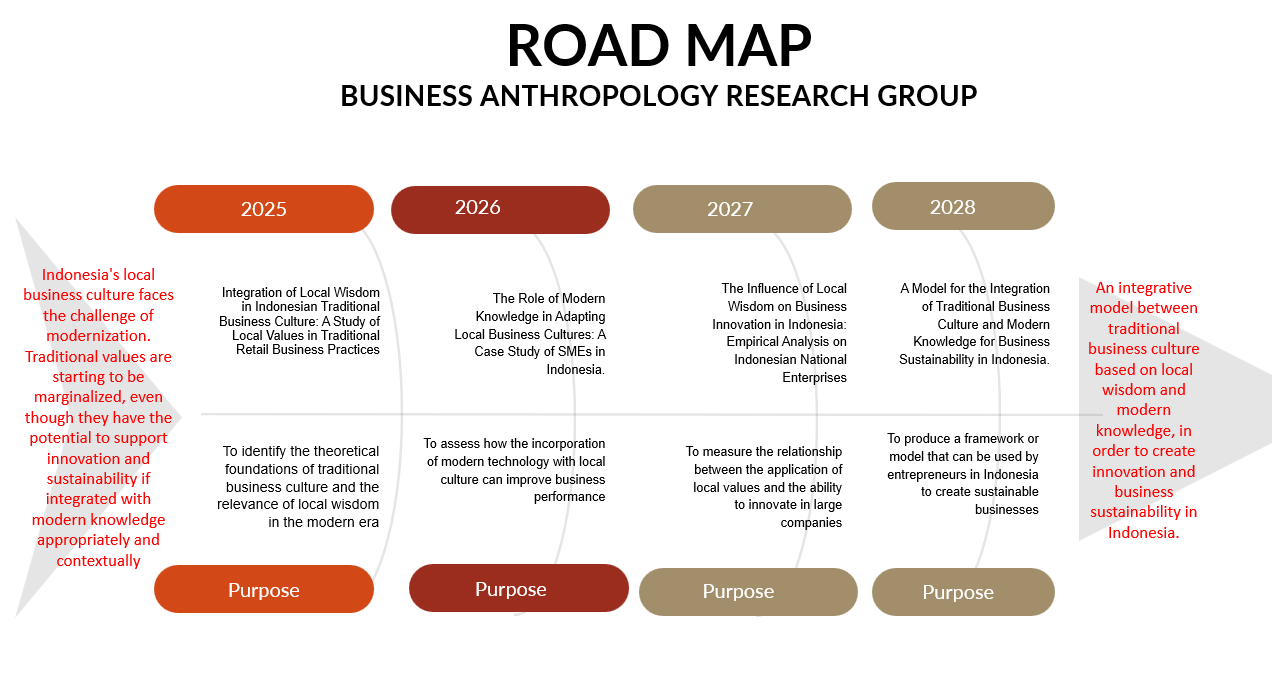
Roadmap Business Anthropology Research Group
Long-Term Research (Innovation and Advanced Applications)
- Integration of Blockchain in Corporate Auditing: Investigating blockchain applications for enhancing transparency and security in audits.
- Forensic Auditing and Fraud Prevention: Developing predictive models and risk assessment frameworks to combat financial fraud.
- Sustainability Auditing and ESG Compliance: Researching the role of auditors in ensuring environmental, social, and governance (ESG) accountability.
Research Sub-Theme
Organizational Culture and Work Dynamics
Explores local values, traditions, and social norms that shape workplace behavior and organizational life. In many communities, cultural elements such as kinship, hierarchy, religion, and communal obligations deeply influence how authority is perceived, how decisions are made, and how employees interact. Understanding these local dynamics is essential for managing organizations effectively, as they affect motivation, loyalty, and conflict resolution. An anthropological perspective reveals that organizations are embedded in broader cultural systems, and successful management requires sensitivity to these local meanings and practices that govern everyday work and organizational relationships
Consumption and Cultural Identity
The way individuals and groups express, negotiate, and construct their cultural identities through the goods and services they consume. Consumption is not merely an economic activity but also a social and symbolic act that reflects values, status, traditions, and group affiliations. People may choose certain brands, clothing styles, foods, or technologies to assert belonging or difference, often influenced by cultural norms, historical experiences, and global trends. In this context, consumption becomes a key site where cultural identities are maintained, challenged, or transformed, highlighting the intersection between market practices and the cultural meanings people attach to them
Business Ethics and Social Responsibility
The Concepts that guide how businesses operate about society. Business ethics refers to the moral principles and values that govern decisions and actions within an organization, ensuring fairness, integrity, and respect for stakeholders. Social responsibility, meanwhile, extends beyond profit-making, emphasizing a company's obligation to contribute positively to society and minimize negative impacts on the environment, communities, and employees. Together, these principles encourage ethical conduct, transparency, and sustainable practices. Businesses that uphold ethics and social responsibility not only build trust and reputation but also foster long-term success and meaningful relationships with the wider public
Entrepreneurship and Socio-Cultural Capital
Cultural values, social networks, and community norms influence entrepreneurial behavior and success. Socio-cultural capital refers to the resources derived from relationships, shared values, trust, and cultural knowledge within a community. Entrepreneurs often rely on these intangible assets to access support, market opportunities, and credibility. Cultural norms can shape business practices, risk-taking, innovation, and leadership styles. In many contexts, entrepreneurship is not just an economic activity but also an artistic expression of identity, resilience, and adaptation. Understanding the interplay between entrepreneurship and socio-cultural capital is key to fostering inclusive, context-sensitive, and sustainable economic development
Digitalization and Changing Business Practices
Integration of digital technologies is transforming the way businesses operate, communicate, and deliver value. From e-commerce platforms and digital marketing to automation and data analytics, digitalization enables greater efficiency, scalability, and customer engagement. It also reshapes organizational structures, labor dynamics, and consumer behavior. Traditional business models are being disrupted, requiring firms to innovate continuously and adapt to rapidly evolving digital environments. Moreover, digital tools facilitate global reach and real-time decision-making, but they also raise new ethical and cultural challenges. Understanding these shifts is essential for businesses to remain competitive and culturally responsive in the digital age