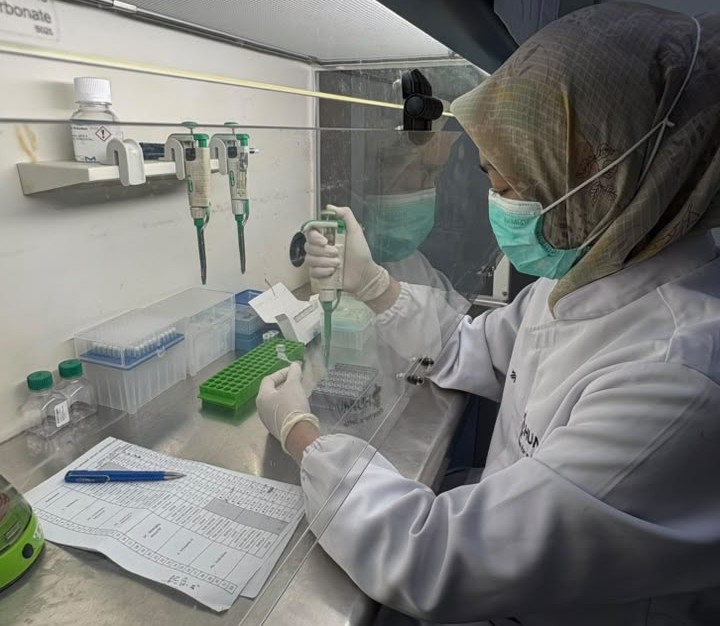

Makassar, Indonesia 13/07/2026/BioVax TB/ – Molecular research requires standardized and carefully controlled laboratory procedures to ensure the validity, reliability, and reproducibility of the data generated. An essential stage in the molecular characterization of Mycobacterium tuberculosis involves the preparation of polymerase chain reaction (PCR) components required for the amplification of specific genetic loci. In this context, the activity entitled “MIX PCR Preparation for 24 MIRU-VNTR Loci in Tuberculosis Research” was conducted on 13 July 2026 at the Hasanuddin University Medical Research Center (HUMRC) Laboratory, Faculty of Medicine, Hasanuddin University (Lab HUMRC FK UNHAS). The activity was performed by Nursamsi and Marina as part of a broader molecular research workflow aimed at supporting the genetic characterization of M. tuberculosis.
The primary objective of this activity was to prepare the PCR reaction mixture for 24 MIRU-VNTR loci as an integral component of M. tuberculosis genotyping analysis. MIRU-VNTR (Mycobacterial Interspersed Repetitive Units–Variable Number Tandem Repeats) is a molecular typing approach used to investigate genetic variation within the M. tuberculosis genome. Analysis of multiple MIRU-VNTR loci enables the generation of genetic profiles that can subsequently be used to assess genetic relatedness among isolates or samples. Such information is particularly relevant to molecular epidemiological studies investigating the genetic diversity, distribution, and potential transmission patterns of M. tuberculosis.
The preparation of the PCR mixture was conducted systematically in accordance with established laboratory procedures. The activities included preparation of the required PCR components, formulation of reaction mixtures targeting the designated MIRU-VNTR loci, verification of sample identities, and proper documentation of the laboratory process. Accuracy and consistency throughout these procedures are critical because variations in reaction composition may affect amplification efficiency and, consequently, the quality of the molecular data obtained. Accordingly, the implementation of good laboratory practices, accurate handling of research materials, and maintenance of sample traceability were emphasized to minimize procedural errors and preserve the integrity of the research process.
Beyond its direct contribution to molecular analysis, this activity also supports the development of human resource capacity in molecular biology and biomedical research. The preparation of PCR mixtures for 24 MIRU-VNTR loci provides practical experience in PCR component management, handling of research materials, implementation of standardized laboratory procedures, and quality control during the pre-analytical stage. These competencies are essential for conducting systematic, well-documented, and reproducible molecular research. Consequently, the activity contributes to strengthening institutional research capacity and supporting the generation of scientifically valid and reliable molecular data.
From the perspective of the Sustainable Development Goals (SDGs), this activity is primarily aligned with SDG 3: Good Health and Well-being, through its contribution to tuberculosis research and the application of molecular approaches for the characterization of M. tuberculosis. It also supports SDG 4: Quality Education by enhancing technical competencies, scientific knowledge, and academic capacity in molecular biology and biomedical research. Overall, this activity represents an important component of efforts to strengthen molecular research capacity and generate scientifically robust data that may contribute to a better understanding of tuberculosis epidemiology and the development of evidence-based strategies for disease control.