


Makassar, Indonesia, October 19th, 2023/asds/. Imagine knowing how intense the rain will be years before it happens. For cities like Makassar, where heavy rainfall can lead to floods and disasters, this is more than just curiosity—it is a necessity. Thanks to modern data science, scientists are now able to predict extreme rainfall patterns with greater confidence. This breakthrough directly contributes to Sustainable Development Goal (SDG) 13: Climate Action, which calls for urgent steps to combat climate-related risks.
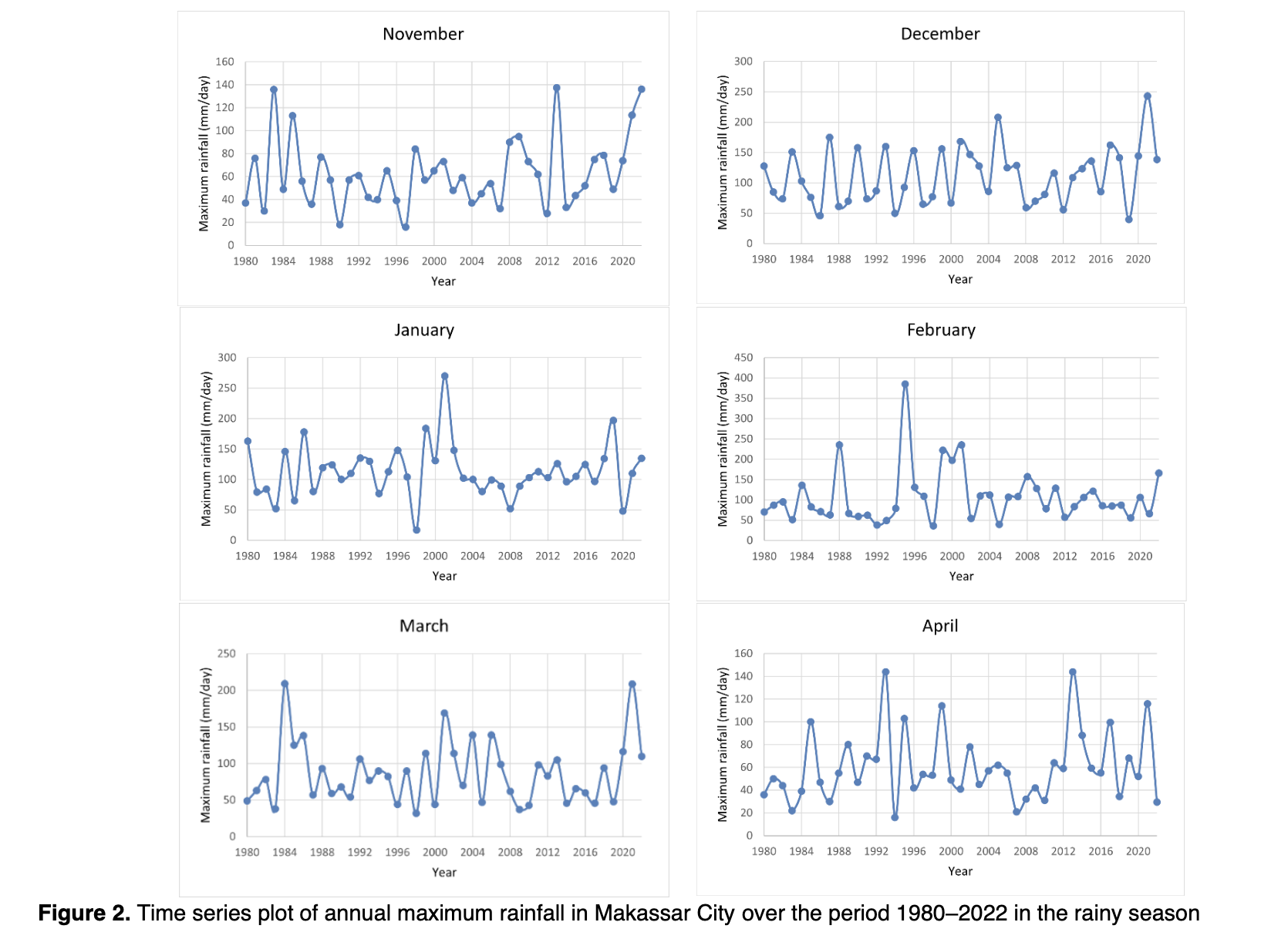
A recent study titled*“Stochastic Model of the Annual Maximum Rainfall Series Using Probability Distributions”* shows how researchers use statistical models to better understand rainfall behavior. The study analyzes rainfall data in Makassar City from 1980 to 2022, focusing on the rainy season when the risk of flooding is highest.
Rainfall may seem random, but it actually follows patterns that can be studied. Scientists describe rainfall as a “stochastic process,” meaning it contains randomness but can still be modeled using probability. By applying mathematical tools such as the Generalized Extreme Value (GEV) distribution and the Gumbel distribution, researchers can estimate how often extreme rainfall might occur and how severe it could be.
The study found that rainfall intensity in Makassar usually peaks between December and February, with the highest variability occurring in February. This is critical information because it highlights when the city is most vulnerable to floods and other climate hazards.
One of the most valuable concepts introduced in this research is the “return period.” In simple terms, it helps answer questions like: “How often will a very heavy rain happen?” For example, certain rainfall levels may be expected to occur once every 10 or 20 years. This helps governments and planners design infrastructure such as drainage systems, dams, and flood barriers that can withstand extreme weather events.
The findings reveal that heavier rainfall events are expected in longer return periods, meaning rare but extreme events are likely to be more intense. This is especially important in the context of climate change, where extreme weather is becoming more frequent and unpredictable.
So how does this connect to SDG 13: Climate Action? The answer lies in preparedness. By predicting extreme rainfall, policymakers can develop early warning systems, improve disaster response, and protect communities from harm. For example, accurate rainfall forecasts can reduce flood damage, save lives, and protect economic activities such as agriculture and urban infrastructure.
Moreover, this research highlights the importance of collaboration between scientists, governments, and communities. Climate action is not only about reducing emissions—it is also about adapting to the changing environment. Data-driven insights allow us to make smarter, safer, and more sustainable decisions.
In everyday terms, this means fewer surprises when storms hit. It means better planning, stronger infrastructure, and safer communities. It also shows how science and mathematics, often seen as abstract, play a very real role in protecting our future.
In conclusion, predicting rainfall is no longer just about weather forecasts—it is about building resilience. By embracing scientific models and data analysis, we take an important step toward a world that is better prepared for climate challenges. And in doing so, we move closer to achieving SDG 13: Climate Action.
DOI: https://doi.org/10.11113/mjfas.v19n5.2945
Contact: Prof. Sri Astuti Thamrin
+6285298934579


