
Preserving the Scientific Treasure of Oryzias eversi at the Edge of Extinction
Khusnul Yaqin1, Al Maghfira Maharani1, Putri Rahastri Adelia1, and Tesalonika Tirsa Rura1
1Thematic Research Group on Aquatic Ecotoxicology, Hasanuddin University, Indonesia
Corresponding Author: khusnul@unhas.ac.id
The Kabumbu fish, known scientifically as Oryzias eversi, is a species recognized by the Toraja people as a unique treasure of their land. This fish exists nowhere else in the world but in Toraja, specifically in the ancient natural pool of Tilanga. Like its close relative Oryzias celebensis, which is widely distributed across South Sulawesi, O. eversi has the potential to be developed as a model organism in biological research and its derivatives, such as ecotoxicology (Sari et al., 2018; Lalombo et al., 2021; Yaqin et al., 2021; Hardiana et al., 2024).
While the genus Oryzias may not be visually striking as ornamental fish compared to other species with exotic colors, their value as biological model organisms is undeniable (Yaqin et al., 2022). For example, O. celebensis has already been used to develop simple yet effective biomarkers, such as heart rate assays, to detect pollutants in vivo (Lalombo et al., 2025; Yaqin et al., 2025; Reikardi et al., 2025) and in situ (Yaqin et al., 2024).
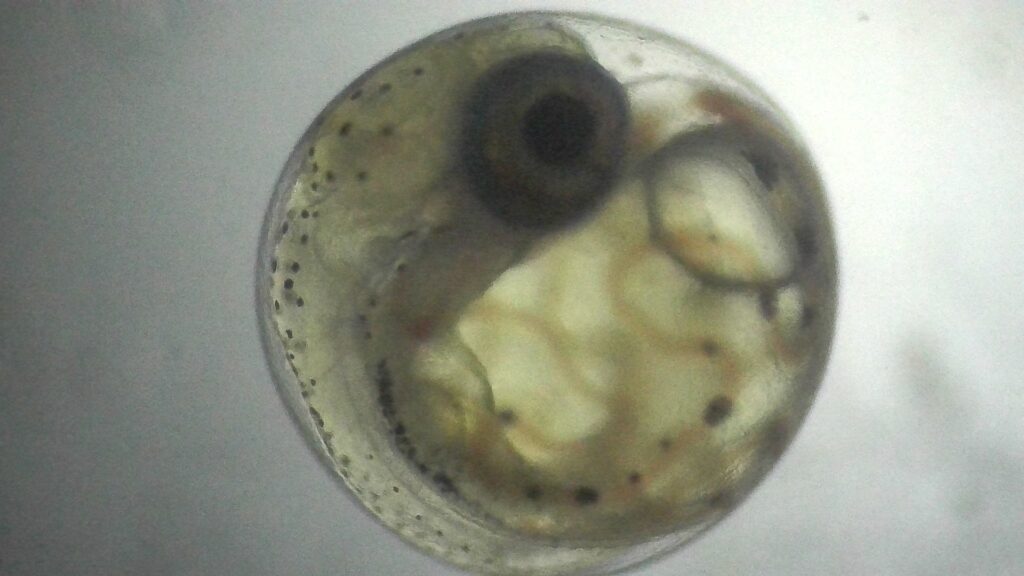
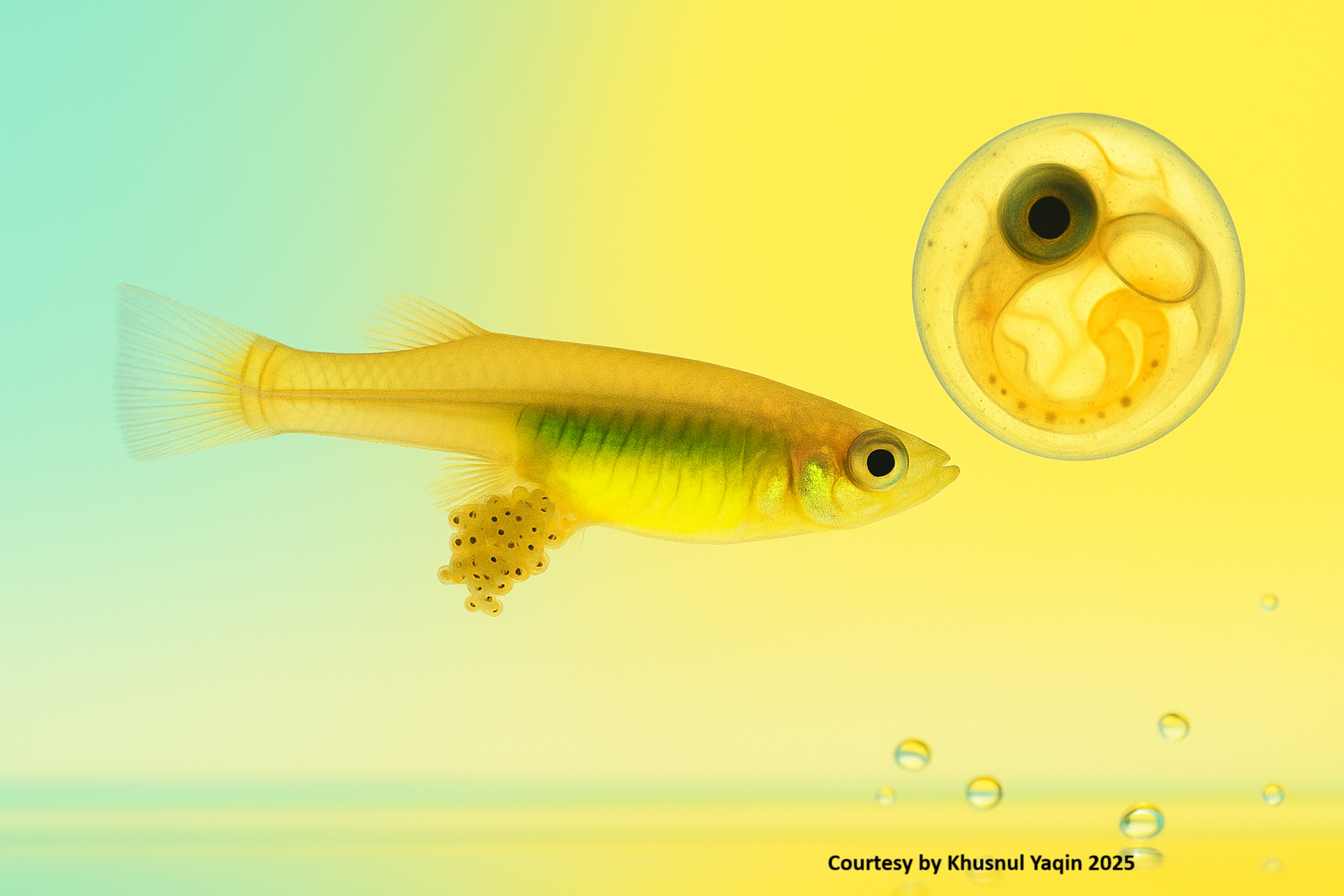
The discovery of a female O. eversi carrying 45 embryos at stage 37 in the upper pool of Tilanga on August 26, 2025, was like a sudden flash of light breaking through the fog that has long overshadowed conservation efforts for Sulawesi’s endemic fishes. In recent years, Kabumbu fish have become increasingly rare in Tilanga, with surveys by the Thematic Research Group (TRG) Aquatic Ecotoxicology often failing to detect their presence. Intriguingly, the species has been maintained successfully by researchers in Nagoya, Japan, and Bonn, Germany, yet bringing them back to Tilanga, Tana Toraja, faces immense bureaucratic hurdles.
This discovery is not only unusual but also monumental, reigniting optimism for the possibility of domesticating this species for conservation purposes. Tilanga, located at the heart of Tana Toraja, is more than a mythical and scenic site; it has now become a vital stage for modern conservation biology. A single female carrying dozens of embryos demonstrates that O. eversi still persists, though at the edge of extinction—threatened by competition with invasive guppies and by disease and parasitic infections.
For academics and conservationists, the message is clear: O. eversi cannot be allowed to fade into memory as a species once endemic to Sulawesi. It must be safeguarded, managed, and—if necessary—domesticated. Hatching embryos in controlled laboratory conditions, rearing larvae, and establishing stable colonies under managed environments are urgent first steps. Domestication, in this context, should not be seen merely as a strategy for fish farming, but as a bridge between conservation and biodiversity sustainability.
Recent studies highlight the biological uniqueness of O. eversi. Schüller et al. (2022) revealed its remarkable reproductive strategy involving a “plug” system that anchors egg filaments, allowing embryos to attach firmly to the mother until hatching. Unlike other Oryzias species, O. eversi embryos possess fewer filaments, which greatly facilitates embryonic observations in the laboratory. Such pelvic brooding is a rare phenomenon among teleost fishes, marking O. eversi as an extraordinary example of reproductive adaptation. At the same time, Herder et al. (2012) emphasized that O. eversi is not merely a biological curiosity but also evidence of Sulawesi as a hotspot of adaptive radiation in ricefishes, with diverse reproductive strategies. From an evolutionary standpoint, the pelvic-brooding adaptation represents a novel evolutionary pathway that enables the species to survive in Toraja’s rocky pool ecosystem. This makes it a living testimony of Sulawesi’s evolutionary history.
Yet the threats cannot be ignored. The introduction of guppies and other alien species has imposed immense competitive pressure, outcompeting O. eversi for food and habitat. Infections by parasites and diseases further accelerate its population decline. For this reason, in-situ conservation within natural habitats is no longer sufficient. A carefully planned ex-situ domestication program is urgently required.
The Stages of Domestication
The domestication of wild fishes, including O. eversi, is a demanding scientific endeavor requiring precision at every step:
- Broodstock capture and egg hatching under controlled laboratory conditions to maximize embryo survival.
- Larval rearing, the most fragile stage, requiring stable water quality and disease management.
- Juvenile rearing, focusing on feed optimization, stocking density, and environmental quality.
- Adaptation to controlled systems, ensuring individuals accustomed to Tilanga’s natural environment can adjust to aquaria or laboratory tanks.
- Reproductive cycling under captivity, confirming whether the species can complete its life cycle and sustain generations outside its natural habitat.
Each of these steps demands scientific rigor, patience, and sustained laboratory support.
Cultural and Philosophical Dimensions
Beyond biology, the domestication of O. eversi carries cultural and philosophical weight. For Toraja, whose ancestral traditions honor harmony with nature, saving this fish is not merely about preserving a species—it is about respecting ecological heritage. If Kabumbu were to vanish, we would lose not only a biological entity but also an irreplaceable chapter of cultural and evolutionary history.
At the same time, domestication offers avenues for innovation and scientific progress. From reproductive physiology studies to potential use as a novel model organism, O. eversi could elevate Indonesia’s role in global biological research. Just as the Japanese medaka (Oryzias latipes) became a cornerstone of biomedical and ecotoxicological research, O. eversi, with its pelvic brooding adaptation, could emerge as Indonesia’s scientific icon. Sulawesi, rich in endemic biodiversity, could rightfully claim its place as a global hub for ricefish research.
A Call for Collaboration
Achieving this vision requires collective effort. Academic institutions must lead initial breeding efforts, while local communities are empowered to protect natural habitats. Government agencies must enforce regulations against species introduction and prevent pollution from industrial and domestic waste. International collaborations should advance research on genetics, reproductive physiology, and fish health management. Without cross-sectoral support, domestication risks faltering.
Ethical Considerations
Most importantly, conservation-oriented domestication must differ fundamentally from commercial aquaculture. The goal is not mass production but safeguarding survival, preserving genetic diversity, and eventually restoring populations to the wild. Ethical standards—such as ensuring animal welfare, avoiding inbreeding, and protecting ecological balance—must guide every step. Conservation is not a quick project but a long-term investment in life itself.
The recent discovery of a female O. eversi bearing 45 embryos in Tilanga is more than a field note—it is both alarm and hope. Alarm, because natural populations are critically endangered. Hope, because it reveals a path forward through domestication. As Schüller et al. (2022) described its reproductive complexity and Herder et al. (2012) situated it within Sulawesi’s adaptive radiation, O. eversi emerges as a priceless scientific treasure. To lose it would mean erasing a vital chapter of fish evolutionary history.
This moment must inspire decisive action: controlled hatching, larval rearing, the formation of captive colonies, and advanced research in health and genetics. If the stages of domestication are pursued diligently, O. eversi could not only survive but also thrive—standing as an emblem of Indonesia’s contribution to global biology. Toraja would then be remembered not only for its cultural splendor but also for rescuing a small fish that carries a profound evolutionary story.
Let this discovery expand our horizons of conservation. Oryzias eversi must not share the fate of other endemic species that slipped into extinction silently. Through domestication, we are not merely saving a species—we are preserving hope, safeguarding pride, and rewriting the narrative that humanity can indeed be guardian, not destroyer, of life.
References
Hardiana, A.D. , Yaqin, K. & Rahim, S.W. 2024. Detection of triclosan pollutants adsorbed on polypropylene microplastics using simple biomarkers in the embryos of Oryzias javanicus (Bleeker, 1854). Journal of Sustainability Science and Management. 19(10):115–132.
Herder, F. , Hadiaty, R.K. & Nolte, A.W. 2012. Pelvic-Fin brooding in a new species of riverine ricefish (Atherinomorpha: Beloniformes: Adrianichthyidae) from Tana Toraja, Central Sulawesi, Indonesia. Raffles Bulletin of Zoology. 60(2):467–476.
Lalombo, Y.I. , Yaqin, K. & Rahim, S.W. 2025. The use simple biomarkers on Oryzias celebensis embryos for toxicity determination in Tallo River sediment semi-in situ. Journal of Sustainability Science and Management. 20(3):459–477.
Lalombo, Y.I.S. , Yaqin, K. & Omar, A. 2021. Nutrient Absorption Rate of Oryzias celebensis Embryo Laju Penyerapan Nutrisi Embrio Oryzias celebensis. Akuatikisle: Jurnal Akuakultur, Pesisir dan Pulau-Pulau Kecil. 5(2):67–71.
Reikardi, D.A. , Sodiqah, Y. , Basri, S.W.G. , Masdipa, A. , Karim, M. , Mutmainnah, A. , Ramadan, F. & Yaqin, K. 2025. In vivo Assessment of Ocimum sanctum and Ciprofloxacin Against Escherichia coli in Oryzias celebensis Embryos Using Heart Rate as a Non-Destructive Biomarker. 29(4):5053 – 5067.
Sari, D.K. , Andriani, I. , Yaqin, K. & Satya, A.M. 2018. The Use of Endemic Sulawesi Medaka Fish (Oryzias celebensis) as an animal model candidate. In: Proceedings of the 20th FAVA Congress & The 15th KIVNAS PDHI. Makassar. pp. 564–565.
Schüller, A. , Vehof, J. , Hilgers, L. , Spanke, T. , Wipfler, B. , Wowor, D. , Mokodongan, D.F. , Wantania, L.L. , Herder, F. & Parenti, L.R. 2022. How to stay attached—Formation of the ricefish plug and changes of internal reproductive structures in the pelvic brooding ricefish, Oryzias eversi Herder et al.(2012)(Beloniformes: Adrianichthyidae). Journal of Morphology. 283(11):1451–1463.
Yaqin, K. , Lalombo, Y.I. , Omar, S. bin A. , Rahim, S.W. & Sari, D.K. 2022. Survival Rates of Oryzias Celebensis Embryo Reared in Different Media in an Attempt to Provide Embryos for Ecotoxicological Studies. International Journal on Advanced Science, Engineering and Information Technology. 12(5):2008–2014.
Yaqin, K. , Rahim, Sri Wahyuni; Parawansa, B.S. , Kudsiah, H. , Tambaru, R. , Sari, D.K. , Riani, E. , Hardiana, A.D.M. & Lalombo, Y.I. 2024. Toxicity Detection of Pollutants in the Tallo River Using Simple Biomarkers of Oryzias celebensis Embryo. International Journal on Advanced Science, Engineering and Information Technology. 14(2):664–674.
Yaqin, K. , Rahim, S.W. & Idris, R.I. 2025. The Potential Use of Oryzias celebensis Embryo Heart Rate as a Simple and Non-Invasive Biomarker to Detect the Adverse Effects of UV-C Light. Egyptian Journal of Aquatic Biology & Fisheries. 29(2).
Yaqin, K. , Rahim, S.W. , Sari, D.K. & Tresnati, J. 2021. Can Oryzias Celebensis Embryo be Transported Dry? In: IOP Conference Series: Earth and Environmental Science. vol. 934. IOP Publishing.,. p. 12067.
Yaqin, K. , Rahim, S.W. & Sari, D.K. 2021. Dry transportation of Oryzias wolasi embryo for ecotoxicological studies. In IOP Conference Series: Earth and Environmental Science. 860(1):012102.