

Floating Wetland Islands: Indonesia’s Nature-Based Innovation for Ecology, Tourism, and Pollution Monitoring
Khusnul Yaqin
In the face of escalating ecological degradation in aquatic systems, a new paradigm of environmental engineering is emerging—one that reimagines the river not as a channel to be tamed, but as a living ecosystem to be healed. Constructed wetland islands (CWIs), built using biodegradable materials such as bamboo, coconut coir (sabut), and palm fiber (ijuk), represent one of the most compelling innovations in this movement. These floating ecosystems are more than aesthetic interventions; they are ecological infrastructures that purify water, provide habitats for aquatic organisms, mitigate climate change through carbon sequestration, and foster community engagement through education and ecotourism. Their simplicity, affordability, and ecological synergy make them uniquely suited for adoption across Indonesia’s vast and varied archipelago.
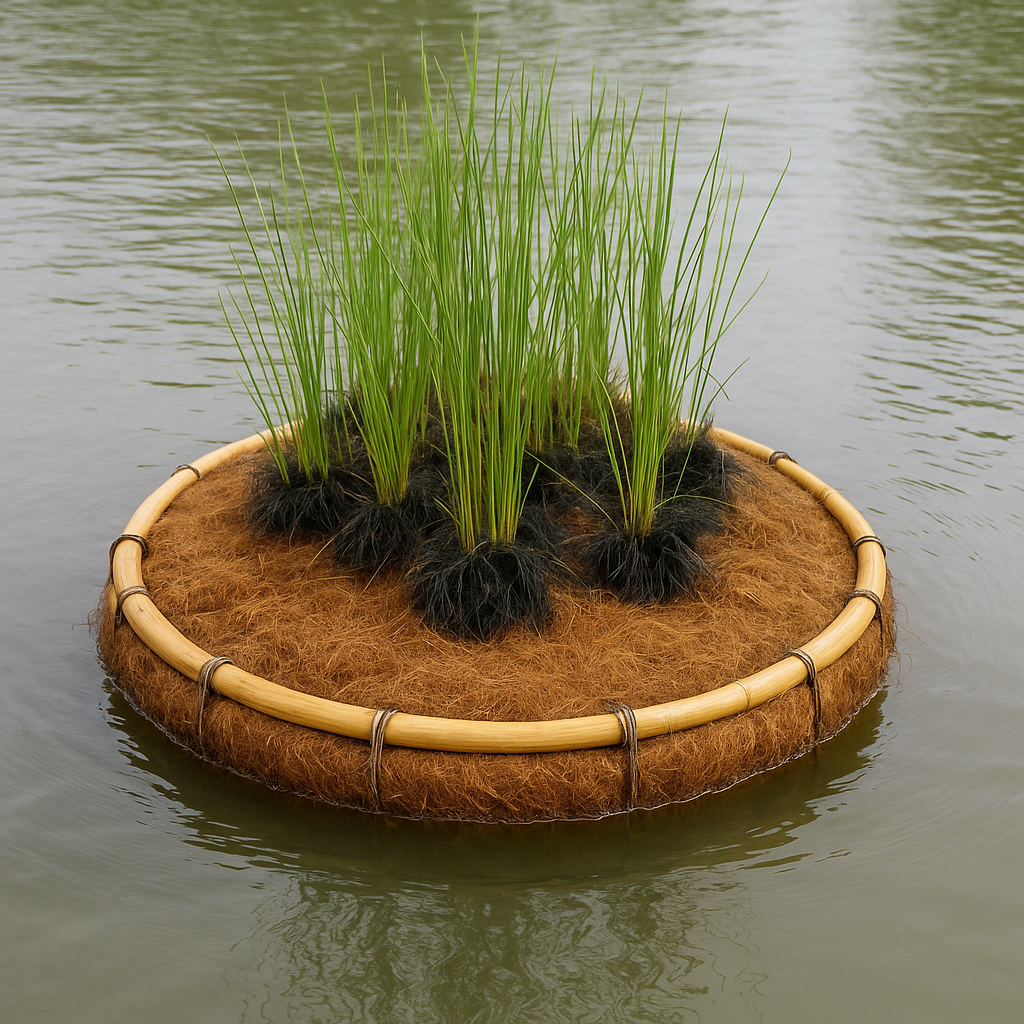
The story begins with the materials themselves. Bamboo, with its impressive tensile strength and rapid growth cycle, forms the skeletal framework of the islands. Sabut, derived from discarded coconut husks, provides buoyancy and a fibrous matrix for root anchoring, while ijuk—a resilient black fiber harvested from sugar palm trunks—acts as a moisture-retaining medium ideal for supporting microbial life. Together, these elements create a lightweight, porous platform that floats effortlessly on rivers, lakes, or reservoirs. Layered on top is a soil-substitute planting bed, rich in organic compost, where native wetland vegetation is grown. Typical choices include Typha, Cyperus, and Phragmites—plants with robust root systems that hang beneath the raft, filtering the water and creating a refuge for fish and invertebrates.
These root systems are not passive; they form the beating heart of the island’s ecological functions. As roots dangle in the water, they uptake excess nutrients such as nitrogen and phosphorus, two of the leading causes of freshwater eutrophication. In doing so, they prevent algal blooms that suffocate aquatic life and degrade water quality. But their function goes even deeper. The tangled network of roots becomes a substrate for periphyton and biofilms, which harbor microbial communities that metabolize organic pollutants and break down toxic compounds. Heavy metals such as cadmium, lead, and mercury—often discharged from industrial outfalls—adhere to the surfaces of these roots and fibers, eventually becoming sequestered in the root biomass and surrounding sediment.
Floating islands also act as biodiversity hotspots. In heavily urbanized waterways where natural riparian zones have been lost, CWIs reintroduce vertical complexity and habitat heterogeneity. Juvenile fish find refuge among the submerged roots, safe from predators and strong currents. Amphibians and reptiles bask and breed on the island surfaces. Waterbirds use the elevated platforms for nesting and feeding, especially when the islands are positioned away from human disturbance. Over time, these artificial islands begin to function much like natural wetlands, supporting a complex food web that spans multiple trophic levels. In this way, CWIs do not merely restore habitat; they create new ecological opportunities where none previously existed.
Beyond their biological functions, wetland islands serve as important tools in climate change mitigation. Wetland vegetation, like all green plants, absorbs atmospheric carbon dioxide through photosynthesis. But unlike terrestrial systems, the anoxic conditions of wetland environments slow the decomposition of organic matter, allowing more carbon to be stored in root biomass and submerged substrates. This makes CWIs effective micro carbon sinks. When scaled across a river network or lake system, they can contribute meaningfully to a region’s carbon balance. Additionally, the organic accumulation in the plant and fiber matrix provides further sequestration potential, particularly if managed through periodic harvesting that prevents re-release of carbon through decay.
Importantly, CWIs are not just ecological interventions but social ones. When installed in urban rivers, they transform perceptions of these spaces from neglected backwaters into living classrooms and community assets. In cities like Makassar, CWIs can serve as platforms for environmental education, offering schoolchildren and university students direct experience with ecological processes. Signage, guided tours, and volunteer planting days can foster environmental stewardship and strengthen local ties to urban waterways. Communities can participate in the construction and maintenance of islands, creating jobs and empowering residents to become caretakers of their environments.
These islands also hold immense potential for ecotourism. Imagine a network of CWIs along a riverfront promenade, each planted with different native species and hosting interpretive signage explaining their function. Tourists and locals alike could traverse floating walkways, observe birds, photograph dragonflies, and learn about natural water purification. In rural areas, CWIs integrated with traditional bamboo rafts could offer immersive nature experiences, combining recreation with conservation. Local economies could benefit from these low-impact attractions, diversifying income sources while reinforcing the value of intact ecosystems.
The economic feasibility of CWIs is one of their greatest strengths. All core materials—bamboo, sabut, ijuk—are abundant and renewable in Indonesia. Local labor can be mobilized for construction, reducing reliance on high-tech imports. Maintenance is minimal, consisting mostly of plant harvesting and structural checks. Even the end-of-life phase is benign: as bamboo degrades, it returns to the ecosystem; plants can be composted or harvested for biomass energy. A well-designed island can function for five to ten years, delivering multiple ecosystem services at a fraction of the cost of hard infrastructure.
Yet, challenges remain. Extreme weather events such as floods or typhoons can damage the floating structures, especially if they are not securely anchored. Invasive species can colonize islands and outcompete native vegetation. Regulatory barriers may delay implementation, as CWIs occupy contested spaces in public waterways. Moreover, while the ecological principles of CWIs are well-established, site-specific adaptations are essential. What works in the quiet backwaters of a dammed reservoir may fail in a fast-flowing urban canal. Success requires context-sensitive design, long-term monitoring, and institutional coordination across environmental, planning, and public works agencies.
Still, these obstacles are not insurmountable. Pilot projects in various parts of Indonesia have already demonstrated the viability of CWIs. In Bandung, small-scale islands have been used to treat effluents entering the Cikapundung River. In Denpasar, community-built CWIs serve as both filtration systems and floating gardens. These initiatives reveal that with political will, community involvement, and scientific guidance, CWIs can be integrated into broader watershed management strategies.
Moreover, CWIs can also function as aquatic monitoring stations. By incorporating sentinel organisms such as the embryos of Oryzias celebensis, researchers can assess real-time water quality and detect sublethal pollutant exposure through biomarker responses. For instance, studies have shown that these embryos exhibit measurable biochemical and developmental changes when exposed to contaminants such as microplastics, antibiotics, or heavy metals. Biomarkers such as oxidative stress enzymes, acetylcholinesterase activity, and hatching delay have been effectively used to indicate environmental toxicity levels. From an ecotoxicological perspective, these floating islands serve not only as passive filters but also as active platforms for bioindication, enabling early detection of ecologically hazardous compounds. This makes CWIs especially valuable in polluted urban waterways where conventional chemical monitoring may miss complex synergistic effects. These organisms, due to their sensitivity, accessibility, and ecological relevance in Indonesian waters, offer a low-cost, biologically meaningful metric of aquatic health, enhancing the scientific utility of CWIs beyond passive filtration.
As climate pressures intensify and cities seek resilient, low-cost solutions for ecological restoration, CWIs offer a rare convergence of benefits: they are modular, scalable, participatory, and ecologically effective. They embody the principles of nature-based solutions and align with Indonesia’s broader commitments to sustainable development, climate adaptation, and biodiversity conservation. If supported by enabling policies and interdisciplinary collaboration, CWIs could become a cornerstone of Indonesia’s river revitalization efforts in the twenty-first century.
In embracing the floating wetland island, we are not merely deploying a tool but advancing a philosophy—one that sees water not as waste, but as life; not as problem, but as potential. The rivers of Indonesia, from the Mahakam to the Ciliwung, need healing. And perhaps, in the quiet labor of sabut, ijuk, and bamboo, we may find the blueprint for restoration, resilience, and renewal.


