
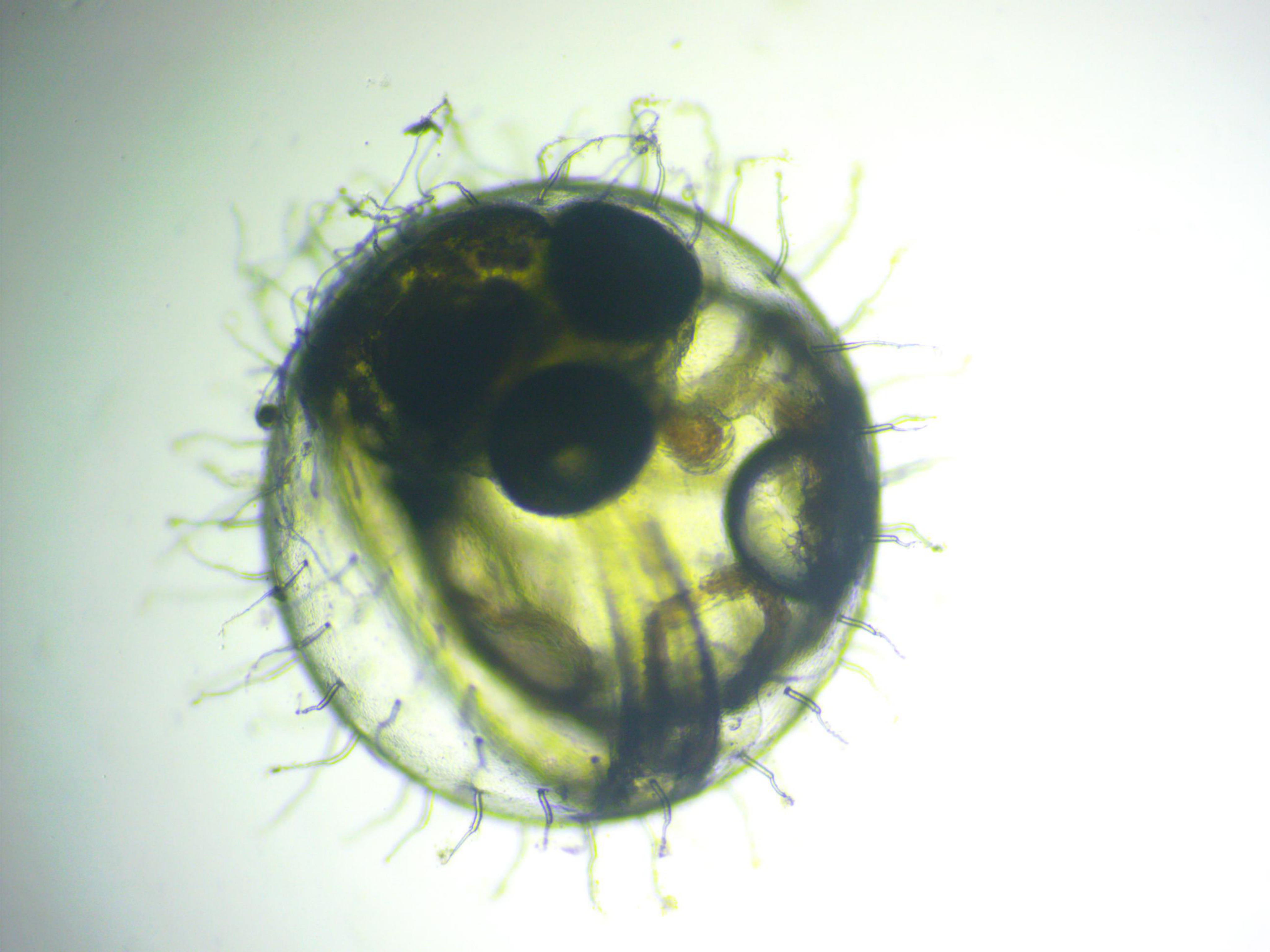

The Heartbeat of a Tiny Fish Embryo, A Giant Leap for Aquatic Environments
By Khusnul Yaqin
Amid the ever-expanding discourse on environmental issues, our attention is often drawn to large-scale concerns: industrial pollution, deforestation, or global climate change. Yet, behind these complexities lies a remarkably simple yet revolutionary approach emerging from the microscopic world—specifically from the embryo of a tiny fish known as Oryzias celebensis, or the Celebes medaka. Through its embryonic heartbeat, we now have a straightforward, non-invasive biomarker that holds great promise as an early indicator of aquatic environmental pollution.
This innovative research was conducted by a team from Hasanuddin University, Makassar, and published in the Egyptian Journal of Aquatic Biology & Fisheries (2025 edition): https://ejabf.journals.ekb.eg/article_420158.html. In this study, Celebes medaka embryos were exposed to ultraviolet C (UV-C) radiation at varying durations, and their heart rates were monitored to assess physiological responses to environmental stress.
The results were striking: UV-C exposure for 10 to 15 minutes daily over three consecutive days led to significant alterations in the embryos’ heart rates. The embryos exhibited abnormal tachycardia followed by a sharp decline in cardiac rhythm, indicating that UV-C light induced physiological stress and potential embryonic damage. Interestingly, embryos exposed for only five minutes showed relatively stable responses—suggesting a threshold of tolerance to such exposure.
Why is this important? Because the heartbeat of a fish embryo can be observed without dissection or harm. With their transparent bodies, internal organs—especially the heart—can be easily monitored under a basic microscope. This allows for environmental quality assessment without the need for expensive, complex, or destructive testing methods.
In a country like Indonesia, where many coastal regions lack access to high-end laboratory equipment for pollutant detection, this method presents a highly promising alternative. Moreover, Oryzias celebensis is a native species of Sulawesi waters, easily cultured, and has a short life cycle. This makes it an ideal candidate for developing a low-cost, effective early warning system for aquatic toxicity.
Even more compelling is the potential integration of this method with digital technologies. Optical measurements of embryonic heartbeats could be incorporated into Internet of Things (IoT) systems. Imagine micro-sensors deployed in strategic aquatic areas, monitoring fish embryos in real-time and transmitting data directly to central laboratories—or even to the smartphones of local policymakers. What once seemed like distant, high-end technology can now be built from humble, accessible foundations.
This does not mean we should rely solely on one method to tackle environmental degradation. However, this research demonstrates that impactful innovation doesn’t always require massive investment or technological complexity. In the realm of ecotoxicology, simplicity can be a powerful force. The use of biomarkers like the heartbeat of Oryzias celebensis embryos signals a new era of environmental monitoring—one that is more inclusive, accessible, and sustainable.
It also underscores the importance of tapping into local biological potential. While much of the world continues to rely on foreign species such as Danio rerio (zebrafish), Indonesian researchers are proving that our endemic species are just as reliable—if not more appropriate—for studies in tropical environments. This is the spirit of scientific decolonization in action: recognizing and elevating local resources within global research frameworks.
We must begin to embrace approaches that are more humane, locally grounded, and environmentally sustainable. From a single fish embryo, we learn that environmental protection doesn’t always require high-end technology or billion-dollar budgets. Sometimes, the answers lie in a university lab, beneath a microscope, and within the minds of researchers who care deeply about aquatic life and the ecosystems they study.
Given its immense potential, we hope this biomarker approach using local sentinel organisms will receive serious attention from governments, academics, and civil society. Not merely as a scientific tool, but as an embodiment of what may be called transcendental ecology—a philosophy that acknowledges our spiritual capacity to empathize with the suffering of other beings. In this sense, a disrupted embryonic heartbeat is not just scientific data; it is the silent voice of aquatic life in distress.
This biomarker, then, becomes a bridge between empirical science and ecological empathy—a reminder of our shared existence and the sacred duty to protect this Earth as a legacy for future generations.
As the Prophet Muhammad (peace be upon him) said:
“He who does not love those on Earth will not be loved by those in Heaven.”
(Mizan al-Hikmah)
Tamalanrea Mas, April 2, 2025


