MAKASSAR, January 27, 2026/STOCHASTIC A falling unemployment rate may sound like good news, but provincial averages can hide very different local realities. A busy metropolitan economy may face a skills mismatch, while a rural district may struggle with limited industries, education, or access to opportunity. To design effective employment policies, governments need to understand not only what influences unemployment, but also where and when those influences are strongest.
This challenge is examined in the article “A Modified Geographically and Temporally Weighted Regression Modeling on Open Unemployment Rate in South Sulawesi.” The article was published by Unpatti in the journal Barekeng on 18 January 2026. Rather than treating South Sulawesi as a single, uniform labor market, the study uses a statistical model that recognizes differences between locations and changes over time.
The researchers analyzed official data from the Central Statistics Agency for 24 regencies and cities between 2020 and 2023. They examined six possible influences on the open unemployment rate: the Human Development Index, the percentage of people living in poverty, average years of schooling, life expectancy, population density, and regional economic output.
Their approach, known as Geographically and Temporally Weighted Regression, can be understood as a “local lens.” Instead of producing only one equation for the entire province, it calculates relationships for each place and year. The researchers modified this method using Mahalanobis distance to account for connections among regional characteristics. They also added a Locally Compensated Ridge technique to reduce problems caused when explanatory factors, such as education and human development, overlap too strongly.
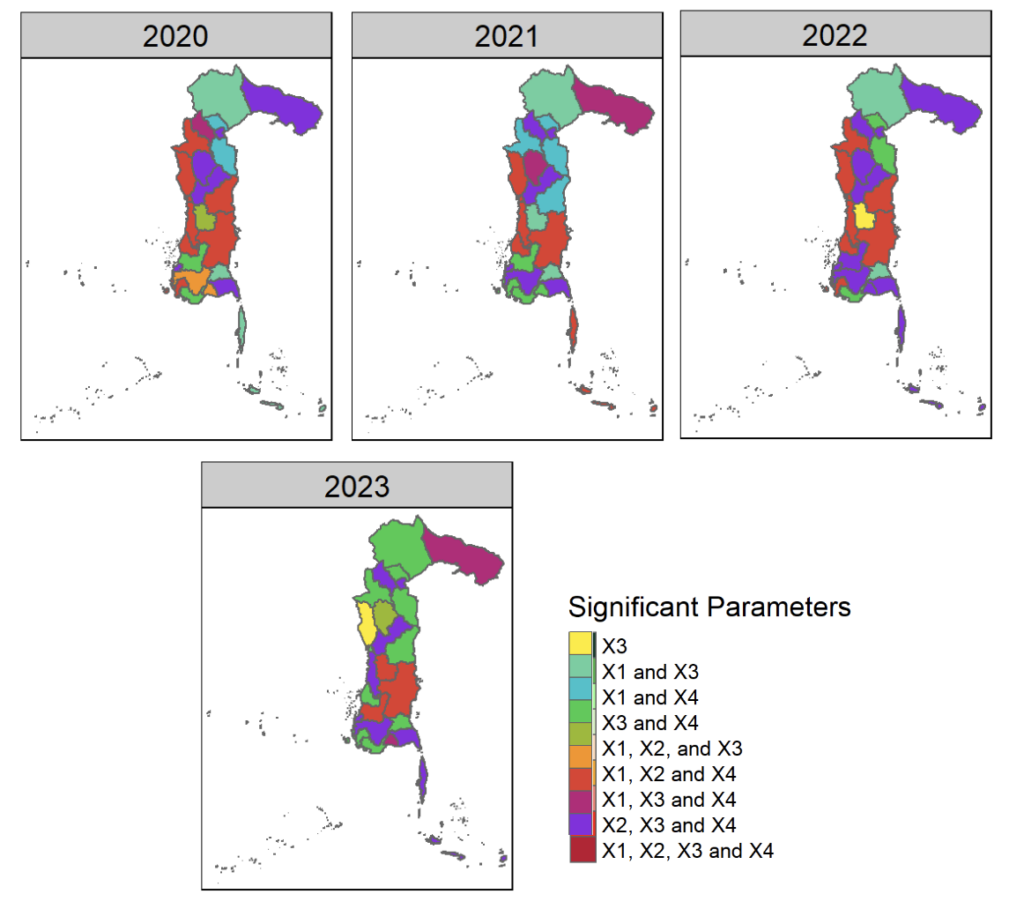
The result was 96 local models, reflecting 24 areas across four years. The modified model performed far better than the version without the local correction, producing much smaller prediction errors. This suggests that unemployment patterns become clearer when regional differences, time, and overlapping socioeconomic factors are analyzed together.
The maps also revealed striking contrasts. In 2023, Makassar recorded an open unemployment rate of 10.60 percent, while Enrekang and Bulukumba recorded 1.53 and 1.31 percent, respectively. Across the study period, four factors generally showed significant relationships with unemployment: the Human Development Index, poverty levels, average years of schooling, and life expectancy. However, their strength and direction varied across locations and years. These are statistical relationships, not automatic proof that one factor directly causes unemployment.
The findings support Sustainable Development Goal 1 (SDG 1): No Poverty. Unemployment can remove a household’s main source of income and increase its vulnerability to poverty. More precise local evidence can help governments connect employment programs with education, skills training, health improvement, productive poverty reduction, and regional economic diversification.
The study’s central message is practical: South Sulawesi does not need one unemployment policy copied everywhere. Makassar, Bulukumba, Enrekang, and other regions require strategies shaped by their own labor markets and changing conditions. Better models do not create jobs by themselves, but they can help public resources reach the places and problems where they matter most.
Reference
DOI:
https://doi.org/10.30598/barekengvol20iss2pp1099-1110
Contact:
Prof. Dr. Nurtiti Sunusi, S.Si., M.Si.
+62 813-9540-8907
nurtitisunusi@unhas.ac.id /