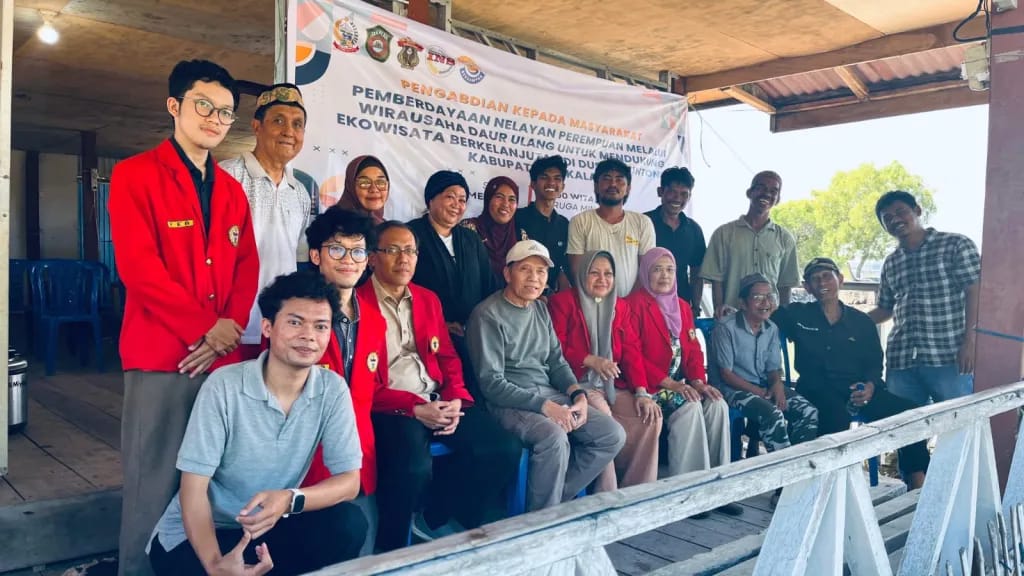

Universitas Hasanuddin (Unhas), through its Community Service Program funded by the KIPKU Unhas grant, conducted a community empowerment initiative entitled “Development of Recycling-Based Entrepreneurship to Support Sustainable Ecotourism” in Puntondo Hamlet, Laikang Village, Mangarabombang District, Takalar Regency, South Sulawesi. Held on 1–2 May 2026, the program involved 60 participants and was designed to strengthen the community’s economic capacity while promoting environmental awareness and sustainable tourism.
The program was led by Prof. Dr. Idayanti Nursyamsi, S.E., M.Si., Professor of Management at the Faculty of Economics and Business, Universitas Hasanuddin, in collaboration with the INS Consumer Cooperative. The multidisciplinary team involved Prof. Dr. Muhammad Idrus Taba, S.E., M.Si.; Prof. Dr. Cepi Pahlevi, S.E., M.Si.; Dr. Ir. Nursinah Amir, S.Pi., M.P.; Dr. Andi Nur Bau Massepe, S.E., M.Si.; Dra. Andi Reni; M. Nur Wahyudin S.; Dr. Marzuki Ukkas; Ir. Syarifuddin; and Unhas students Daniel, Andi Muhammad Farid Hadi, and Andi Muhammad Fakhrul Wahyudi.
The activity began with a free health examination for local residents, led by Prof. Dr. Marhaen Hardjo, M.Biomed., Ph.D. from the Faculty of Medicine, Universitas Hasanuddin. The service received an enthusiastic response from the community and was attended by the Head of Laikang Village. This opening activity demonstrated that community empowerment requires an integrated approach that considers both economic and social well-being.
The main program focused on entrepreneurship training, basic financial management, digital marketing, institutional strengthening, and practical recycling workshops. Prof. Muhammad Idrus Taba and Prof. Cepi Pahlevi introduced participants to fundamental business management, including simple cash-flow recording and small-business planning. Dr. Andi Reni and Dr. AM Nur Bau Massepe provided guidance on marketing strategies and strengthening community business groups, encouraging residents to use digital platforms to reach wider tourism-related markets.
The innovation sessions, facilitated by Dr. Marzuki Ukkas and Ir. Syarifuddin, trained participants to sort waste and transform used materials into marketable creative products, including flower vases and accessories. Through this approach, waste was reframed not merely as an environmental problem but as a potential source of economic value.
The initiative directly supports Sustainable Development Goal (SDG) 1: No Poverty by strengthening community entrepreneurship and income-generating opportunities. It also advances SDG 4: Quality Education through practical, lifelong learning in entrepreneurship, financial literacy, digital marketing, and recycling skills. Furthermore, collaboration between Universitas Hasanuddin, the INS Consumer Cooperative, local government, academics, students, and the community reflects SDG 17: Partnerships for the Goals.
Overall, the program demonstrates that sustainable ecotourism can grow from active community participation. By connecting education, entrepreneurship, environmental responsibility, and institutional collaboration, the initiative seeks to build a more resilient local economy while encouraging residents of Laikang to become active stewards of their tourism environment.