
MAKASSAR, Indonesia Apr 24 2026 /PharmaEpid RG/- In today’s digital era, public health is no longer shaped only by hospitals, governments, or scientific research—it is also influenced by what people say online. Social media platforms such as Twitter (now X) have become powerful spaces where information, opinions, and even misinformation about diseases can spread rapidly. A recent study reveals how online conversations about mpox (formerly known as monkeypox) can influence public perception and health responses worldwide.
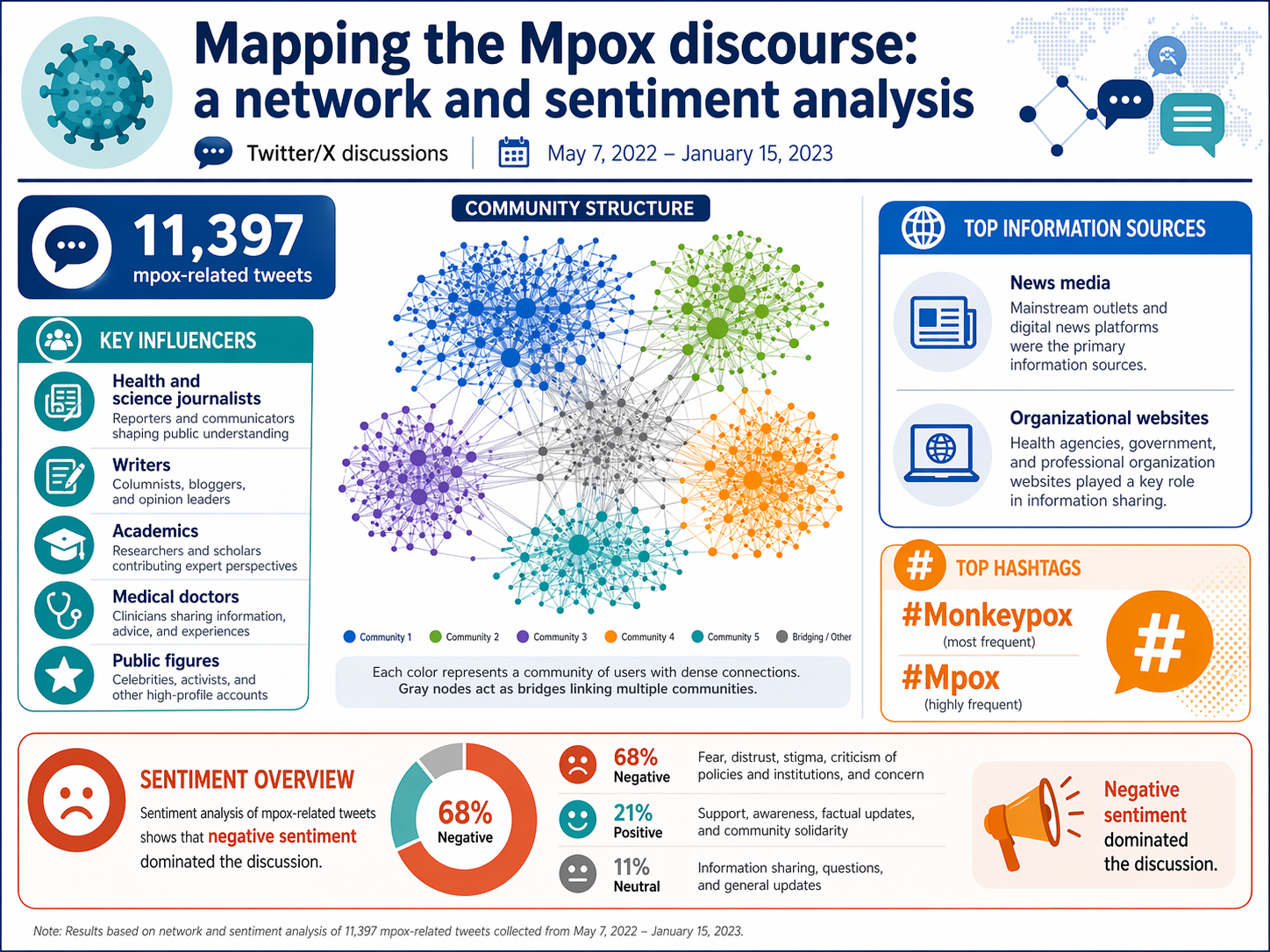
The study, titled “Mapping the Mpox discourse: a network and sentiment analysis” (Publisher: Elsevier), published in Exploratory Research in Clinical and Social Pharmacy (Volume 16, Page 100521) on December 1, 2024, by Ikhwan Yuda Kusuma, Ádám Visnyovszki, and Muh. Akbar Bahar, explores how mpox-related discussions spread across social media and how people feel about the outbreak. By analyzing 11,397 tweets collected over several months, the researchers mapped communication networks, identified key influencers, and examined public sentiment.
The findings show that online discussions about mpox form a complex network involving journalists, scientists, healthcare professionals, and the general public. As illustrated in the network visualization on page 3, a few key influencers act as central hubs, shaping how information flows between users. Interestingly, most widely shared information came from news media and organizational websites, rather than scientific journals . This highlights a critical gap between scientific knowledge and public communication.
Another striking finding is the dominance of negative sentiment. As shown in the sentiment analysis chart on page 5, negative opinions consistently outweighed positive and neutral ones throughout the study period. This reflects public fear, uncertainty, and concern about the spread and impact of mpox. Such emotional responses can influence behavior, sometimes leading to panic or the spread of misinformation.
The importance of this research lies in its implications for public health communication. Understanding how people talk about diseases online allows policymakers and health professionals to respond more effectively. By identifying key influencers and trending topics, health authorities can deliver accurate information through trusted voices and counter misinformation before it spreads widely.
This study is closely aligned with global development goals. It supports SDG 3 (Good Health and Well-being) by improving public health communication during disease outbreaks. It also contributes to SDG 4 (Quality Education) by emphasizing the importance of accessible and understandable health information for the public. The need for collaboration between researchers, governments, and digital platforms reflects SDG 17 (Partnerships for the Goals).
Ultimately, this study reminds us that managing disease outbreaks is not just about controlling viruses—it is also about managing information. In a world where a tweet can travel faster than a virus, ensuring accurate, timely, and trustworthy communication is more important than ever.
Reference:
DOI: https://doi.org/10.1016/j.rcsop.2024.100521
Contact:
Muh. Akbar Bahar, Ph.D
+62 819-4422-8642
akbarbahar@unhas.ac.id