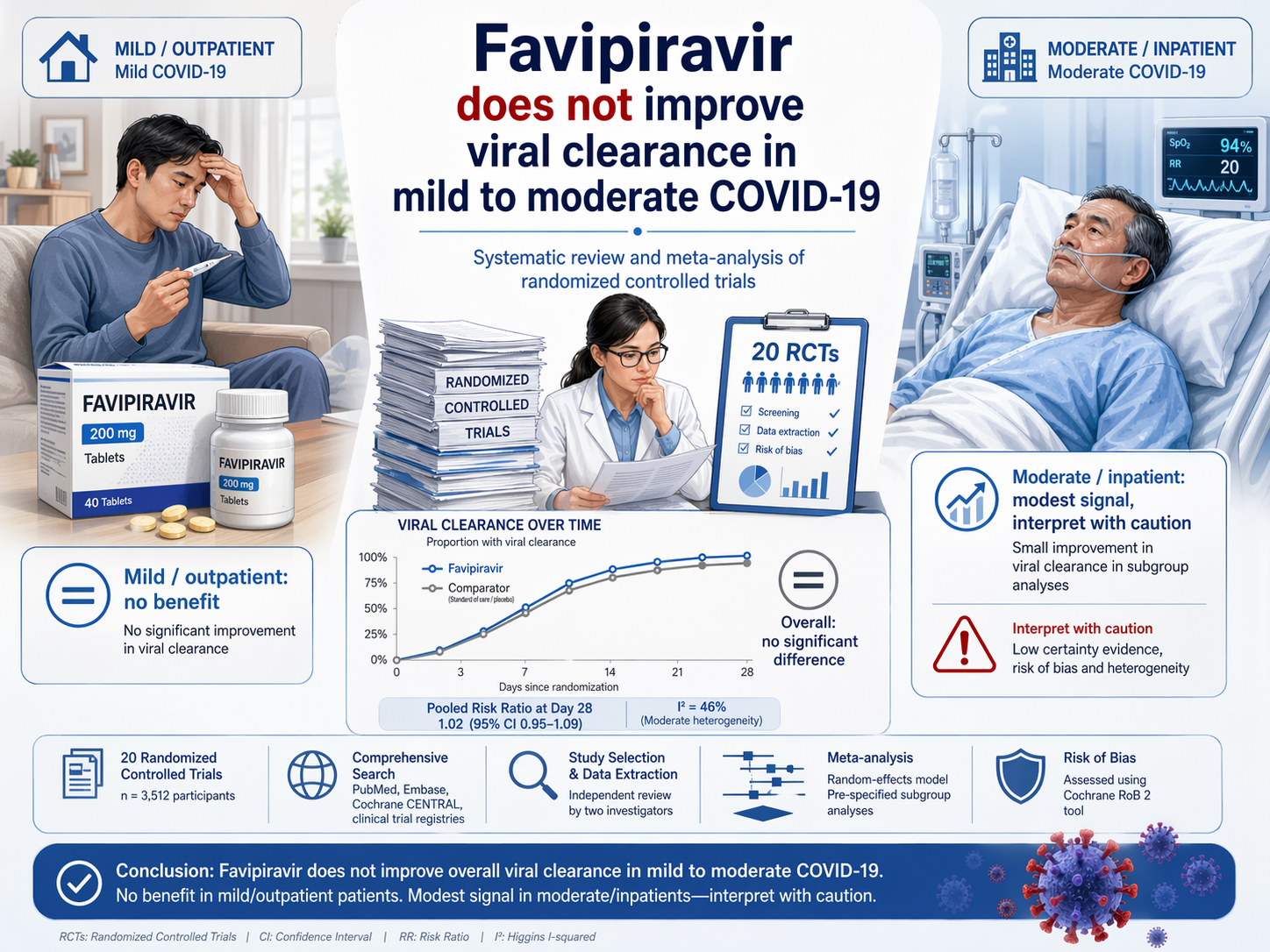

MAKASSAR, Indonesia Apr 24 2026 /PharmaEpid RG/– Since the early days of the COVID-19 pandemic, scientists around the world have raced to find effective treatments. One drug that quickly gained attention was favipiravir—an antiviral medication originally developed for influenza. It was widely used in several countries for COVID-19 patients, especially those with mild to moderate symptoms. But the key question remains: does it actually work?
A recent study titled “Favipiravir does not improve viral clearance in mild to moderate COVID-19 – A systematic review and meta-analysis of randomized controlled trials” (Publisher: ElsevierElsevier), published in Heliyon (Volume 10, Issue 9) on May 15, 2024, provides an important answer. Conducted by Muh. Akbar Bahar and colleagues, this research analyzed data from 20 randomized controlled trials across multiple countries to evaluate the effectiveness and safety of favipiravir.
The results are both insightful and surprising. Overall, the study found that favipiravir does not significantly improve viral clearance—which means it does not help the body eliminate the virus faster—when compared to standard treatments. As shown in the forest plot on page 7, the difference between patients receiving favipiravir and those who did not was not statistically significant .
However, the story does not end there. When researchers looked more closely, they found that favipiravir may offer some benefit for patients with moderate COVID-19, particularly those treated in hospitals. In these cases, the drug appeared to improve viral clearance rates. In contrast, for patients with mild symptoms—especially those treated at home—favipiravir showed no meaningful benefit.
Another important finding relates to safety. While favipiravir is generally considered safe, the study highlighted a significantly higher risk of hyperuricemia (increased uric acid levels in the blood). As illustrated in the chart on page 10, patients taking favipiravir were up to six times more likely to experience this condition compared to those who did not receive the drug .
These findings carry important implications for public health and clinical decision-making. In a global health crisis, using the right treatment is not just about effectiveness—it is also about avoiding unnecessary costs and potential harm. This is particularly relevant for low- and middle-income countries, where healthcare resources are limited.
This study strongly contributes to SDG 3 (Good Health and Well-being) by providing evidence-based guidance on COVID-19 treatment. It also supports SDG 4 (Quality Education) by promoting scientific literacy and helping the public understand which treatments are truly effective. Furthermore, global collaboration in generating and analyzing clinical data reflects SDG 17 (Partnerships for the Goals).
In conclusion, while favipiravir once appeared promising, this comprehensive analysis suggests that its routine use—especially for mild COVID-19—is questionable. As science evolves, evidence like this ensures that healthcare decisions remain grounded in facts, not assumptions.
Reference:
DOI: https://doi.org/10.1016/j.heliyon.2024.e29808
Contact:
Muh. Akbar Bahar, Ph.D
+62 819-4422-8642
akbarbahar@unhas.ac.id