

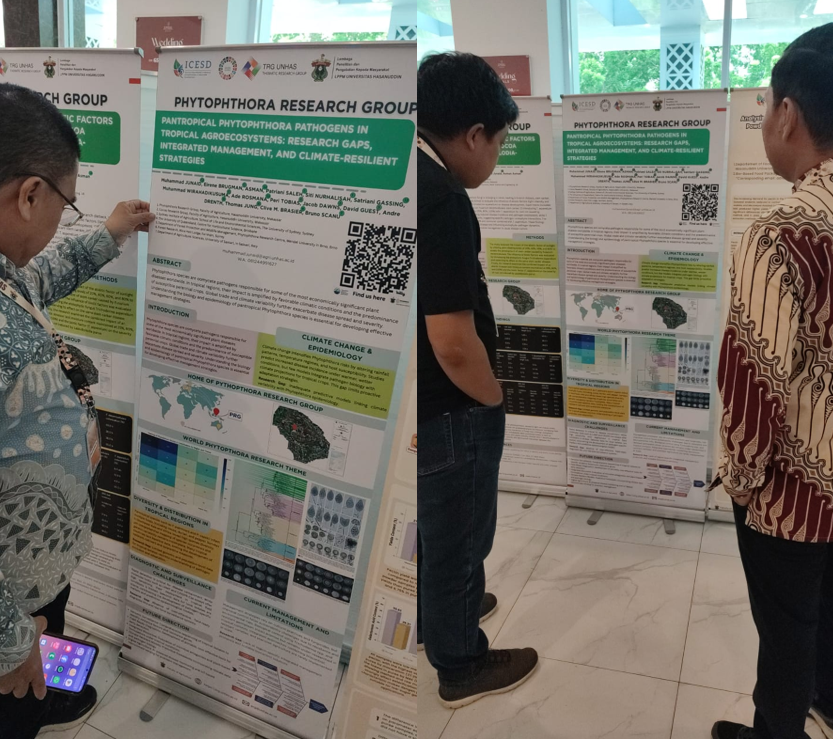
The Phytophthora Research Group played an active role in the International Conference on Environmental and Development Studies (ICEDS) 2025 by organizing a focused scientific session aimed at addressing critical challenges in plant pathology. Held at Unhas Hotel & Convention, this activity served as a strategic platform to highlight existing research gaps while fostering collaborative discussions on future directions in pathogen detection, monitoring, and control.
Conducted on 4–5 November 2025, the session brought together 16 participants from diverse academic backgrounds, including researchers, lecturers, an international collaborator, and a student representative. The presence of Prof. David Guest (Sydney Institute of Agriculture, School of Life and Environmental Sciences, The University of Sydney, Australia) as an international partner significantly enriched the discussion. Through his presentation and engagement, Prof. Guest shared global perspectives on Phytophthora research, including emerging challenges, advances in disease diagnostics, and opportunities for innovation in sustainable plant protection.
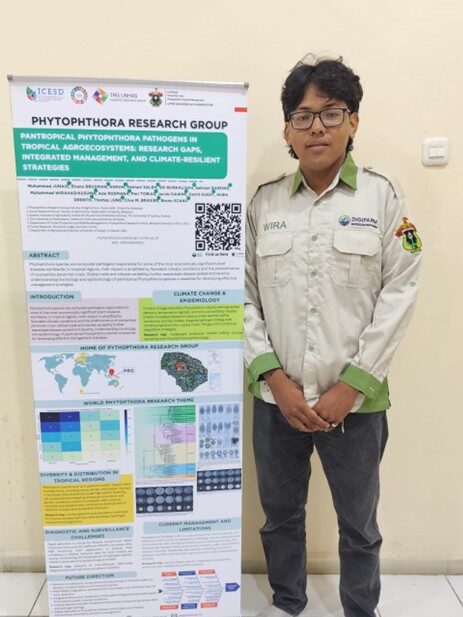
The session also highlighted the involvement of Muh Wirahadi Kusuma Azis, a student participant who contributed to the discussion by sharing insights on research design, data requirements, and potential applications of advanced technologies in plant disease detection. The inclusion of early-career researchers and students emphasized the importance of building future scientific capacity in the field of agricultural innovation.
The discussion focused on strengthening scientific understanding of Phytophthora pathogens, which are known to cause significant losses in various crops, particularly in tropical regions. Participants explored how modern technologies such as Artificial Intelligence (AI), Internet of Things (IoT), and genomics can be integrated into plant disease management systems. These technologies offer promising solutions for early detection, real-time monitoring, and precise control, ultimately improving the efficiency and sustainability of agricultural practices.
This activity aligns closely with several Sustainable Development Goals (SDGs). It contributes to SDG 1: No Poverty by addressing plant disease challenges that directly impact farmers’ productivity and income. By improving disease management strategies, the research supports efforts to reduce economic vulnerability among smallholder farmers.
Furthermore, the activity supports SDG 4: Quality Education through knowledge sharing, scientific discussion, and active participation of students and researchers. The collaborative environment fostered learning, critical thinking, and the exchange of interdisciplinary ideas, which are essential for advancing research and innovation.
In addition, the involvement of international and local stakeholders reflects a strong commitment to SDG 17: Partnerships for the Goals. The collaboration between the Phytophthora Research Group and international experts such as Prof. David Guest highlights the importance of global partnerships in addressing complex agricultural and environmental challenges.
Overall, this activity represents a meaningful contribution to advancing sustainable agriculture through science, innovation, and collaboration. By bridging research gaps and promoting the adoption of advanced technologies, the Phytophthora Research Group continues to support the development of resilient agricultural systems capable of responding to current and future plant disease challenges.


