

MAKASSAR, Indonesia, 28 February 2026/NNRG – Taking medication may seem like a simple part of treatment, but for people living with mental disorders, staying on medication can be a difficult and long-term challenge. Forgetting doses, losing motivation, experiencing side effects, or facing family and financial difficulties can all make treatment harder. In many cases, however, patients are not facing this journey alone. Family caregivers can play an important role in helping them continue treatment.
This issue is explored in the article “Factors associated with caregiver ability to support medication adherence among people with mental disorders: a multivariate cross-sectional study”, authored by Andriani, A., Yusuf, A., Fitryasari, R., Basrah, M. J., Arsyad, D. S., Hariati, S., Erfina, E., Nurmaulid, N., and Kadar, K. S. The study was published in Jurnal Ners, Volume 21, Issue 1, pages 76–86, in February 2026. The journal is published by the Faculty of Nursing, Universitas Airlangga, and the article is available as an open-access publication.
The researchers studied 155 family caregivers at seven community health centers in Makassar, Indonesia. Instead of looking only at patients, they examined a wider picture: family conditions, caregiver characteristics, patient factors, nurses, and healthcare services.
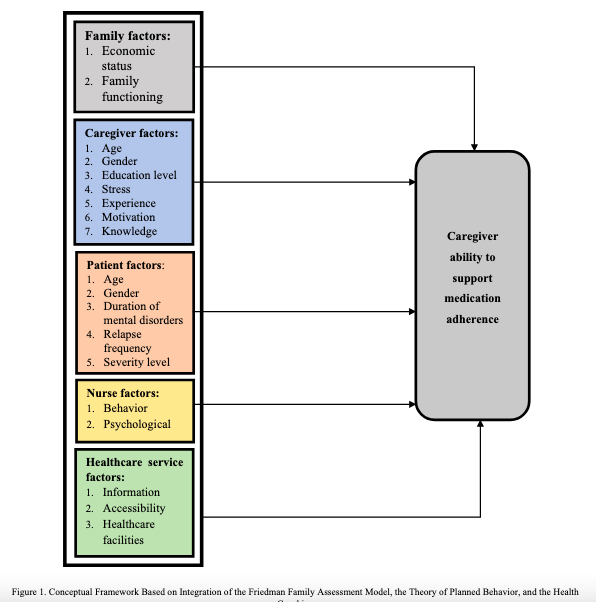
The findings reveal an important message: caregiving ability is influenced by more than willingness to help. Family economic status, family functioning, caregiver motivation, and caregiver knowledge were significantly associated with the ability to support medication adherence. This means that telling families to “just make sure the patient takes the medicine” may be far too simplistic.
A supportive family environment can make a meaningful difference. Caregivers who understand the illness and treatment process may be better prepared to remind patients about medication, encourage continued treatment, recognize challenges, and provide emotional support. At the same time, families may need support themselves, particularly when financial difficulties or problems within the family create additional pressure.
The study therefore offers a broader way of thinking about mental healthcare. Medication adherence should not be viewed solely as the patient’s responsibility. It can also become a shared responsibility involving patients, families, nurses, and healthcare services.
This message directly supports Sustainable Development Goal 3 (SDG 3): Good Health and Well-being, which promotes health and well-being for all. Improving mental healthcare requires not only access to treatment but also the knowledge, motivation, and supportive environment needed to make treatment sustainable.
Ultimately, behind every medication taken successfully, there may be someone who reminds, encourages, listens, and stays. Strengthening that person—the family caregiver—could be an important step toward better mental health outcomes.
Reference:
DOI: https://doi.org/10.20473/jn.v21i1.80610
Contact:
Suni Hariati
+6281387192990
sunihariati@unhas.ac.id