
MAKASSAR, Indonesia, 8 December 2025/NNRG – Tuberculosis (TB) is often described as a disease that can be treated with medication. But successful treatment involves more than simply taking pills. Patients need knowledge, motivation, support, and continuous guidance to complete treatment. This is where health education can make an important difference.
A recent study by Nasrawati Patta, Suni Hariati, and Kadek Ayu Erika, titled “Health Education Strategies for Tuberculosis Treatment Adherence: A Scoping Review,” explores how health education can help people stay committed to TB treatment. The article was published in the Liaquat National Journal of Primary Care, Volume 8, Issue 1, pages 95–102, under Liaquat National Hospital and Medical College. The article was published on 8 December 2025, with the article appearing in the 2026 journal issue.
The researchers conducted a scoping review of studies published between 2014 and 2024. They initially identified 1,213 studies and ultimately included 14 studies from different countries, including Indonesia, Ethiopia, Iran, Malaysia, South Africa, Nigeria, China, and others.
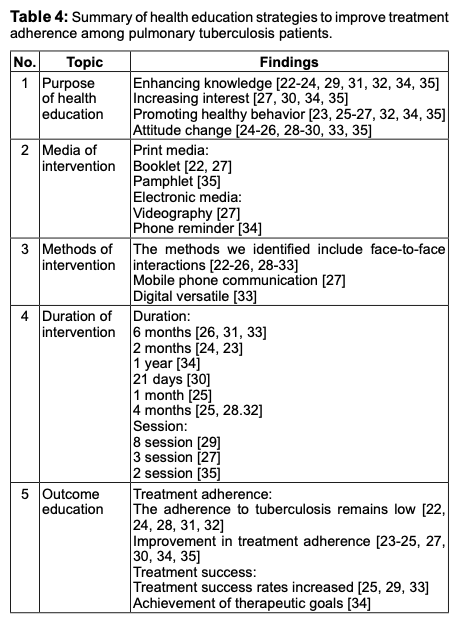
The review identified five important areas of health education: its purpose, communication media, educational methods, duration, and outcomes. Education was used not only to increase patients’ knowledge but also to encourage healthy behaviors, strengthen attitudes, and build interest in completing treatment.
The approaches were diverse. Some programs used traditional face-to-face education, while others used booklets, pamphlets, videos, telephone communication, and digital reminders. Some interventions lasted for several weeks, while others continued for up to a year. The findings generally showed that appropriate health education could improve treatment adherence and contribute to better treatment outcomes.
Importantly, the study highlights that education should not stop after a single consultation. TB treatment can be long and challenging, so patients may need continued encouragement and support. Families can also play an important role by helping patients remember medication schedules and providing emotional support.
Technology offers another promising opportunity. Telemedicine, mobile communication, and tele-nursing could help health professionals maintain contact with patients and provide information between healthcare visits.
These findings strongly support Sustainable Development Goal (SDG) 3: Good Health and Well-being, particularly the global effort to prevent and control infectious diseases. Improving treatment adherence is not only about helping individual patients recover; it also helps reduce transmission, prevent relapse, and limit the development of drug-resistant TB.
Ultimately, the message is simple: knowledge can become part of treatment. When patients understand their disease, receive appropriate guidance, and are supported throughout treatment, they are better equipped to complete the journey toward recovery.
Reference:
DOI: https://doi.org/10.37184/lnjpc.2707-3521.8.20
Contact:
Suni Hariati
+6281387192990
sunihariati@unhas.ac.id