

Makassar, Indonesia, September 08, 2026 /MHVP/ – Imagine sitting in a hospital chair, preparing for another chemotherapy session. The treatment may be necessary to fight cancer, but the experience can also bring fear, uncertainty, discomfort, and many questions. At such a moment, what does a patient need from a nurse?
The answer may be more than medical knowledge.
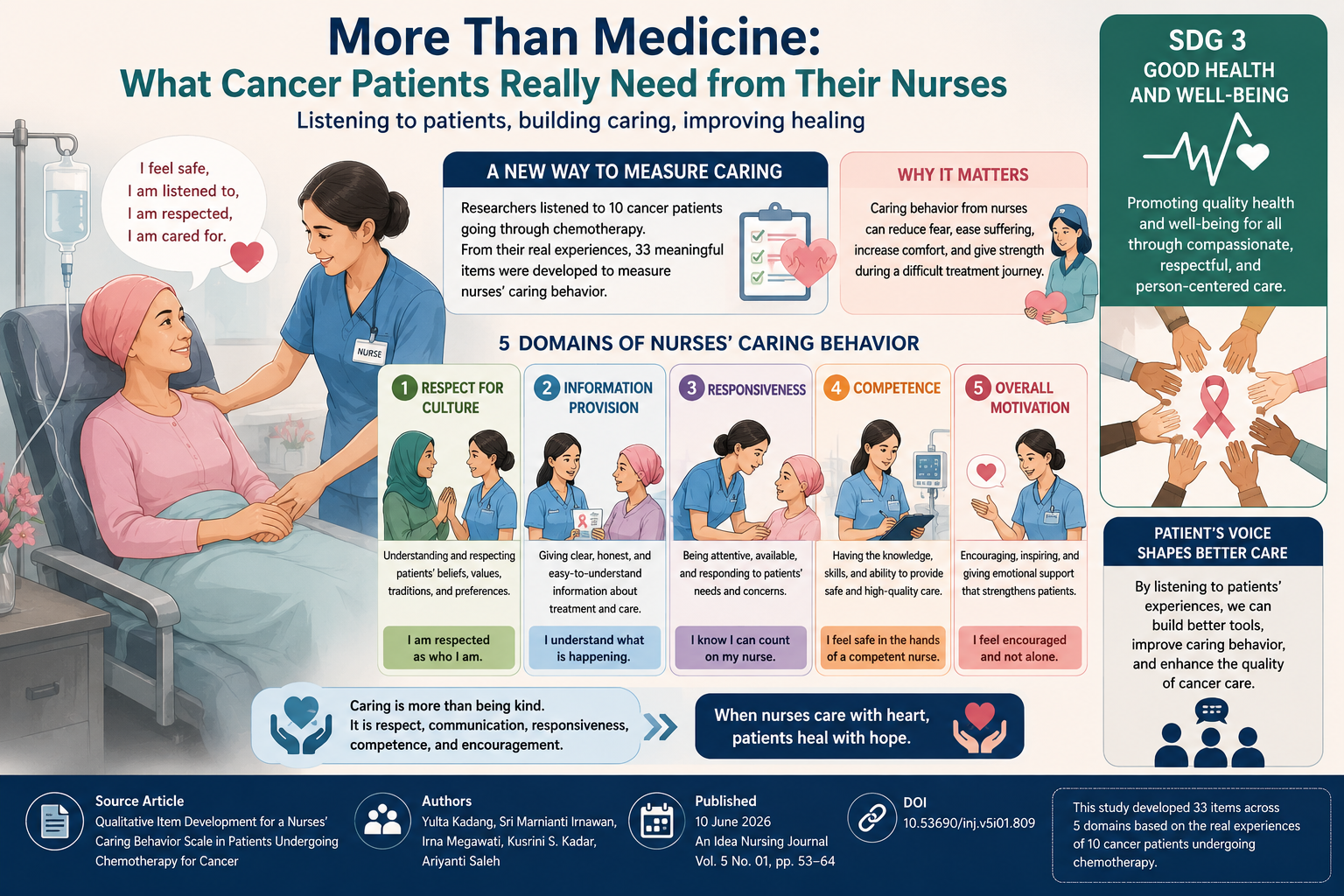
A recent study published in An Idea Nursing Journal explored an important part of cancer care: nurses’ caring behavior. Instead of simply asking what nurses should do clinically, the researchers listened directly to patients receiving chemotherapy and used their experiences to develop a new set of items for measuring caring behavior.
The researchers interviewed 10 patients undergoing chemotherapy using a phenomenological approach. Their interviews were analyzed through content analysis with NVivo 10. From patients’ experiences, the researchers developed 33 statement items grouped into five important domains.
The first was respect for culture. Every patient comes to healthcare with personal beliefs, values, traditions, and expectations. Respecting these differences can help patients feel understood rather than treated as simply another case.
The second was information provision. Cancer treatment can be frightening, especially when patients do not understand what is happening. Clear and understandable information can reduce uncertainty and help patients participate more confidently in their care.
The third domain was responsiveness. Patients need nurses who listen, notice their concerns, and respond when help is needed. Sometimes, caring may begin with something as simple as paying attention.
The fourth was competence. Caring is not separated from professional skill. Patients need nurses who are knowledgeable, capable, and able to provide safe and appropriate care during a challenging treatment journey.
The fifth domain was overall motivation. Encouragement can become an important source of strength when patients are facing repeated chemotherapy sessions and difficult moments.
Together, these five domains show that caring is not simply about being kind. It is a combination of human connection, communication, responsiveness, professional competence, cultural respect, and encouragement.
This research directly supports Sustainable Development Goal 3 (SDG 3): Good Health and Well-being. Good health is not only about treating disease. It also means ensuring that people receive compassionate, respectful, safe, and person-centered care throughout their health journey.
The study is also an important reminder that patients can help define what quality nursing care should look like. By listening to patients’ experiences, researchers can develop tools that allow healthcare organizations to better understand and evaluate caring behavior.
For a person undergoing chemotherapy, a nurse’s presence can mean more than medication or procedures. A clear explanation can reduce fear. A respectful conversation can preserve dignity. A responsive nurse can create a sense of safety. And a few words of encouragement can help a patient continue.
Cancer treatment may target the disease, but caring helps healthcare reach the person behind the diagnosis.
Reference: doi: 10.1136/bmjopen-2025-109727
Contact:
ariyantisaleh@unhas.ac.id
+62 812-4138-7181
https://trg.unhas.ac.id/vnrg/


