
Roadmap
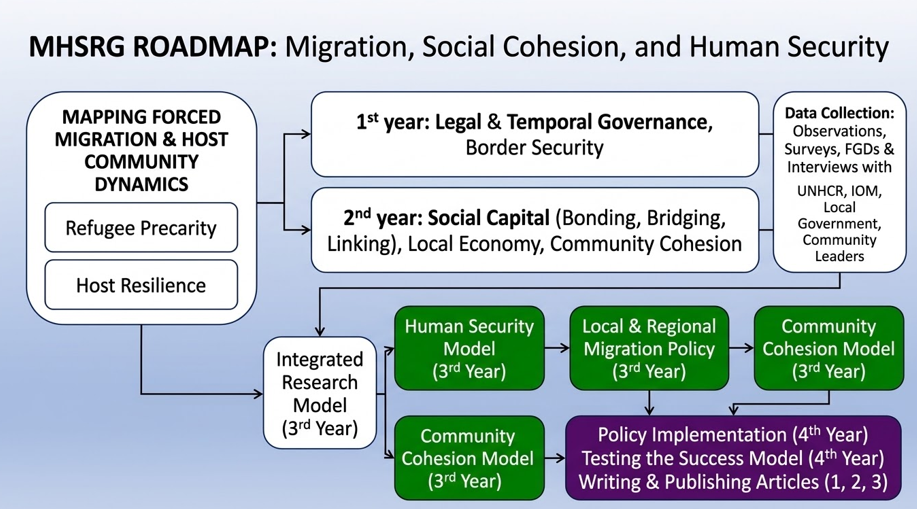
Research Sub-Theme
1. Forced Migration, Temporal Governance, and Legal Precarity
This research theme examines the systemic challenges faced by refugees and asylum seekers living in prolonged transit and “permanent temporariness” within non-signatory states. It explores legal frameworks, policy responses (such as Presidential Regulation No. 125/2016), border management, and the temporal uncertainties of displacement to support evidence-based protection policies and international humanitarian standards.
2. Human Security and Vulnerability in Transit Communities
This theme focuses on the multidimensional security of displaced populations and host communities, spanning economic security, personal safety, health, food security, and community well-being. It analyzes how prolonged waiting, restricted access to formal employment and education, and structural inequalities impact daily lives, mental resilience, and social welfare.
3. Social Cohesion, Social Capital, and Community Resilience
This theme explores the evolving dynamics between refugees and host communities over extended periods. It investigates how social capital, bonding, bridging, and linking, transforms alongside shifts in moral hospitality, local perceptions, and mutual coexistence. The objective is to identify pathways for mitigating “refugee fatigue” and fostering sustainable social harmony in host urban environments.
4. Multi-Stakeholder Governance, Regional Cooperation, and Human Rights
This theme investigates collaborative governance and multi-stakeholder partnerships involving national/local governments, international organizations (such as UNHCR and IOM), civil society organizations, and academic networks. It aims to strengthen human rights protections, align regional migration policies in Southeast Asia, and advance sustainable development goals (SDGs 10, 11, and 16).