

MAKASSAR, Indonesia Apr 24 2026/MALRESVEK/ – As night falls in many parts of Papua, Indonesia, families prepare to rest. Some gather outside, chatting with neighbors or enjoying the cool evening air. Others stay indoors, believing they are safe from mosquito bites. For years, the message has been clear: sleep under a bed net, and you are protected.
But what if that protection is not enough?
A recent study titled “Rapid entomological assessment in eight high malaria endemic regencies in Papua Province revealed the presence of indoor and outdoor malaria transmissions”, published in Scientific Reports by Nature Research on June 25, 2024, challenges this assumption. The research reveals that malaria transmission is happening not only inside homes—but also outside.
This finding changes how we think about risk.
Traditionally, malaria prevention has focused on indoor protection, especially through insecticide-treated bed nets. These tools are still very important and have saved many lives. However, the study shows that mosquitoes are not limited to indoor spaces. Some species bite outdoors, often when people are still active and not protected.
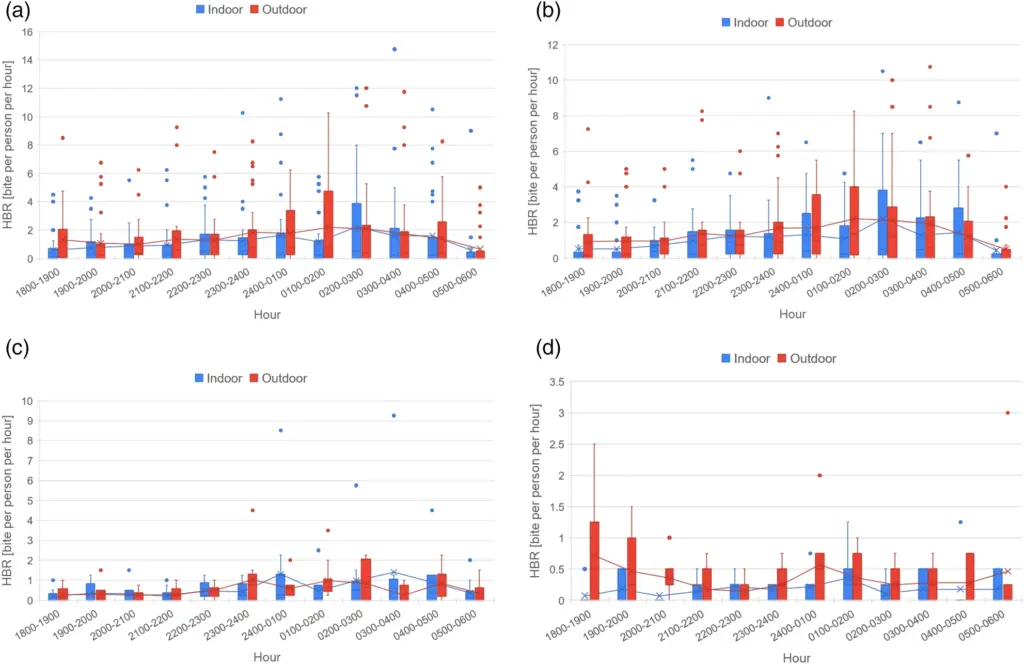
The chart below shows when mosquitoes bite people during the night. In general, Anopheles mosquitoes start biting from early evening (around 6 PM) and continue all night, with the highest number of bites happening after midnight (around 1–2 AM) (a); biting happens both indoors and outdoors at similar levels. Spesifically, An. koliensis (b) and An. punctulatus (c), both species mostly bite later at night, similar to the overall pattern. Meanwhile, An. farauti (d), which is different—it bites earlier in the evening (around 6–7 PM) and continues steadily through the night.
Imagine spending an evening outside your home—talking, cooking, or simply relaxing. These everyday activities may seem harmless, but they can quietly increase exposure to mosquito bites. Even those who use bed nets every night may still be at risk if they are bitten before going to sleep or after waking up.
For people unfamiliar with malaria, this might sound surprising. But for communities living in high-risk areas, it explains why the disease continues to spread despite ongoing prevention efforts.
Malaria is more than just a health issue. It affects people’s ability to work, children’s ability to attend school, and families’ overall well-being. That is why this issue is closely linked to Sustainable Development Goal (SDG) 3: Good Health and Well-being, which aims to reduce disease and improve health for all.
The study highlights an important lesson: solutions must match real life. If people are exposed to mosquitoes both indoors and outdoors, then protection strategies must also cover both environments. This could include raising awareness of outdoor risks, promoting the use of repellents, and developing new tools for outdoor protection.
It also shows the importance of continuous research and collaboration—bringing together scientists, health workers, and communities to better understand how malaria spreads and how it can be stopped.
In the end, the fight against malaria is not just about having the right tools, but about using them in the right way. Because protection should not begin only when we go to bed—it should start the moment the risk begins.
Reference
Rozi, I.E., Permana, D.H., Syahrani, L. et al. Rapid entomological assessment in eight high malaria endemic regencies in Papua Province revealed the presence of indoor and outdoor malaria transmissions. Sci Rep 14, 14603 (2024). DOI: 10.1371/journal.pone.0311076
Contact: Prof. dr. Din Syafruddin, Ph.D
+62 811-9898-766
dinkarim@yahoo.com; syafruddin@unhas.ac.id


