


MAKASSAR, Indonesia Apr 24 2026/MALRESVEK/ – Malaria control depends heavily on insecticides, especially those used in bed nets and indoor spraying. However, new research shows that mosquitoes are beginning to develop resistance, raising concerns about the long-term effectiveness of these interventions.
A recent study titled “Uncovering pyrethroid resistance mechanisms in Anopheles punctulatus group mosquitoes: A novel insight from Keerom, Papua, Indonesia,” published in the International Journal of One Health by VetWorld on May 4, 2025, highlights an emerging challenge in malaria-endemic regions. The study focuses on the Anopheles punctulatus group, a key malaria vector in eastern Indonesia, particularly in Papua.
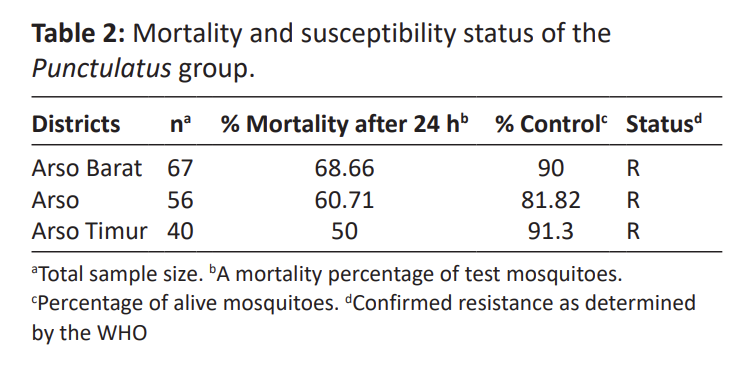
The findings reveal that these mosquitoes are becoming less susceptible to pyrethroids, a class of insecticides widely used in malaria prevention tools such as insecticide-treated bed nets. In simple terms, the mosquitoes are adapting to survive exposure to chemicals that once effectively killed them. The table below shows that only about half to two-thirds died (50–69%), meaning the mosquitoes have become resistant in the study areas.
This resistance occurs through several biological mechanisms. The study identified genetic changes in the mosquitoes as well as increased activity of detoxification enzymes, which allow them to break down insecticides before the chemicals can act. As a result, the effectiveness of commonly used malaria control tools may decline over time.
For communities in areas like Keerom, where malaria transmission remains high, this development is particularly important. Reduced effectiveness of insecticides could lead to increased mosquito survival and, ultimately, higher malaria transmission if no additional strategies are implemented.
Despite these concerns, the study provides valuable insights for future action. Understanding how resistance develops allows researchers and policymakers to design more effective control strategies. These may include using different types of insecticides, combining multiple interventions, or developing new technologies to overcome resistance.
This research contributes directly to SDG 3: Good Health and Well-being by addressing challenges in malaria prevention. It also supports SDG 4: Quality Education, through the advancement and dissemination of scientific knowledge, and SDG 17: Partnerships for the Goals, by strengthening collaboration among research institutions.
The message is straightforward: as mosquitoes evolve, malaria control strategies must also evolve. Continuous research and innovation are essential to ensure that existing tools remain effective and that new solutions can be developed to protect vulnerable populations.
Reference
DOI: 10.14202/IJOH.2025.139-146
Contact: Prof. dr. Din Syafruddin, Ph.D
+62 811-9898-766
dinkarim@yahoo.com; syafruddin@unhas.ac.id


