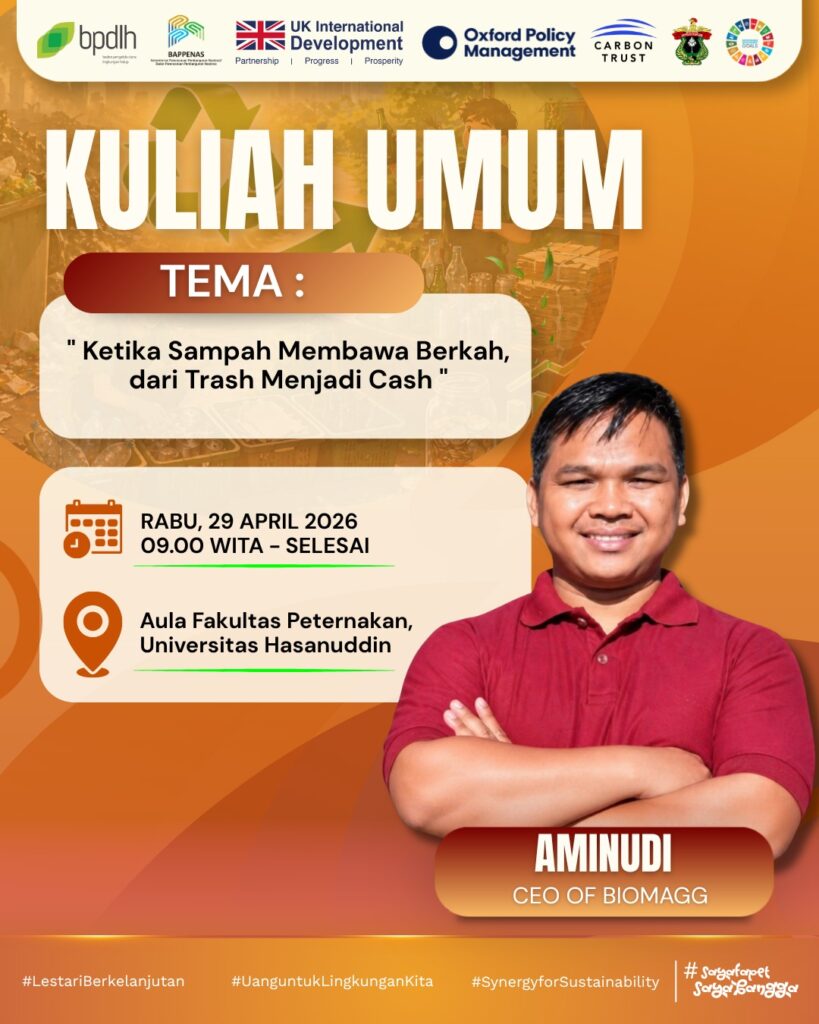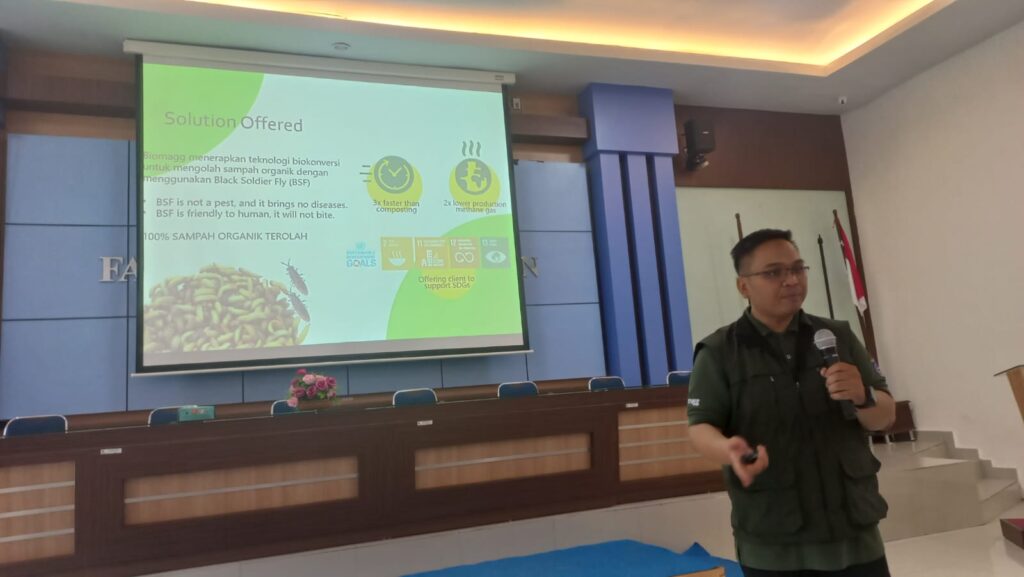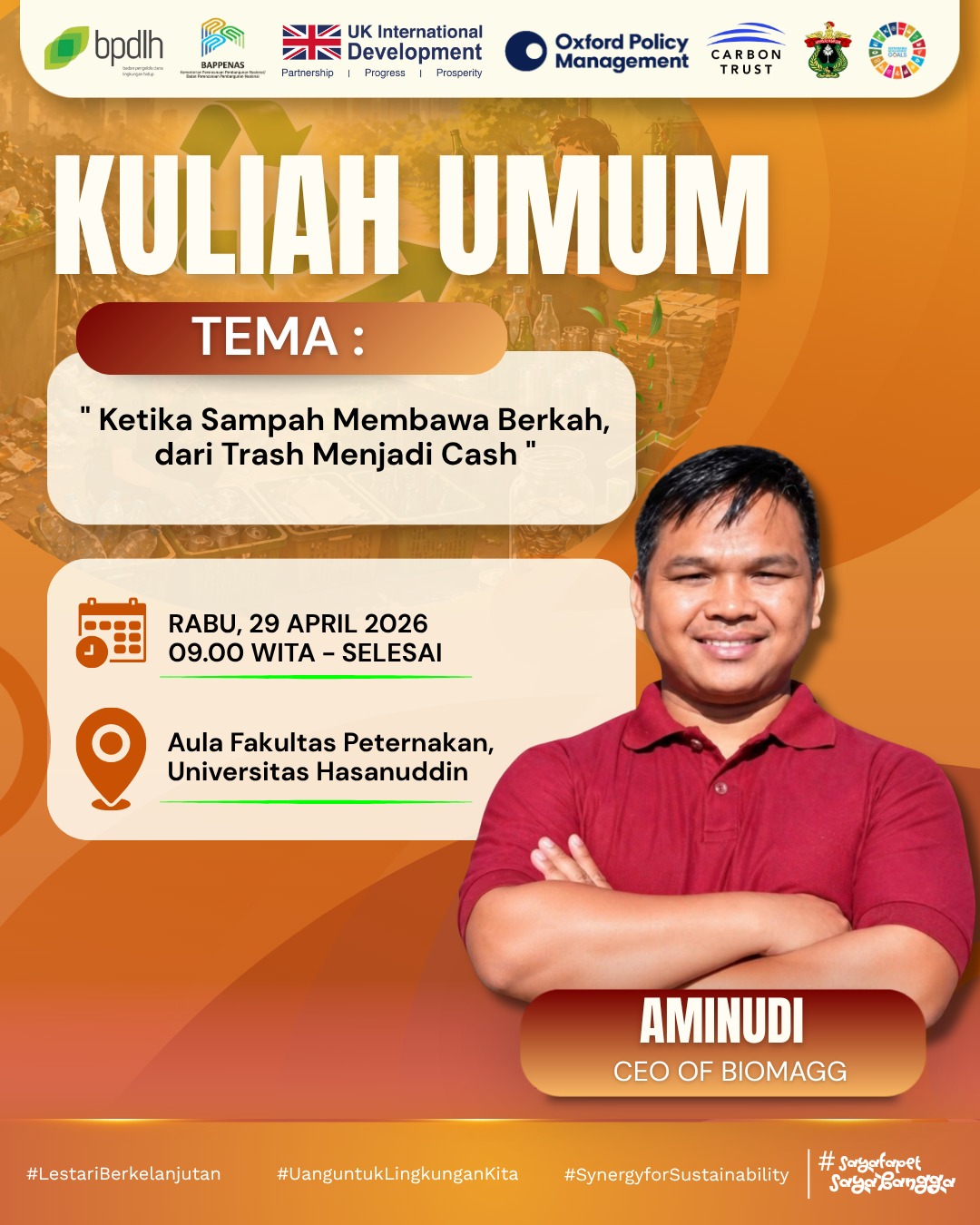

Makassar-Research Group of Local Livestock Genetik Resources (LLGR)-On 29 April 2026, the Faculty of Animal Science, Hasanuddin University (UNHAS) , in collaboration with the LCDI-ITF Program, hosted a Public Lecture and Sharing Session titled “When Waste Brings Blessings: From Trash to Cash.” The event was held in the Auditorium Hall of the Faculty of Animal Science, UNHAS, and featured Mr. Aminudi, CEO of Biomagg, as the keynote speaker. The objective was to educate students and academics on innovative waste management through Black Soldier Fly (BSF) maggot bioconversion technology.
The session was attended by 100 participants, consisting of undergraduate and postgraduate students, lecturers, researchers, and environmental enthusiasts. Mr. Aminudi shared his entrepreneurial journey in transforming organic waste—such as kitchen leftovers, agricultural residues, and market waste—into high-value products using BSF maggots. He explained that maggots can reduce waste volume by up to 70% within 12 days, while simultaneously producing protein-rich larval biomass for animal feed and organic frass fertilizer for crops. This circular economy model not only solves waste problems but also creates new income streams for communities.
The public lecture aligns strongly with several Sustainable Development Goals (SDGs) . SDG 1 (No Poverty) is directly addressed because waste bioconversion provides low-cost, accessible economic opportunities for farmers and small entrepreneurs. By turning trash into valuable products like maggot meal and fertilizer, communities can generate additional income, lifting households out of poverty. SDG 4 (Quality Education) is achieved through the transfer of practical, applied knowledge on bioconversion technology to students and faculty. This hands-on learning equips the next generation with innovative skills in sustainable agriculture and waste management. SDG 17 (Partnerships for the Goals) is strongly embodied by the collaboration between UNHAS Faculty of Animal Science and the LCDI-ITF Program in bringing an industry leader like Mr. Aminudi (CEO of Biomagg) to share real-world expertise. Such multi-stakeholder partnerships—between academia, industry, and development programs—are essential for scaling up sustainable solutions.
Furthermore, the topic aligns with SDG 15 (Life on Land) by promoting responsible waste management and reducing environmental pollution from organic waste, which often ends up in landfills or open dumps. Bioconversion also reduces greenhouse gas emissions associated with waste decomposition.
During the interactive sharing session, participants asked questions about BSF farming scalability, initial investment costs, and market linkages for maggot products. Mr. Aminudi emphasized that even small-scale household units can be profitable, making this technology inclusive and accessible. The Faculty of Animal Science plans to follow up with hands-on workshops and pilot projects to implement BSF bioconversion in local farming communities.
This public lecture successfully demonstrated that waste is not an endpoint but a beginning—an opportunity to create economic value, protect the environment, and build a more sustainable future for Indonesia.