
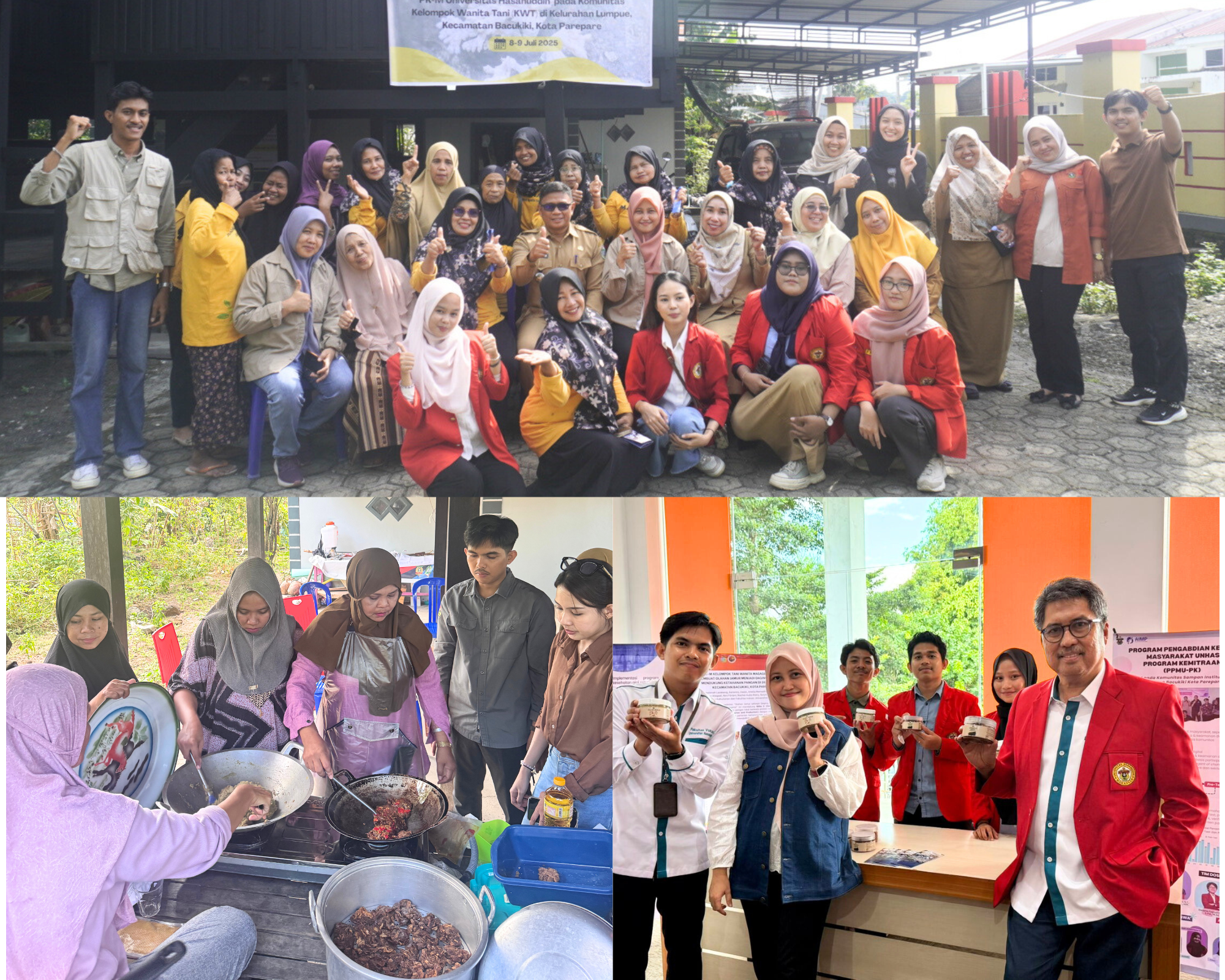

Parepare, South Sulawesi – The Hasanuddin University (Unhas) Karst Microbe Research Collaboration Center conducted a series of mushroom processing training activities for the Masagena Women Farmers Group (Kelompok Wanita Tani/KWT) in Lumpue Village, Parepare, on October 11–12, 2025. Attended by 50 participants, the program aimed to strengthen food security and support women’s economic empowerment through the development of innovative mushroom-based products. This initiative also represents the implementation of the three pillars of higher education, particularly community service and the dissemination of scientific knowledge to society.
The program began with field observations to identify local potential and the specific needs of the Masagena KWT members. This stage became an important basis for preparing training materials that were relevant and applicable to the community’s conditions. By understanding the local context, the service team was able to design activities that could provide practical and sustainable benefits for the participants.
The activities continued with a socialization session officially opened by the Head of the Community Service Team, Prof. Dr. Ir. Siti Halimah Larekeng, S.P., M.P. In her remarks, she emphasized the importance of universities contributing directly to community development through education and innovation.
“Our presence is a tangible form of service to share knowledge and skills, transforming local mushrooms into high-value products,” she stated. Support for the program was also expressed by the Village Head of Lumpue, H. Nur Akbar, S.E., who highlighted the significant opportunities for developing mushroom-based businesses in the region.
The main agenda of the program was practical training in processing edible mushrooms into marketable food products. Participants first received theoretical material from Dr. Asrianny, S.Hut., M.Si., who introduced the diversity and nutritional benefits of edible mushrooms. The practical session was then guided by Irwan, T.P.P., M.T.P. from the Vocational Faculty of Unhas, who demonstrated how to produce shiitake mushroom jerky and oyster mushroom broth paste. The participants enthusiastically joined the cooking demonstrations and learned directly how simple raw materials could be transformed into products with higher economic value. One participant stated, “We were taught from scratch, so we are confident to start our own business.”
To strengthen the sustainability of the business opportunities created through the training, participants also received material on digital marketing management presented by Ariella Ramadhani Putri, S.P., M.Si. The session introduced strategies for utilizing social media and e-commerce platforms to reach wider markets and build home-based business brands. The involvement of Unhas students during the mentoring process also contributed to effective knowledge transfer and interactive learning.
This activity strongly supports several Sustainable Development Goals (SDGs), especially SDG 1: No Poverty, SDG 4: Quality Education, and SDG 17: Partnerships for the Goals. Through collaboration between universities, local communities, and village authorities, the program demonstrates how scientific innovation and community empowerment can contribute to sustainable development and improve local economic resilience.
