
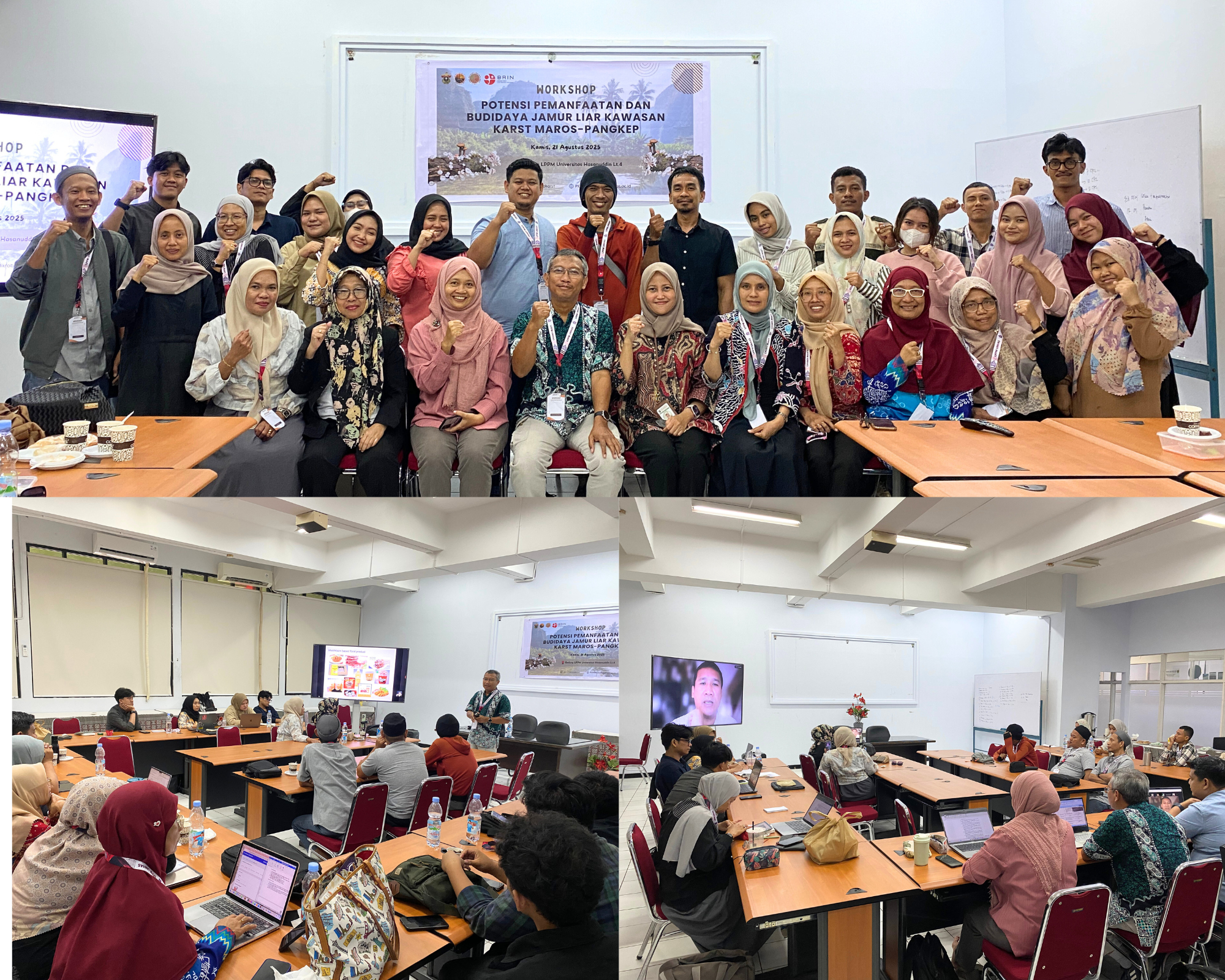

Makassar, August 21, 2025 – The Center for Microbial Karst Research (Pusat Kajian Riset Mikrobakarst – PKRM) at Hasanuddin University has successfully organized a workshop entitled “Potential Utilization and Cultivation of Wild Mushrooms in the Maros-Pangkep Karst Region.” The hybrid event, which took place on Thursday, August 21, 2025, aimed to enhance public knowledge and skills in identifying and cultivating wild mushrooms as a food source with the potential to improve the local economy and food security.
The event, held on the 3rd Floor of the LPPM Building at Hasanuddin University, was attended in person (offline) by 30 participants. These included representatives from mushroom cultivation groups from Parepare City, Maros Regency, and Makassar City, along with several lecturers, researchers, and postgraduate students. Furthermore, public enthusiasm was evident from the participation of 50 attendees who joined the proceedings online via the Zoom Meeting application.
The workshop was divided into three main sessions featuring competent speakers in their fields:
Session 1: Ethnomycology of Wild Edible Fungi
Presented online by Prof. Dr. Wawan Sujarwo, S.Hut., M.Sc from the Center for Ecology Research at the National Research and Innovation Agency (BRIN). In this session, Prof. Wawan introduced the concept of ethnomycology and elaborated on the local wisdom of communities in utilizing wild mushrooms growing in the Maros-Pangkep Karst Region as a food source.
Session 2: Introduction to Potential Wild edible fungi and Cultivation Techniques
Guided offline by Dr. Iwan Saskiawan, M.Sc from the Center for Applied Microbiology Research at BRIN. This final session contained technical presentations and practical guidance on methods for developing wild mushroom cultivation. Dr. Iwan shared knowledge on techniques for spawning, growing media, and maintenance to optimize the yield of mushrooms from the karst region, which is expected to contribute to food security.
The activity received a highly positive response from the participants. Representatives from the farming groups stated that the training was very practical and opened new insights into the untapped potential within their regions.
“This activity is a strategic step to transfer knowledge from researchers directly to the community and business actors. It is hoped that in the future, sustainable synergy can be formed between academics, researchers, and the community to develop wild mushroom cultivation as a leading commodity,” said a member of the organizing committee.
With the closing of this workshop, it is expected that participants can implement the knowledge gained and become pioneers in developing wild mushroom cultivation in their respective regions, while also preserving the karst ecosystem.
