
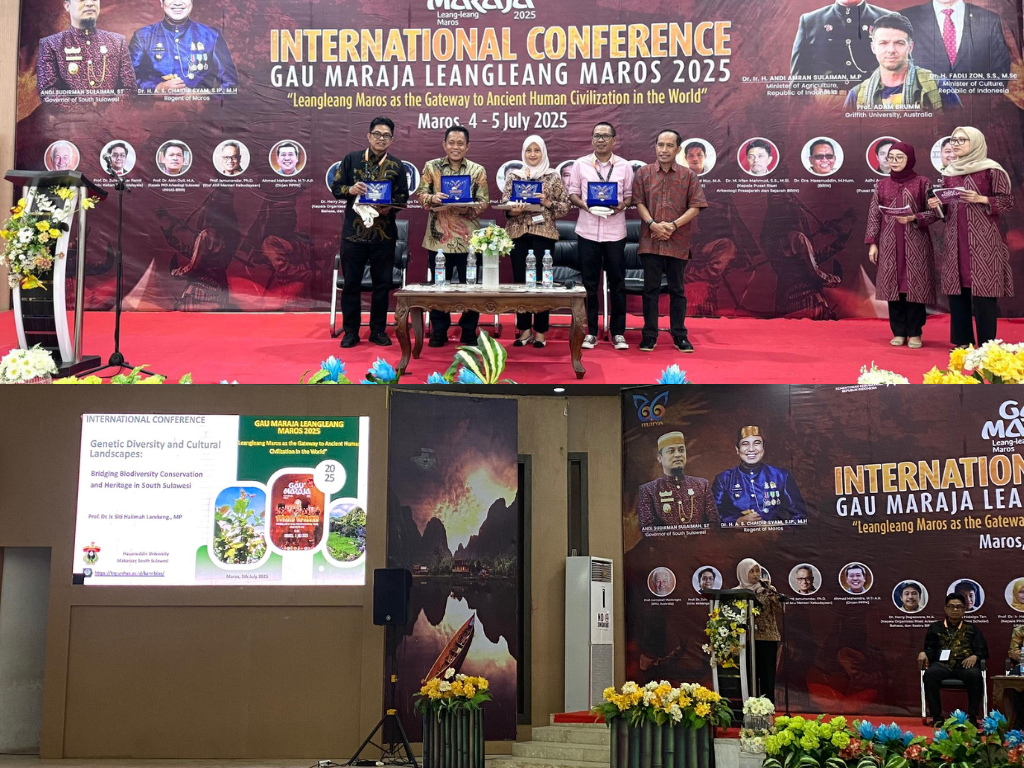

Maros Regency successfully hosted the 2025 Gau Maraja Leangleang Maros International Conference with the theme “Leangleang Maros as the Gateway to the Ancient Civilization of the World.” The event, held on July 4-5, 2025, at the Maros Regional Government Multi-Purpose Building, brought together national and international experts to discuss the biodiversity and cultural heritage of South Sulawesi. One of the keynote speakers at the conference was Prof. Dr. Ir. Siti Halimah Larekeng, M.P., as the Head of the Microbial Karst Research Center (PKR) and Thematic Research Group at Hasanuddin University. In her session titled “Genetic Diversity and Cultural Landscapes: Bridging Biodiversity Conservation and Heritage,” Prof. Halimah presented several important findings, including the use of endemic microbes such as Penicillium citrinum as a disease control agent for dieback in Red Jabon trees, which has the potential to be developed into an environmentally friendly biofungicide. Additionally, she presented the results of chloroplast genome research on Sulawesi Blackwood (Diospyros celebica), the first data supporting conservation efforts for this endangered endemic species.
Prof. Halimah emphasized the importance of integrating modern science with local wisdom in conservation efforts. She highlighted the role of the Toraja and Bugis-Makassar communities in preserving karst biodiversity through agroforestry practices and traditional systems, as seen in the management of the Tongkonan Park. The conference also served as a platform to promote locally-based innovations, including participatory plant breeding programs and the development of nanoparticles from fungi through collaboration with Universiti Putra Malaysia. As a conclusion, Prof. Halimah provided several recommendations, including strengthening conservation policies that involve traditional systems, promoting community-based ecological education, and developing karst microbial bioprospecting to support sustainable economics.
The event, inaugurated by the Regent of Maros, was attended by academics, researchers, and representatives of indigenous communities, reaffirming their shared commitment to preserving the natural and cultural wealth of South Sulawesi. With the conclusion of this conference, it is hoped that Maros will increasingly be recognized as a center of ancient heritage and a natural laboratory for global biodiversity.
