
Description
TWIST 2025Colorectal cancer is no longer a disease affecting only older adults. Across many countries, including Indonesia, the number of cases in younger populations is steadily increasing. This growing trend highlights the urgent need for better cancer detection, treatment, and public awareness. One promising breakthrough comes from recent molecular research exploring how cancer cells “communicate” with the body’s immune system.
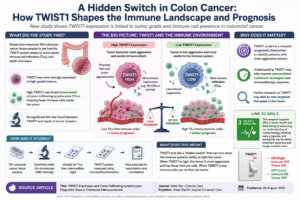
A scientific article titled “TWIST1 Expression and Tumor Infiltrating Lymphocytes: Prognostic Value in Colorectal Adenocarcinoma” published in the Asian Pac J Cancer Care by the Asian Pacific Journal of Cancer Care on 28 August 2025 provides important insight into this issue. The study investigated the relationship between TWIST1, a cancer-related protein, and tumor infiltrating lymphocytes (TILs), which are immune cells that attempt to fight cancer inside tumor tissue.
The researchers analyzed 100 colorectal adenocarcinoma tissue samples from Indonesian patients using immunohistochemical methods. Their findings revealed that strong TWIST1 expression was frequently associated with more aggressive and poorly differentiated tumors. At the same time, tumors with high TWIST1 levels tended to show lower numbers of immune cells infiltrating the cancer tissue.
In simple terms, TWIST1 may help cancer “hide” from the immune system.
This discovery is important because the immune system plays a critical role in controlling cancer growth. Normally, TILs act like the body’s defense soldiers, attacking abnormal cells before they spread. However, when TWIST1 activity becomes too strong, cancer cells may gain the ability to escape immune surveillance, become more invasive, and potentially resist treatment.
The study also explains that TWIST1 is closely related to a biological process called epithelial-mesenchymal transition (EMT). During EMT, cancer cells lose their normal structure and become more mobile, allowing them to invade nearby tissues and spread to distant organs. Scientists believe that TWIST1 functions as one of the “master switches” driving this dangerous transformation.
Beyond its scientific value, this research strongly supports the achievement of the United Nations Sustainable Development Goal (SDG) 3: Good Health and Well-Being. SDG 3 emphasizes reducing premature deaths from non-communicable diseases, including cancer, through improved prevention, early diagnosis, and innovative treatment strategies.
Research such as this can contribute to future precision medicine approaches, where patients receive therapies tailored to the molecular characteristics of their tumors. If biomarkers like TWIST1 can predict tumor aggressiveness or immune response, doctors may one day identify high-risk patients earlier and select more effective personalized treatments.
Equally important, this publication demonstrates the growing contribution of Indonesian researchers to global cancer science. By combining pathology, immunology, and molecular biology, the study opens new opportunities for international collaboration and future therapeutic development.
Although TWIST1 is still being investigated, the message for the public is already clear: understanding cancer at the molecular level is essential for saving lives. Scientific discoveries are no longer confined to laboratories—they are becoming powerful tools in building healthier communities and improving the future of cancer care worldwide.
Description
Cancer is often described as a silent enemy, and colorectal cancer is one of its most dangerous forms. Around the world, millions of people are diagnosed each year, and many patients only discover the disease after it has already spread. This challenge highlights the importance of Sustainable Development Goal (SDG) 3: Good Health and Well-Being, which aims to reduce premature deaths from non-communicable diseases through better prevention, early detection, and innovative healthcare solutions.
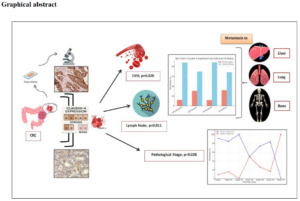
A recent scientific study offers new hope. The research article, "Claudin-4 Expression as a Prognostic Biomarker in Colorectal Adenocarcinoma: Correlation with Lymphovascular Invasion, Lymph Node Metastasis, and Pathological Stage," was published in the journal Trends in Sciences, published by Trends in Sciences, on 23 May 2025. The study explored whether a small protein called Claudin-4 could help doctors predict how aggressive colorectal cancer might become.
But what exactly is Claudin-4?
Think of the human body as a city built from billions of cells. Claudin-4 acts like part of the "cement" that keeps neighboring cells tightly connected. When these connections become weaker or abnormal, cancer cells may find it easier to escape, invade nearby tissues, and spread to other organs.
The researchers examined tissue samples from colorectal cancer patients using laboratory techniques that allowed them to measure Claudin-4 levels. Their findings revealed an interesting pattern. Tumors with stronger Claudin-4 expression were less likely to show lymphovascular invasion, lymph node metastasis, and advanced pathological stages. In simple terms, maintaining higher Claudin-4 levels may be linked to a lower risk of cancer spreading through the body's transport systems.
This discovery matters because doctors currently rely on several clinical and pathological factors to estimate a patient's prognosis. Unfortunately, these methods cannot always predict which tumors will behave aggressively. A biomarker such as Claudin-4 could become an additional tool to help identify high-risk patients earlier and support more personalized treatment decisions.
The impact could extend beyond hospitals. Earlier and more accurate risk assessment may reduce unnecessary treatments for some patients while ensuring that those with aggressive disease receive timely care. Better prediction also means better planning for healthcare systems, potentially lowering treatment costs and improving survival rates.
Importantly, the study also highlights the growing contribution of Indonesian researchers to global cancer science. By studying local patient populations, scientists can generate evidence that reflects regional health challenges while contributing to worldwide medical knowledge.
Although Claudin-4 is not yet a routine clinical test and further studies are needed before widespread use, the findings represent an important step toward precision medicine. They remind us that even the smallest molecules can provide valuable clues about life-threatening diseases.
Supporting research like this aligns directly with SDG 3: Good Health and Well-Being. Scientific innovation, early diagnosis, and accessible healthcare are essential for reducing the burden of colorectal cancer. Sometimes, the key to saving lives is not a new drug or a complex machine, but a tiny protein that helps doctors see the future of a disease before it is too late.
Description
Our research group focuses on the identification of molecular biomarkers in colorectal cancer (CRC) to enhance early detection, prognosis, and personalized treatment strategies.
By integrating multi-omics approaches, including genomics, transcriptomics, proteomics, and metabolomics, we aim to uncover key molecular signatures associated with tumor progression, metastasis, and therapeutic resistance.
We employ advanced bioinformatics and experimental validation to identify novel biomarkers that can serve as diagnostic, prognostic, or predictive indicators. Our ultimate goal is to bridge the gap between basic research and clinical application, contributing to precision medicine and improving patient outcomes in CRC.
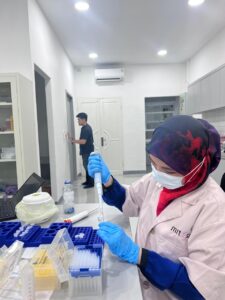
Description
Based on our previous research published in Scientific report entitled \" Genetic Risk factors for Colorectal Cancer in Multiethnic Indonesians\" https://www.nature.com/articles/s41598-021-88805-4
We want to explore more about both genetic and non genetic factors related Colorectal cancer. Our previous study investigated both genetic and non‐genetic risk factors for colorectal cancer in a diverse, multiethnic Indonesian population. We collected detailed lifestyle and demographic information via questionnaires from 162 colorectal cancer cases and 193 frequency‐matched healthy controls, alongside blood samples for genomic analysis. After quality control, genome-wide association analysis on 84 cases and 89 controls confirmed known risk variants on chromosomes 6 (rs9497673, rs6936461, rs7758229), 10 (rs11255841), and 15 (rs4779584, rs11632715, rs73376930). In addition, a Bayesian polygenic risk model identified 10 single nucleotide polymorphisms that appear to be associated with colorectal cancer risk. These findings implicate genes including SLC22A3, SCG5, GREM1, and STXBP5-AS1 and highlight the combined influence of genetic predisposition and non-genetic (environmental and lifestyle) factors on colorectal cancer risk in Indonesians, paving the way for future research and personalized screening strategies.
With further biobanking and international research collaborations, variants specific to colorectal cancer risk in Indonesians will be identified.