-
 When Corn Looks Fine, Is It Really Safe? A Simple Warning System for Hidden Aflatoxin RiskResearch Project
MAKASSAR, Indonesia, 20 July 2026/FeedTechRG/-Corn is one of the most important ingredients in poultry feed, but its appearance can reveal a hidden problem. Behind a few broken or moldy kernels may be a hidden problem: aflatoxin, a toxic substance produced by certain molds, especially Aspergillus. Aflatoxin can reduce animal performance, weaken immunity, increase disease susceptibility, and create food-safety concerns when contaminated feed enters the production chain.
A recent study offers a practical way to spot this risk earlier. Researchers explored whether ordinary physical checks of corn could provide an early warning.
The study examined 390 corn samples collected from vehicles arriving at a feed factory. After data screening, 384 samples were used to build the prediction model. Researchers looked at several familiar quality indicators: moisture content, damaged kernels, broken kernels, moldy kernels, and foreign materials. Aflatoxin risk was grouped into three levels—low, medium, and high—and an ordinal logistic regression model was developed to estimate the risk.
The results point to three particularly useful warning signs: moisture content, broken kernels, and moldy kernels. Among them, moldy kernels showed the strongest statistical association with higher aflatoxin risk. Broken kernels also increased the likelihood of a higher risk category. Damaged kernels and foreign materials remained useful indicators of general corn quality, but they did not make a significant contribution to the final aflatoxin prediction model.
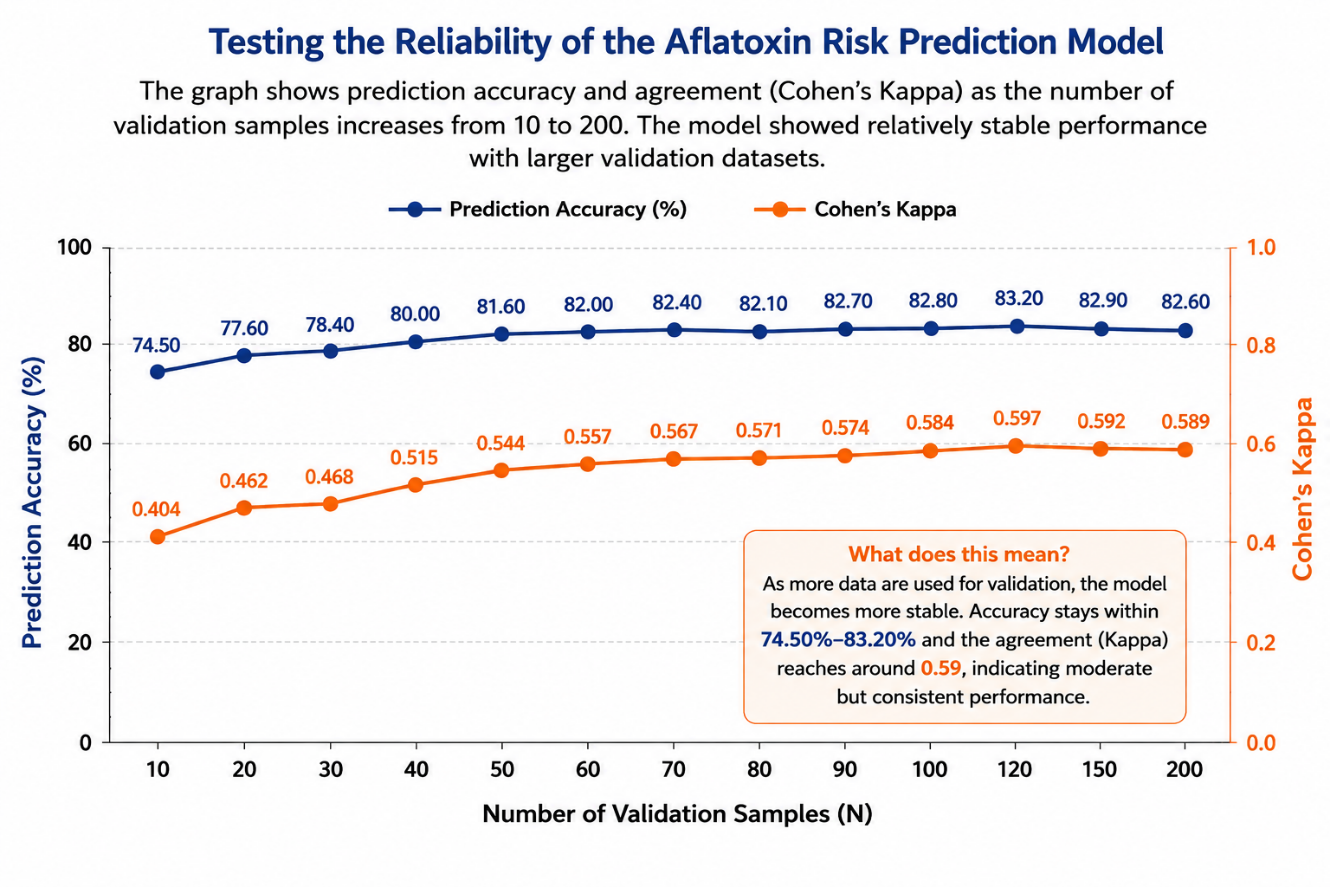
How well did the model work? When tested on 105 independent samples, it correctly classified 73.33% of the samples. Its agreement with the actual risk categories was moderate, with a Cohen’s Kappa of 0.597. Further testing with increasing sample sizes showed relatively stable performance, with accuracy ranging from 74.50% to 83.20%. Importantly, the researchers emphasize that this model is not a replacement for laboratory confirmation. Instead, it can act like a “traffic light” for feed mills: corn lots showing warning signs can be dried again, sorted, segregated, tested further, or rejected before entering storage.
This message is especially important in tropical regions, where warm and humid conditions can encourage fungal growth. Good drying, careful handling, proper storage, and routine inspection are therefore not just technical procedures—they are part of protecting animal and human health.
This research directly supports SDG 3: Good Health and Well-being. Safer feed contributes to healthier livestock and helps reduce the potential for harmful contaminants to move through the food chain. A simple quality check, supported by data and statistical modeling, can therefore become a valuable first step toward safer feed and healthier food.
The source article is “Prediction of aflatoxin risk in corn feed based on physical quality parameters: development and validation of ordinal models,” published in Agrobiological Records by Unique Scientific Publishers on 9 July 2026. Its findings show how physical quality indicators can provide an early warning of aflatoxin risk.
Reference
DOI :
https://doi.org/10.47278/journal.abr/2026.045
Contact :
Jasmal Ahmari Syamsu
+6281342654542
jasmal.syamsu@unhas.ac.id -
 When Cattle Meet Oil Palm, Collaboration Makes the DifferenceResearch Project
MAKASSAR, Indonesia, 30 May 2026/FeedTechRG/- What happens when cattle farming and oil palm plantations are brought together? The answer is not only about animals, land, grass, or palm trees. It is also about people—and how well they work together.
The integration of cattle and oil palm is increasingly viewed as a way to use plantation resources more efficiently. Cattle can utilize vegetation growing beneath oil palm, while manure can contribute to soil fertility and nutrient cycling. Such integration can potentially support livestock production without requiring major expansion of agricultural land. But making this system work requires many different actors to move in the same direction.
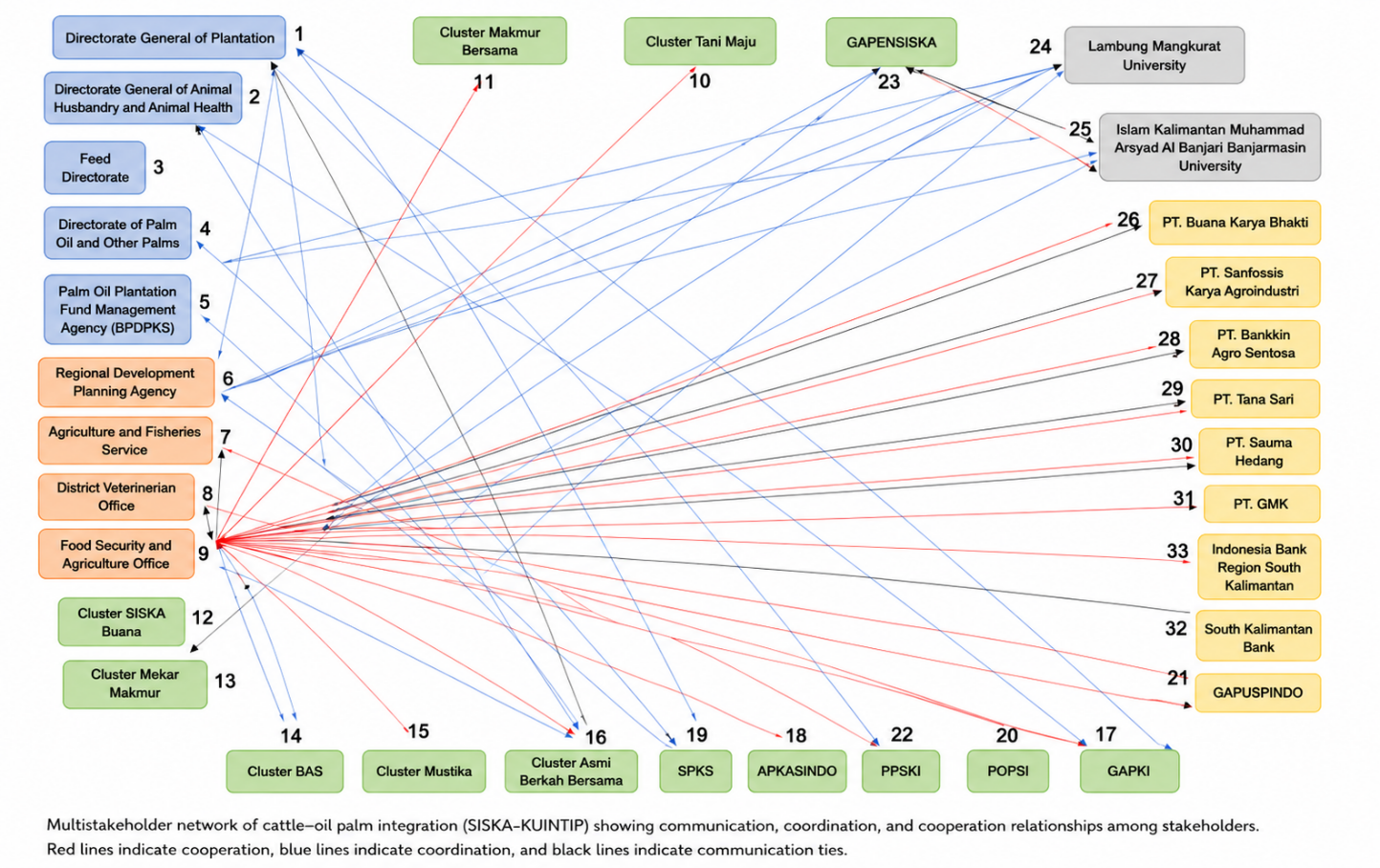
A recent study examined the SISKA-KUINTIP program in Tanah Bumbu Regency, South Kalimantan, to understand who is involved and how these stakeholders interact. Researchers identified 33 stakeholders, representing government institutions, farmer groups, private companies, financial institutions, associations, and universities.
The study found that not all relationships in the network were equally strong. Three types of relationships were examined: communication, coordination, and cooperation. Coordination was the strongest, involving 37 connections, with a network density of 0.0701. Communication had 22 connections, while cooperation had only 19. In other words, stakeholders were more frequently connected through planning and institutional coordination than through deeper forms of joint action and resource sharing.
Government institutions emerged as the main hubs of the network. The Food Security and Agriculture Office played a particularly important role in cooperation and communication, while the Plantation and Livestock Office became the leading coordination actor. Universities, business associations, companies, and financial institutions also served as important supporting and bridging actors.
But the research also uncovered an important challenge. Although participation was broad, strategic influence remained concentrated in a relatively small group of public institutions. Farmer groups and some private organizations were closely involved in implementation but had less influence over strategic decisions. This means that having many stakeholders does not automatically create balanced collaboration.
The researchers therefore suggest moving beyond coordination toward more distributed cooperation. Farmer groups and producer organizations need greater representation in strategic planning, while universities, business associations, companies, and financial institutions can strengthen their roles as bridges between different parts of the system.
The message is simple: sustainable cattle–oil palm integration is not achieved by technology alone. Strong partnerships, shared responsibilities, and inclusive decision-making are equally important.
This research supports SDG 17: Partnerships for the Goals, highlighting how collaboration among government, farmers, businesses, financial institutions, and universities can strengthen sustainable agricultural development.
The source article is “Stakeholder Relations and Social Network Analysis in the Development of Cattle-oil Palm Integration Systems: A Case Study of SISKA-KUINTIP in South Kalimantan, Indonesia,” published in the International Journal of Agriculture and Biosciences, by Unique Scientific Publishers. The article was published online first on 13 May 2026 and appears in Volume 15(5), pages 2147–2156.
Reference
DOI:
https://doi.org/10.47278/journal.ijab/2026.119
Contact :
Jasmal Ahmari Syamsu
+6281342654542
-
 The Hidden Cost of Faster Harvesting: Less Rice Straw for CattleResearch Project
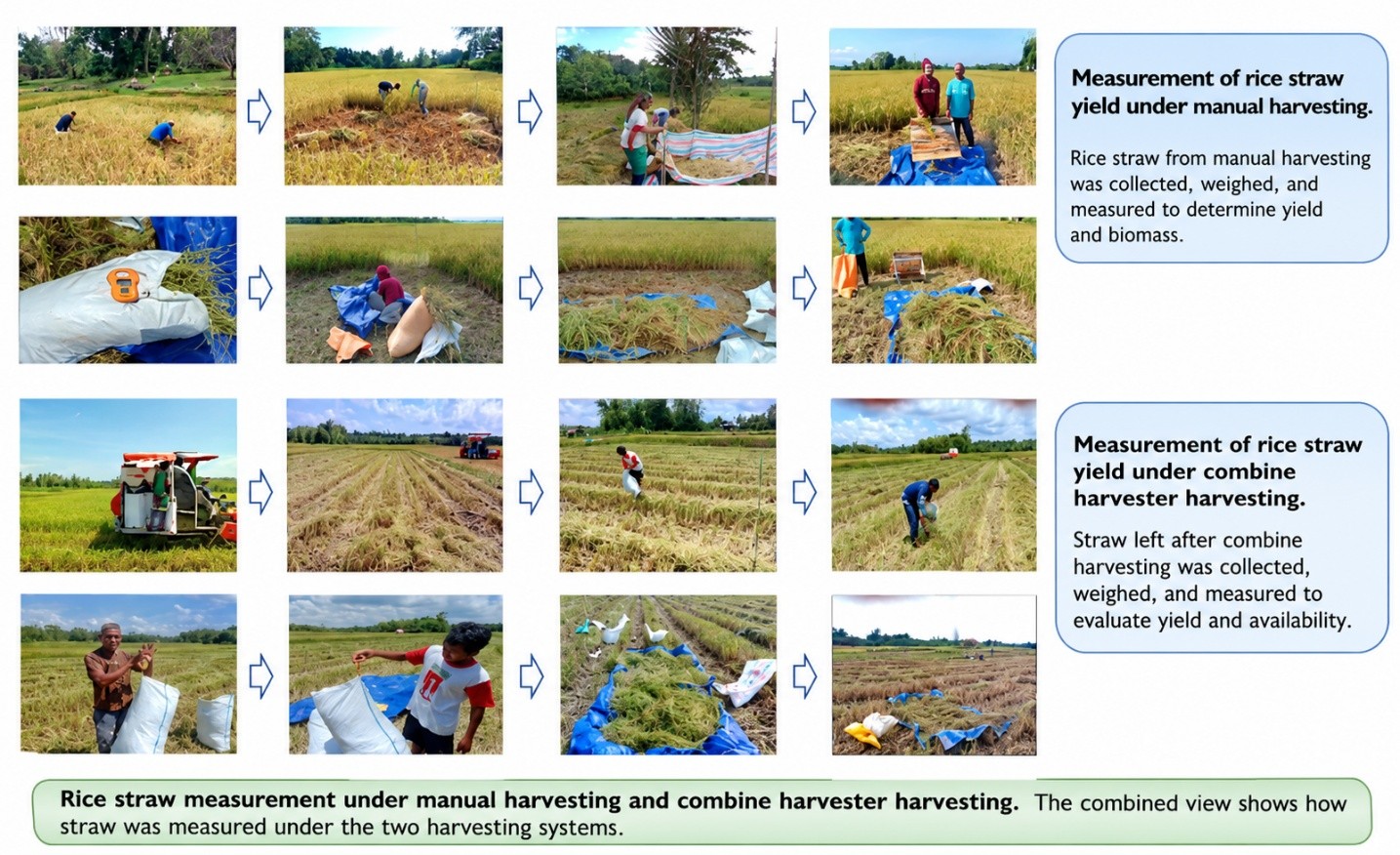
MAKASSAR, Indonesia, 20 July 2026/FeedTechRG/- Rice farming produces more than grain. It also leaves behind a valuable resource: rice straw, which can become feed for beef cattle. But a recent study from South Konawe, Indonesia, reveals an important challenge. The way rice is harvested can determine how much straw remains available for livestock.
Researchers compared two harvesting systems in Palangga District: traditional manual harvesting and mechanical harvesting using a combine harvester. They measured straw production in 24 field observation units across four representative villages and evaluated its nutrient composition and potential to support cattle.
The difference was striking. Manual harvesting produced 8.27 tons of fresh straw per hectare, while combine harvesting produced only 3.90 tons. For air-dried straw, the figures were 3.73 and 1.74 tons per hectare. More importantly, dry matter—the part of the feed that remains after water is removed—was 1.40 tons per hectare under manual harvesting, compared with only 0.65 tons with a combine harvester.
Why does this matter? Rice straw is not simply agricultural waste. It can provide fiber and energy for cattle, especially when forage becomes scarce. In the study area, the estimated annual dry matter from rice straw reached 2,739.10 tons under manual harvesting, but only 1,271.73 tons under combine harvesting. As a result, the estimated feed carrying capacity fell from 1,201.36 animal units to 557.77 animal units—only about 46.4% of the manual-harvesting level.
Interestingly, the story is not simply that manual harvesting produces “better” straw. Straw from combine harvesting contained more crude protein, 5.84% compared with 4.54%. However, it also contained more crude fiber, NDF, ADF, and cellulose, characteristics that can potentially reduce digestibility. This means that both quantity and quality need to be considered when evaluating rice straw as feed.
The researchers do not suggest abandoning agricultural mechanization. Instead, they point to a more practical solution: make harvesting and straw management work together. Adjusting cutting height, collecting scattered straw, and using technologies such as balers, transport systems, or integrated collection and chopping machines could help recover more straw after mechanized harvesting.
This research directly supports SDG 15: Life on Land. Turning crop residues into useful livestock feed can improve resource efficiency and reduce the need to treat agricultural residues as waste. Better straw recovery can also help avoid open burning and strengthen integrated rice–livestock systems.
The source article is “Rice straw production and feed carrying capacity under combine harvester systems for beef cattle in Palangga District, South Konawe Regency, Indonesia,” published in Agrobiological Records by Unique Scientific Publishers on 25 February 2026.
Reference
DOI: https://doi.org/10.47278/journal.abr/2026.009
Contact :
Jasmal Ahmari Syamsu
+6281342654542
jasmal.syamsu@unhas.ac.id