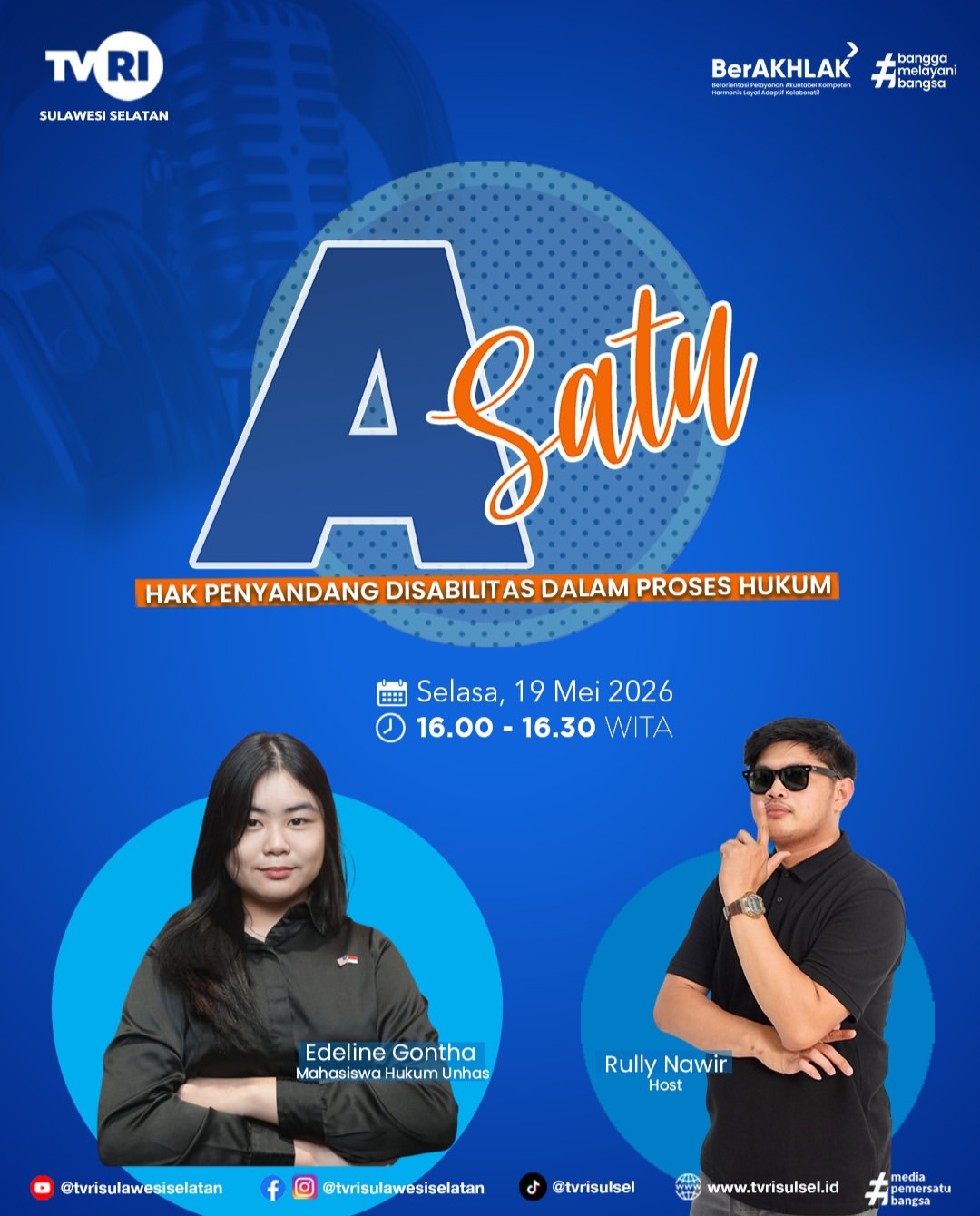

MAKASSAR, May 18, 2026 – In an effort to broaden public discourse on legal inclusivity, Edeline Gontha recently featured as a guest speaker on the prominent A-Satu podcast, produced by TVRI Sulawesi Selatan. During the broadcast, Gontha shared critical insights from her collaborative research with The Disability Law and Policy Research Group. This rigorous academic study served as the foundation for her recent championship victory at the Asian Card News Competition (ACNC) 2026, where she represented Indonesia on an international stage.
The podcast session provided a strategic platform to translate complex institutional legal frameworks into an accessible public dialogue. By engaging with mainstream media, Gontha highlighted the vital role that young researchers play in bringing scholarly legal assessments out of academic silos and into the broader societal consciousness.
Translating Empirical Research into Media Advocacy
During the interview, Gontha articulated the core focus of her award-winning project: “Access to Justice for People with Disabilities in Indonesia.” She elaborated on how her research with The Disability Law and Policy Research Group exposed persistent structural and procedural gaps within the national judiciary. Rather than examining disability rights through a purely theoretical lens, her discussion emphasized the practical lived realities of marginalized individuals navigating the court system.
Gontha explained that the transition from a traditional research paper to a winning card news format required a deep understanding of visual literacy. The A Satu platform allowed her to demonstrate how empirical data, when paired with strategic communication, can dismantle complex socio-legal concepts and make legal knowledge far more democratic and digestible for the public.
Fostering Collaborative Legal Inclusivity
A central theme of the podcast discussion was the necessity of clinical legal education and institutional collaboration. Gontha emphasized that academic research groups like The Disability Law and Policy Research Group are crucial for developing future legal minds who are sensitive to the systemic barriers faced by vulnerable communities. Through these research initiatives, students are encouraged to collaborate directly with disability rights organizations to foster genuine policy reforms.
Furthermore, the dialogue underscored that achieving true access to justice extends far beyond merely providing basic legal aid. It demands a holistic transformation of the justice system—ranging from physical courtroom accessibility to the elimination of implicit biases within judicial attitudes.
Advancing Global Development Frameworks
Gontha’s broadcast contribution serves as a reminder of the academic community’s role in advancing the United Nations Sustainable Development Goals (SDGs). Her discourse directly aligns with SDG 16 (Peace, Justice, and Strong Institutions) by advocating for institutional reforms that offer equitable protection under the law.
Additionally, the insights shared on TVRI Sulawesi Selatan support SDG 10 (Reduced Inequalities) by confronting systemic discrimination. By utilizing public media to amplify her The Disability Law and Policy Research Group research and celebrate her ACNC 2026 success, Gontha has set a powerful precedent for how academic scholarship can inspire meaningful public awareness and drive the movement toward a barrier-free justice system.