

The PEP-star Project: “A Performance-Enhancing Proxy for Low Earth Orbit Satellite Communications in Disaster-Resilient ASEAN Network Infrastructure” was successfully conducted on 29–30 January 2026 at the Department of Informatics Engineering, Faculty of Engineering, Universitas Hasanuddin. The activity served as an important milestone in strengthening international research collaboration and promoting technological innovation to support resilient communication infrastructure across the ASEAN region.
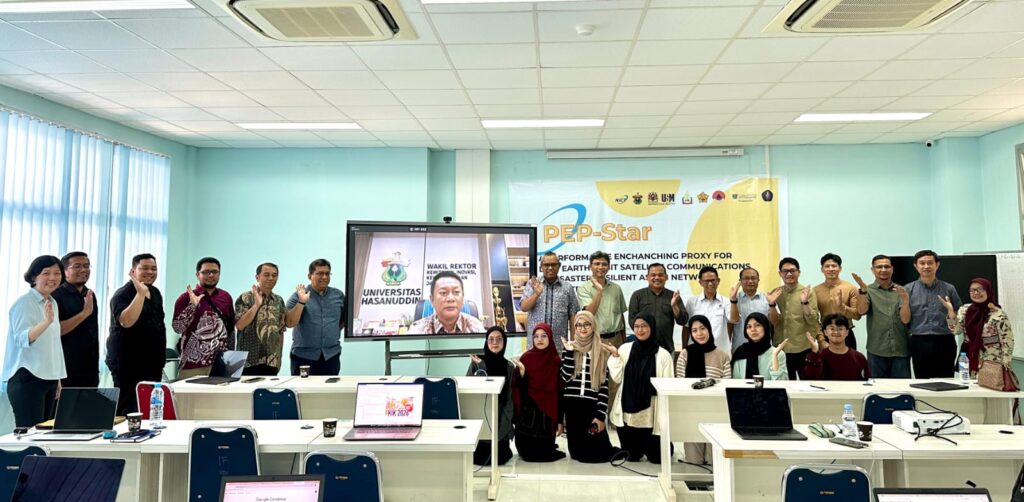
This initiative was organized with the primary objective of fostering international research collaboration among researchers and academics who share common interests in satellite communications, network performance optimization, and disaster-resilient digital infrastructure. The project focused on exploring innovative approaches to improve the reliability and efficiency of Low Earth Orbit (LEO) satellite communications, particularly in situations where conventional communication systems are disrupted by natural disasters or other emergencies.
A major highlight of the project was the strong collaboration established among eight leading institutions from Indonesia, Malaysia, Laos, and Singapore. Domestic partners included the Computing and Data Mining Research Group and the Cyber Resilience and Internet of Things Research Group at Universitas Hasanuddin, Universitas Brawijaya (UB), Universitas Syiah Kuala (USK), and the Aceh Disaster Management Agency (BPBA). The international collaboration involved Universiti Sains Malaysia (USM), the National University of Laos (NUOL), and the University of Glasgow Singapore (UGS). This diverse consortium combined expertise from academia and government institutions, creating a multidisciplinary platform for addressing regional challenges in resilient communication technologies.
The activity brought together 15 participants representing these partner institutions, including 5 participants from Universitas Hasanuddin, 2 from Universitas Brawijaya, 2 from Universitas Syiah Kuala, 2 from the Aceh Disaster Management Agency (BPBA), 2 from the National University of Laos, 1 from Universiti Sains Malaysia, and 1 from the University of Glasgow Singapore. Researchers, lecturers, and institutional representatives actively engaged in scientific discussions, knowledge exchange, and strategic planning for future collaborative research. Through intensive interactions, participants examined current challenges in communication networks, shared research experiences, and identified opportunities for developing advanced technologies capable of supporting sustainable and resilient digital ecosystems in the ASEAN region.
As Southeast Asian countries continue to face various environmental and disaster-related challenges, the development of reliable communication infrastructure has become increasingly important. The PEP-star Project emphasized the role of research and innovation in ensuring that communities remain connected during critical situations. Enhanced communication capabilities are essential for coordinating emergency responses, delivering information efficiently, and supporting socioeconomic recovery in affected areas.
The implementation of this project is closely aligned with several Sustainable Development Goals (SDGs), particularly SDG 1: No Poverty, SDG 3: Good Health and Well-Being, SDG 4: Quality Education, and SDG 17: Partnerships for the Goals.
The contribution to SDG 1: No Poverty is reflected in the potential of resilient communication infrastructure to support disaster recovery and minimize economic losses experienced by vulnerable communities. In addition, reliable communication systems can facilitate access to information and services that contribute to community resilience and long-term socioeconomic development.
The project also supports SDG 3: Good Health and Well-Being, as effective communication networks are crucial for emergency healthcare coordination and the dissemination of health-related information during disasters. Furthermore, the active involvement of researchers and academics contributes to SDG 4: Quality Education by promoting knowledge sharing, research capacity building, and the development of future scientific talents.
Most importantly, the collaborative nature of the PEP-star Project embodies SDG 17: Partnerships for the Goals, highlighting the significance of international cooperation in addressing complex regional challenges through science, innovation, and shared expertise.

Overall, the PEP-star Project demonstrates how collaborative research can generate impactful technological solutions while strengthening academic partnerships and contributing to sustainable development across the ASEAN community.