
The Future of Skincare: How Artificial Intelligence is Revolutionizing the Diagnosis of Facial Blemishes

GOWA, Indonesia Apr 24 2026/CDM/ –Almost everyone has experienced the frustration of waking up to an unexpected skin issue. Whether it is a sudden acne breakout, stubborn blackheads, or hyperpigmentation, aesthetic facial skin disorders can significantly impact our self-confidence and overall quality of life. Traditionally, dermatologists rely heavily on visual examinations to diagnose these conditions, which can sometimes be subjective and prone to human error. However, a groundbreaking study published on 19 January 2025 offers a high-tech solution. The research article, titled “Convolutional neural network architectural models for multiclass classification of aesthetic facial skin disorders” was featured in the International Journal of Advanced Technology and Engineering Exploration and published by the Association of Computer, Communication and Education for National Triumph Social and Welfare Society (ACCENTS).
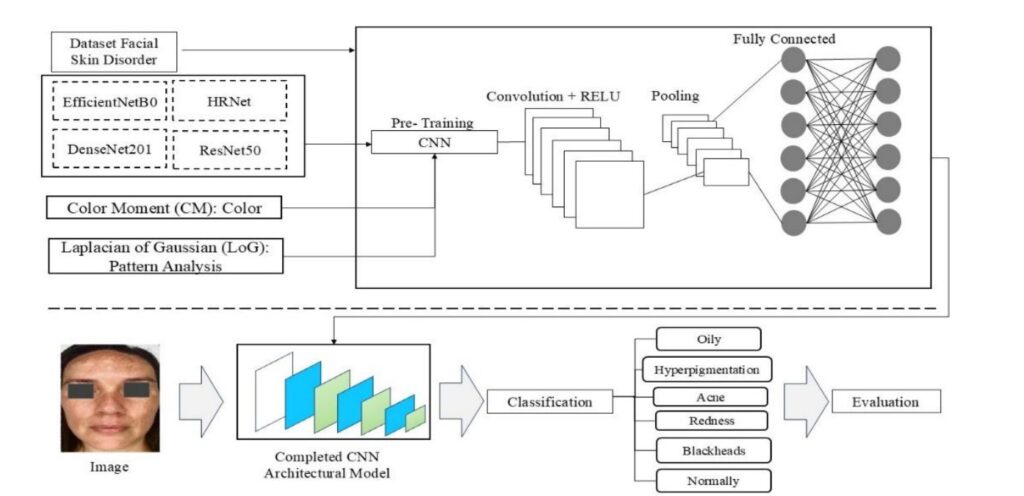
This fascinating study explores how artificial intelligence (AI), specifically Convolutional Neural Networks (CNNs), can act as a highly accurate digital dermatologist. Think of a CNN as a brilliant digital detective that learns to identify microscopic patterns in images. The researchers tested several state-of-the-art AI models—such as EfficientNetB0, HRNet, DenseNet201, and ResNet50—to classify six common facial skin categories: oily skin, hyperpigmentation, acne, redness, blackheads, and normal skin. To make the AI even smarter, they combined these architectural models with special techniques known as Color Moment (CM) and Laplacian of Gaussian (LoG). In simple terms, these analytical additions allowed the AI to better understand the distinct colors and intricate shapes of different skin blemishes.
The results were nothing short of impressive. By feeding the AI thousands of sample images, the researchers discovered that the ResNet50 model, when combined with the enhanced color and pattern recognition features, achieved a remarkable accuracy rate of 95%. This means the computer can correctly identify exactly what type of aesthetic skin issue a person is facing almost every single time.
The implications of this technology extend far beyond the surface of cosmetics; they align perfectly with Sustainable Development Goal 3: Good Health and Well-being. By integrating AI-based technology into modern dermatology, medical professionals can detect skin disorders much earlier and with far greater precision. This technological leap leads to more effective, personalized treatments, ultimately improving patient outcomes and overall well-being. Ensuring accurate medical diagnoses is a crucial step in promoting healthier, happier lives for everyone.
As artificial intelligence continues to learn and evolve, the days of guessing what skin treatment might work could soon be behind us. With just a quick photo, the future of dermatology promises a clearer, more accurate path to healthy skin.
Reference
DOI:
https://doi.org/10.19101/IJATEE.2024.111101077
Contact:
Prof. Dr. Ir. Amil Ahmad Ilham, S.T., M.IT
+62 853-9883-1853
amil@unhas.ac.id