
Eyes in Your Pocket: How AI is Transforming the World for the Visually Impaired

GOWA, Indonesia Apr 23 2026/CDM/ – Imagine navigating a busy city street where every sign, obstacle, and person is a mystery. For millions of people with visual impairments, this is a daily reality. While we often take our sight for granted, a group of innovative researchers is using artificial intelligence to bridge this gap, turning smartphones into “digital eyes” that can describe the world in real-time.
A fascinating study titled “Attention-Driven Image Captioning for Mobile Accessibility of the Visually Impaired” offers a glimpse into this high-tech future. Published on May 9, 2025, in the International Journal of Interactive Mobile Technologies by the International Association of Online Engineering, this research demonstrates how a specialized AI model can translate images into spoken words with remarkable precision.
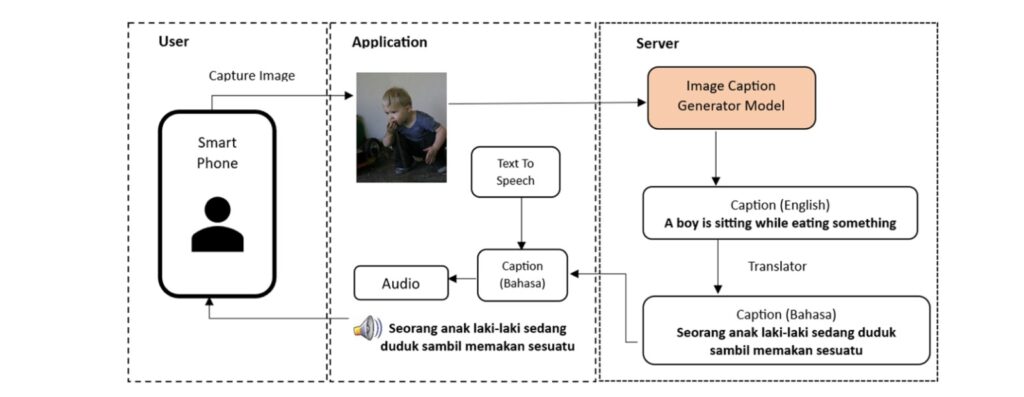
The “Spotlight” of Artificial Intelligence
The secret sauce behind this technology is something called an “attention mechanism”. Traditional AI models often try to look at an entire image at once, which can lead to vague or confusing descriptions. In contrast, the attention mechanism works like a spotlight, focusing on the most important parts of a scene—like a person’s face, a flight of stairs, or a computer—to generate a detailed and contextual caption.
Technically, the system uses a powerful visual “brain” called ResNet-152 to identify objects and a language “voice” called LSTM to string those observations into natural sentences. For users in Indonesia, the system even translates these descriptions into Bahasa and reads them aloud using text-to-speech technology.
Real-World Impact and Global Goals
What makes this study particularly impressive is its real-world speed. On average, the system takes only 2.99 seconds to capture an image and speak the description. In campus trials, a blindfolded participant was able to identify stairs, whiteboards, and other students just by listening to their phone.
This technological leap is a significant contribution toward achieving Sustainable Development Goal 3 (SDG 3): Good Health and Well-being. By fostering independence and reducing the social barriers caused by disability, this tool directly improves the mental well-being and quality of life for the visually impaired community. It empowers individuals to navigate their environments more safely and confidently, ensuring that no one is left behind in our visually-driven world.
The Road Ahead
While the model performed exceptionally well on standard datasets, the researchers noted that “messy” real-world conditions—like low lighting or partially hidden objects—still pose a challenge. However, the future looks bright. Plans are already underway to integrate this AI into smart glasses and walking canes, providing hands-free, real-time feedback.
Through the marriage of mobile technology and advanced AI, we are moving closer to a world where “seeing” is no longer a requirement for understanding the beauty and complexity of the environment around us.
Reference
DOI:
https://doi.org/10.3991/ijim.v19i09.53441
Contact:
Prof. Dr. Ir. Amil Ahmad Ilham, S.T., M.IT
+62 853-9883-1853
amil@unhas.ac.id