2 June – 28 July 2024
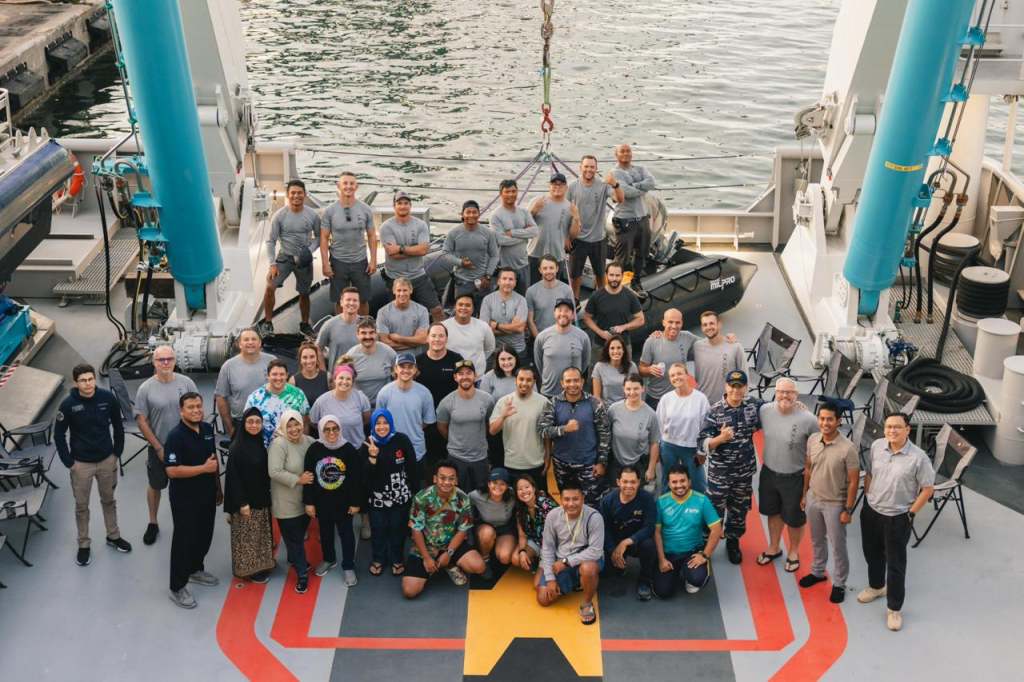
OceanX, in collaboration with Indonesia’s Coordinating Ministry for Maritime Affairs and Investment (Kemenkomarves) and the National Research and Innovation Agency (BRIN), has successfully conducted the expediation in Indonesian waters, wrapping up all five legs on 25th August 2024 in Bitung, Sulawesi. The Indonesia Mission 2024 marks a significant milestone in marine exploration and research in Indonesian waters, contributing to both science and conservation efforts.
The mission revolved around biodiversity research in support of Marine Protected Area designation, understanding the ecosystem’s climate and paleoclimate, microplastics and water quality testing, and mapping seafloor bathymytry such as Megathrust zones—which have significant implications for future earthquake and tsunami risks and mitigation.
Indonesia has the 2nd highest marine biodiversity in the world. Joining an expedition on a state-of-the-art research vessel from the United States (the OceanXplore Ship) is a great opportunity to explore the marine biodiversity in the waters of the Indian Ocean, with OceanXplore’s state-of-the-art equipment. Two Hasanuddin University researchers (Prof. Nita Rukminasari, Ph.D and Dr. Widyastuti Umar) joined this expedition at leg 2 (Sabang to Teluk Bayur, West Sumatra) and leg 3 (Teluk Bayur to Jakarta). The OceanXplore research team has been equipped with state-of-the-art equipment and cutting-edge technology to support our research. The expedition not only aims to identify the species that live in the waters around Sumatra, but also to investigate their genetic diversity. Through careful genetic analysis, scientists will be able to uncover each species’ genetic uniqueness and the evolutionary relationships between them. We can take water samples from sea level to a depth of more than 4000 meters. The water samples we took from dozens of locations and various depths were then filtered using a filter with a size of 0.22 microns to extract eDNA (DNA from the environment). After extracting the DNA, with the advanced equipment available on the ship, the DNA is then analyzed for sequencing metabarcoding. The data from the sequencing results will then be further analyzed to map the genetic diversity of all marine organisms detected along the waters of Sumatra (Indian Ocean) based on the eDNA we sampled. The data and findings from this expedition are expected to help in efforts to conserve and protect the marine environment in the Indian Ocean region.