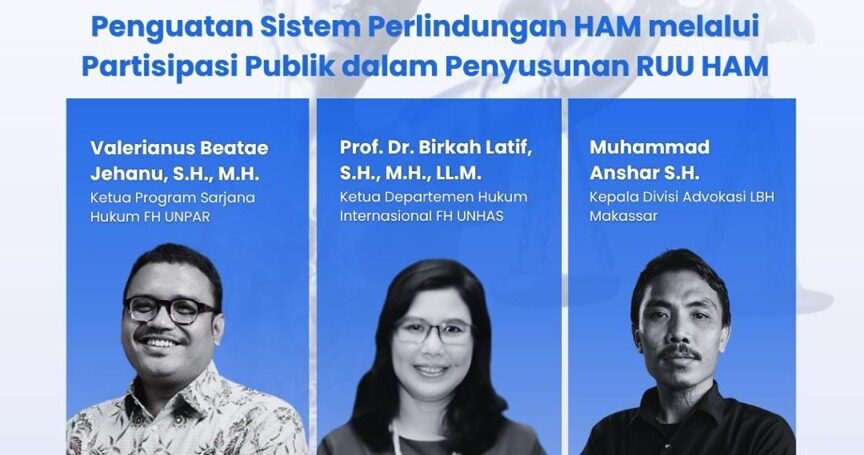

MAKASSAR, July 9, 2026-The Faculty of Law, Hasanuddin University (FH Unhas), in collaboration with YAPPIKA and SEPAHAM, hosted an academic discussion entitled “The Human Rights Bill (RUU HAM): An Analysis of Academic Contributions” on July 9, 2026. Convened under the sub-theme “Assessing the Direction of Legal Policy in the Human Rights Bill: TRG Hasanuddin University’s Critical Perspective on Centralization and Civic Space,” the forum aimed to dissect the trajectory of national legal reform. In this strategic agenda, the Unhas Thematic Research Group (TRG) team, represented by Lead Researcher Prof. Dr. Birkah Latif, S.H., M.H., LL.M., attended to deliver a scientific presentation. The discussion was further enriched by in-depth analyses from other expert speakers, namely Muhammad Anshar, S.H. from the Makassar Legal Aid Institute (LBH Makassar), and Valerianus Beatae Jehanu, S.H., M.H., the Head of the Undergraduate Law Program at the Faculty of Law, Parahyangan Catholic University (UNPAR).
During the forum, Prof. Birkah Latif highlighted a contradictory dualism of paradigms within the Human Rights Bill; wherein the draft regulation offers the strengthening of a human rights system based on social inclusion, yet is overshadowed by the threat of democratic regression due to a trend toward centralizing authority within the executive branch. This perspective was reinforced by Muhammad Anshar, S.H., and Valerianus Beatae Jehanu, S.H., M.H., who jointly dissected the vulnerabilities of the draft from the lenses of legal aid practice and academic study. The speakers unanimously mapped out three primary systemic impacts of this centralization: the erosion of the independence of national human rights institutions (such as Komnas HAM, Komnas Perempuan, and KPAI), the weakening of victim remedy mechanisms and protection for human rights defenders, and the emergence of conflicts of interest in the oversight of Business and Human Rights (BHR) issues, which risks dulling corporate accountability.
This research-based advocacy and inter-institutional collaboration directly align with the achievement of the Sustainable Development Goals (SDGs). Safeguarding institutional independence in human rights and the advancement of civil liberties represent concrete manifestations of enforcing SDG 16 (Peace, Justice, and Strong Institutions). The protection of indigenous peoples, vulnerable groups, and human rights defenders accords with SDG 10 (Reduced Inequalities), while enforcing corporate legal accountability for environmental sustainability supports SDG 12 (Responsible Consumption and Production) and SDG 13 (Climate Action). Finally, the multi-stakeholder synergy among FH Unhas, YAPPIKA, SEPAHAM, LBH Makassar, and Parahyangan Catholic University reinforces the pillar of SDG 17 (Partnerships for the Goals) in safeguarding the sustainability of democracy and human rights in Indonesia.