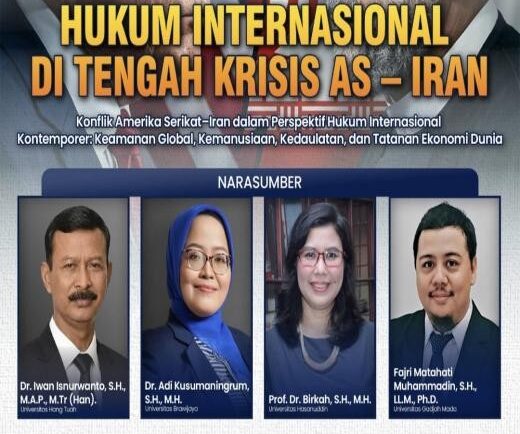
MAKASSAR, March 6, 2026 — Amid growing geopolitical volatility, the Indonesian Society of International Law Lecturers (ISILL) successfully convened its 19th installment of ISILL Talk, titled “Hukum Internasional di Tengah Krisis AS – Iran” (International Law in the Midst of the US–Iran Crisis), today via Zoom and YouTube Live. The national webinar brought together prominent legal scholars, international law practitioners, and hundreds of participants nationwide to dissect the complex friction between the United States and Iran through the lens of contemporary international law.
The event was specifically designed to evaluate the multifaceted dimensions of the conflict, focusing on its profound implications for global security, humanity, state sovereignty, and the world economic order. The academic discourse was seamlessly moderated and guided by Dr. Aurora Meliala, S.H., M.A., the Chairperson of the ISILL Partnership Commission.
The panel featured a distinguished lineup of legal experts who provided critical assessments of the structural challenges brought by the crisis. Dr. Iwan Isnurwanto, S.H., M.A.P., M.Tr (Han). from Universitas Hang Tuah, Dr. Adi Kusumaningrum, S.H., M.H. from Universitas Brawijaya, and Fajri Matahati Muhammadin, S.H., LL.M., Ph.D. from Universitas Gadjah Mada offered comprehensive analyses regarding the escalation of military tensions, state responsibility, and the strict boundaries of international humanitarian law.
Representing a crucial socio-economic and legal perspective, Prof. Dr. Birkah Latif, S.H., M.H., LL.M., a prominent legal scholar from Universitas Hasanuddin and Chairperson of the Business Law Thematic Research Group (TRG), delivered a compelling presentation focusing on the conflict’s severe disruptions to the world economic order. As a keynote speaker, Prof. Birkah argued that geopolitical standoffs between global powers inevitably fracture international trade compliance, trigger aggressive unilateral economic sanctions, and threaten transnational corporate security. She emphasized that international business frameworks and economic law must adapt to protect neutral states and supply chains from becoming collateral damage in diplomatic crises.
“When major global actors clash, international economic law must act as a stabilizing anchor to maintain fair play in global markets. Protecting global trade routes and ensuring adherence to multilateral economic treaties prevents widespread economic marginalization and safeguards global business resilience during times of war,” Prof. Birkah emphasized during her session.
The webinar concluded with an intensive, highly interactive Q&A session where academics and law students actively debated the effectiveness of international enforcement mechanisms. To support widespread academic growth and legal literacy, the organizers provided open virtual access and official e-certificates to all registered attendees.
In a broader developmental context, this national webinar directly supports Indonesia’s commitment to achieving the United Nations Sustainable Development Goals (SDGs), particularly SDG 16 and SDG 10. By critically evaluating international legal instruments for conflict resolution, maritime safety, and state sovereignty, the forum contributes significantly to SDG 16 (Peace, Justice, and Strong Institutions) by advocating for a stable, rules-based international legal order. Furthermore, by addressing how volatile geopolitical standoffs disproportionately disrupt developing markets, supply chains, and international trade equity, the discussion directly advances SDG 10 (Reduced Inequalities), championing a fairer economic and political landscape for all nations within global governance.