


MAKASSAR, Indonesia, 2026 – After a mining operation moves on, the land does not immediately recover. Vegetation may disappear, soil structure can be damaged, and nutrients needed by plants may be severely depleted. Beneath the surface, another problem may also emerge: the loss of the microorganisms that keep soil alive. But what if part of the solution could come from something as simple as organic waste? A recent study titled “Eco-Enzyme-Assisted Restoration of Soil Fertility and Microbial Activity in Nickel Mining-Contaminated Soils,” published in Ecological Engineering and Environmental Technology by Polskie Towarzystwo Inzynierii Ekologicznej, investigated the potential of eco-enzyme as a sustainable amendment for restoring soils affected by nickel mining.
Why Is Mining-Damaged Soil Difficult to Restore?
Open-pit nickel mining can remove topsoil, vegetation, and organic matter while disrupting soil structure and microbial communities. As a result, post-mining soils may become acidic and poor in nutrients, making it difficult for plants to establish naturally. In the study area, the initial post-mining soil had a pH of only 3.82, with soil organic carbon of 0.82% and total nitrogen of just 0.07%. Such conditions indicate severe soil degradation and limited biological activity.
What Is an Eco-Enzyme?
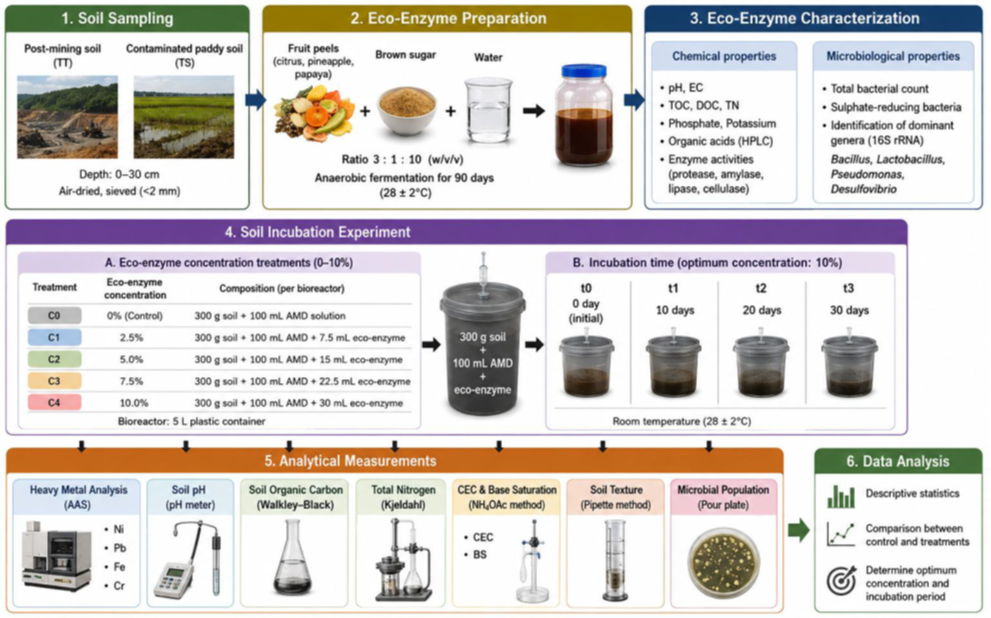
Eco-enzyme is a liquid produced by fermenting organic waste with sugar and water. During fermentation, the process generates organic compounds, nutrients, enzymes, and microorganisms that may support soil biological processes. The researchers tested eco-enzyme concentrations ranging from 0 to 10% on two soil types: post-mining soil and contaminated paddy soil. The samples were incubated for up to 30 days under controlled laboratory conditions.
What Happened to the Soil? The results were encouraging. The strongest treatment—10% eco-enzyme with 30 days of incubation—increased soil pH from 3.82 to 5.86 in post-mining soil and from 4.15 to 6.21 in contaminated paddy soil. The soil also gained valuable organic matter and nutrients. In post-mining soil, soil organic carbon increased from 0.82% to 2.41%, while total nitrogen rose from 0.07% to 0.27%. Even the soil’s microscopic life responded. Microbial populations in post-mining soil increased from 1.2 × 10⁶ to 10.3 × 10⁶ CFU/g soil after 30 days of treatment.
Supporting SDG 15: Life on Land
This research directly supports Sustainable Development Goal (SDG) 15 – Life on Land, which promotes the protection, restoration, and sustainable use of terrestrial ecosystems and combating land degradation. The findings suggest that eco-enzyme could become a low-cost and environmentally friendly tool for soil rehabilitation, helping restore chemical, physical, and biological soil functions.
Giving Damaged Soil a Second Chance
Mining provides valuable resources, but the land left behind also needs attention. This study shows that restoration does not always have to begin with expensive materials. Sometimes, the ingredients for recovery may already exist in our waste. By turning organic waste into eco-enzyme, we may be able to turn one environmental problem into part of the solution for another.
Reference
url:
https://www.jeeng.net/Eco-Enzyme-Assisted-Restoration-of-Soil-Fertility-and-Microbial-Activity-in-Nickel,224854,0,2.html (in progress)
Contact:
Prof. Fahruddin
+62 853-4264-9190
fahruddin_science@unhas.ac.id