


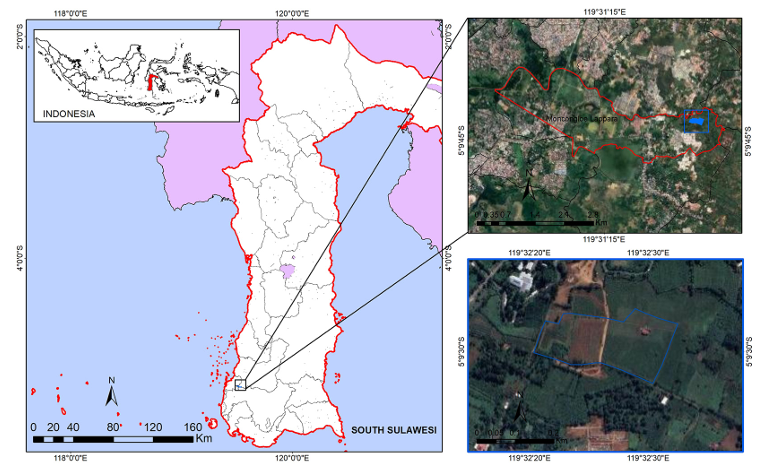
MAKASSAR, Indonesia, May 2026 – What if some of the most promising helpers for growing food are too small to see? Deep around plant roots lives a hidden community of microorganisms. Some of them can help plants obtain nutrients, stimulate root development, and survive difficult soil conditions. Scientists are now exploring these microscopic partners as a more sustainable way to support food production—especially in soils where crops struggle to grow. A recent study titled “Indigenous Plant Growth-Promoting Rhizobacteria as Biofertilizer Candidates for Hybrid Maize in Acidic Soils,” published in the Journal of Ecological Engineering by Polskie Towarzystwo Inzynierii Ekologicznej (PTIE) on April 1, 2026, investigated beneficial bacteria living around the roots of hybrid maize grown in acidic soils in Moncongloe District, South Sulawesi.
Why Are Acidic Soils a Challenge?
Acidic soils can be difficult places for crops to grow. Low pH can limit the availability of important nutrients such as nitrogen, phosphorus, and potassium, while high levels of aluminum and iron can interfere with plant development. These conditions can reduce crop vigor and productivity. For farmers, this often means greater dependence on fertilizers to maintain crop growth. But could beneficial soil bacteria provide part of the answer?
Meet the Plant’s Microscopic Partners
The researchers collected soil from five locations and obtained 10 representative bacterial isolates from the maize rhizosphere—the narrow zone of soil directly influenced by plant roots. The bacteria were tested for three important abilities: producing indole-3-acetic acid (IAA), fixing nitrogen, and making phosphorus more available to plants. These functions are important because plants need nitrogen and phosphorus for healthy growth, while IAA is a plant hormone that can stimulate root development. Two isolates stood out: TJMS19 and TJMTE54. TJMS19 showed the highest nitrogen-fixing capacity, reaching 49.07 mg/L, while TJMTE54 produced 47.30 mg/L. TJMTE54 also recorded the highest IAA production at 6.55 mg/L and the strongest phosphate-solubilizing ability at 14.54 mg/L.
Do the Bacteria Actually Help Plants Grow?
The researchers inoculated hybrid maize seedlings with the selected bacteria. The results were encouraging. Seedlings treated with TJMTE54 reached an average height of 33.97 cm, compared with 22.50 cm in untreated plants. Their roots also reached 22.10 cm, more than twice the control value of 10.27 cm. Fresh biomass increased to 1.87 g, compared with 0.96 g in untreated seedlings. TJMS19 also significantly improved plant growth. Molecular analysis identified TJMS19 as closely related to Bacillus paramycoides and TJMTE54 as belonging to the Pseudomonas group.
Supporting SDG 2: Zero Hunger
This research directly supports Sustainable Development Goal (SDG) 2 – Zero Hunger, which seeks to promote sustainable agriculture and improve agricultural productivity. By identifying indigenous bacteria adapted to acidic soils, the study opens possibilities for developing eco-friendly biofertilizers that can help crops use nutrients more effectively and grow on marginal land.
A Small Solution Beneath Our Feet
The study offers an important reminder: solutions to food-production challenges may already exist in nature. Instead of depending entirely on external inputs, sustainable agriculture can also learn to work with the microorganisms already living in local soils. Sometimes, the next big step toward food security may come from something we cannot even see.
Reference
DOI:
https://doi.org/10.12911/22998993/215937
Contact:
Prof. Fahruddin
+62 853-4264-9190
fahruddin_science@unhas.ac.id