
Makassar, Indonesia August 23 2026 /AISRG/– Organic farming is often presented as a promising path toward healthier ecosystems and better rural livelihoods. Yet adopting organic practices does not automatically guarantee that farmers can remain in the system. A recent study from rural Indonesia shows that the survival of organic rice farming may depend on something less visible: how farmer institutions manage market risk.
Published in Societies by MDPI on February 22, 2026, the study “Governing Market Risk in Organic Agriculture: Institutional Resilience and Collective Action in Rural Indonesia” compares organic rice systems in Magelang, Central Java, and Tasikmalaya, West Java. Using a qualitative comparative case study, the researchers examined interviews, observations, organisational records, policy documents, and certification materials collected between March and August 2024. The study involved 75 respondents, including farmers, cooperative and farmer-group leaders, buyers, certification bodies, government officers, and development facilitators.
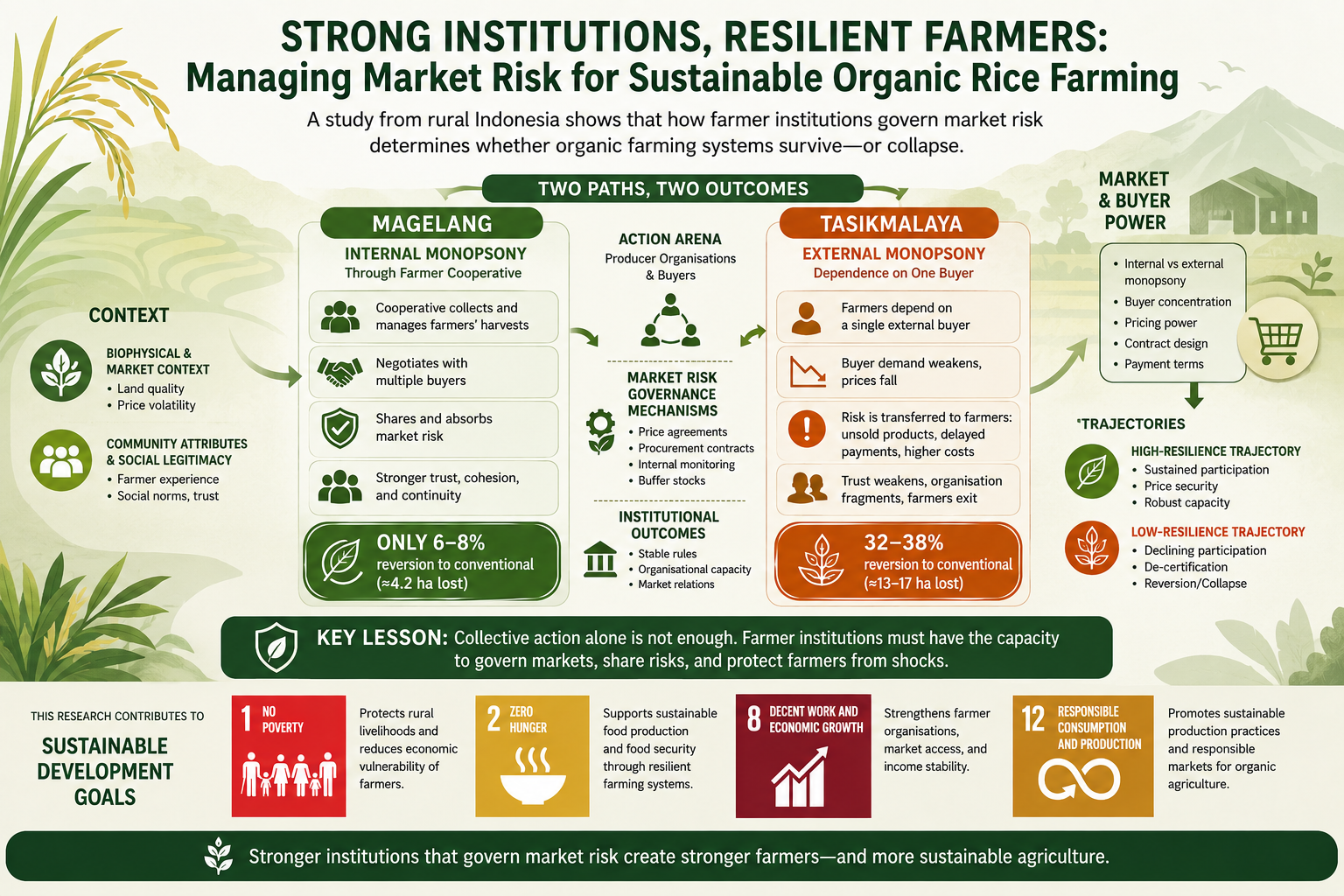
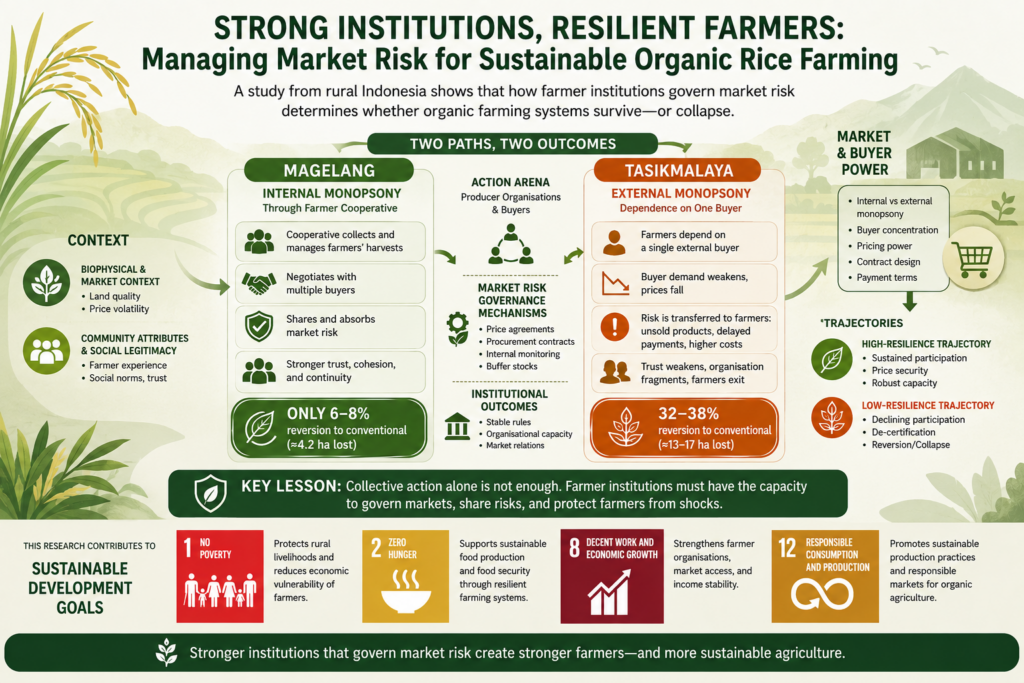
The results reveal a striking difference. In Magelang, only around 6–8% of farmers returned to conventional rice production, equivalent to approximately 4.2 hectares of former organic land. In Tasikmalaya, reversion reached approximately 32–38%, representing around 13–17 hectares. Both areas had experience with organic farming, government support, and collective action, but their institutional arrangements produced very different outcomes.
The key difference was how market risk was governed. In Magelang, a farmer cooperative acted as an internal monopsony: it collected farmers’ harvests, helped manage quality and prices, and negotiated with several buyers. This arrangement allowed the cooperative to absorb part of the market uncertainty instead of passing every shock directly to individual farmers. Buyer diversification also meant that declining demand from one buyer could be partly compensated by other market channels.
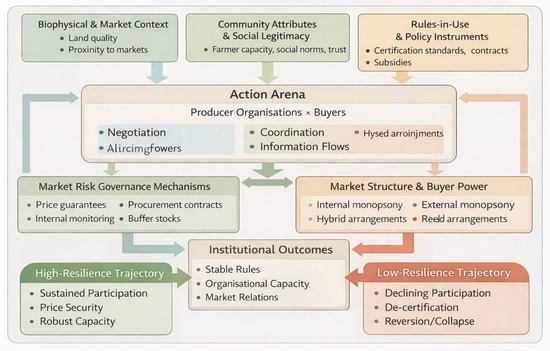
Tasikmalaya followed a different path. Farmers depended heavily on a single external buyer, creating an external monopsony. While this arrangement initially provided market access, it also created dependency. When buyer demand weakened, farmers faced unsold products, payment uncertainty, certification costs, and limited alternatives. The resulting pressure weakened trust and organisational cohesion, encouraging many farmers to return to conventional production.
The study therefore offers an important lesson: collective action alone is not enough to make sustainable agriculture resilient. Farmer organisations need the capacity to govern markets, share risks, manage finances, diversify buyers, and protect members from sudden shocks. Policies should therefore go beyond certification and production training by strengthening cooperatives as economically capable market institutions.
This research is closely connected to Sustainable Development Goal 1 (SDG 1): No Poverty, through its emphasis on protecting smallholder livelihoods and reducing economic vulnerability; SDG 2: Zero Hunger, through the sustainability of food production systems; SDG 8: Decent Work and Economic Growth, through stronger farmer organisations, market access, and income stability; and SDG 12: Responsible Consumption and Production, through the development and long-term sustainability of organic farming systems.
Reference:
DOI: 10.3390/soc16020075
Contact:
Prof. Sitti Bulkis
+62 813-5549-1888
bulkisd@agri.unhas.ac.id