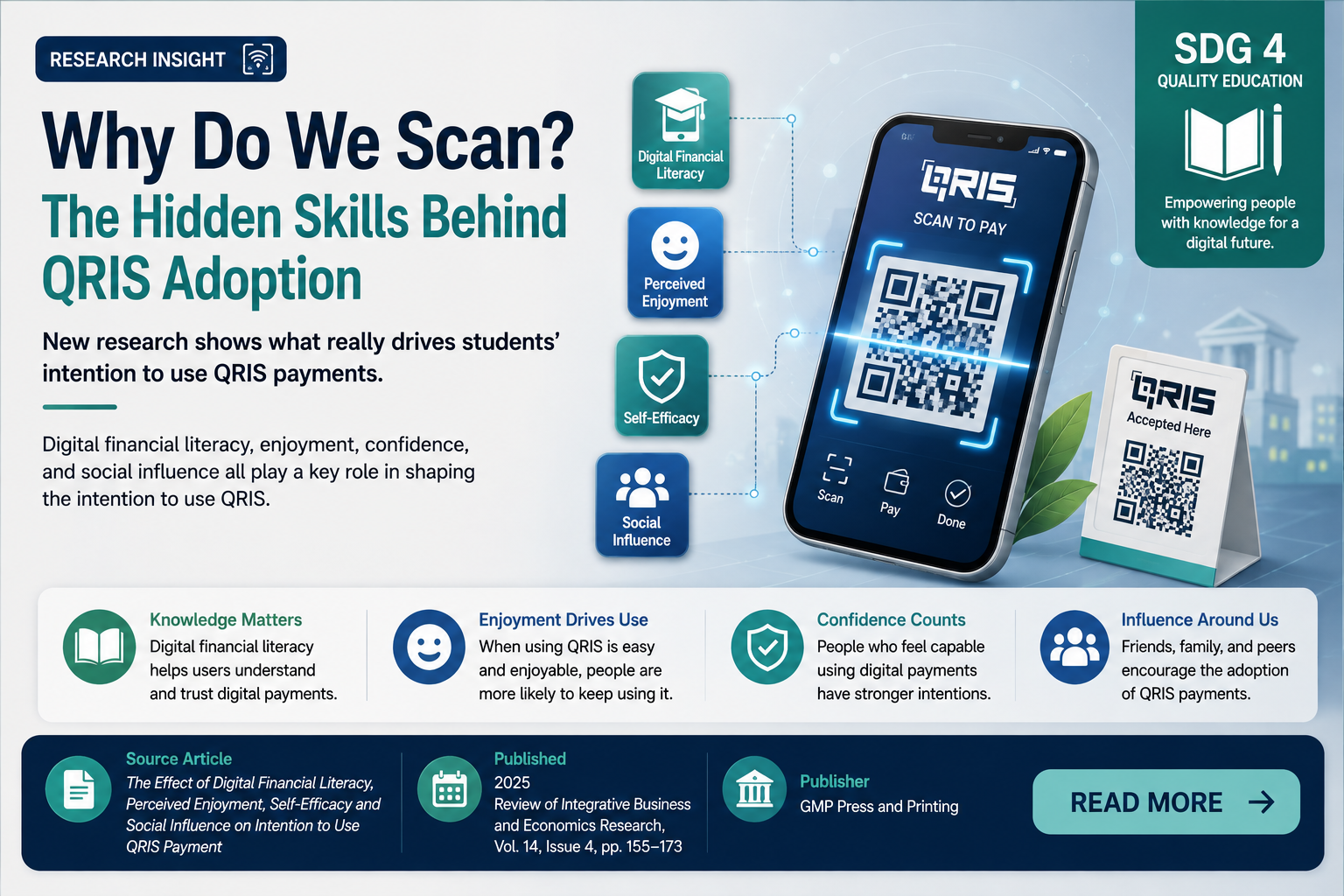

MAKASSAR, Indonesia, August 8, 2026/AIS-TRG/– A QR code may look like nothing more than a small black-and-white pattern. Yet for millions of Indonesians, it has become a gateway to everyday payments. One quick scan can replace cash, cards, and complicated transactions. But what makes someone actually want to use QRIS?
A recent study suggests that the answer is not simply convenience. People’s knowledge, confidence, enjoyment, and social environment can all shape their intention to use digital payments.
The research examined 508 students from five universities in Makassar. The respondents were students of Faculties of Economics and Business, and the researchers used questionnaires and Partial Least Squares Structural Equation Modeling to examine four potential influences: digital financial literacy, perceived enjoyment, self-efficacy, and social influence.
The findings were consistent across all four factors. Digital financial literacy positively influenced the intention to use QRIS. Students who understood digital financial services better were more likely to recognize the usefulness and safety of QRIS and develop stronger intentions to use it.
Enjoyment mattered too. QRIS makes payment relatively simple: users can scan a code with a mobile phone instead of searching for cash or using a physical card. When people find a technology convenient and enjoyable, they may become more willing to continue using it.
Confidence also plays a role. The study found that self-efficacy positively affected intention to use QRIS. People who feel capable of operating digital payment technology are more likely to see it as useful and develop an intention to use it.
Perhaps the most familiar factor is social influence. When friends, classmates, or people around us regularly use QRIS, their behavior can encourage us to do the same. The study found that stronger social influence was associated with stronger intentions to use QRIS.
This connects with Sustainable Development Goal (SDG) 4: Quality Education. Digital financial technology is useful only when people understand how to use it. Strengthening digital financial literacy can therefore help individuals make more informed decisions when adopting financial technologies. The lesson is not simply “teach people to scan QR codes,” but help them understand digital financial services, evaluate their usefulness, and use them confidently.
The source article is “The Effect of Digital Financial Literacy, Perceived Enjoyment, Self-Efficacy and Social Influence on Intention to Use QRIS Payment” published in the Review of Integrative Business and Economics Research, with GMP Press and Printing as the publisher, in 2025, Volume 14, Issue 4, pages 155–173. The authors are Alvyonitha Ratu Ramba, Grace T. Pontoh, and Sri Sundari. The PDF records that the manuscript was received on 1 July 2024, revised on 22 November 2024, and accepted on 8 January 2025; it does not state a specific day of publication.
The broader message is simple: digital payment adoption is not only about technology. It is also about knowledge, confidence, enjoyment, and the people around us. As cashless payments become part of everyday life, digital financial literacy may be just as important as the technology itself.
Reference
GMP Press & Printing Co.
Contact:
Grace T. Pontoh
+6281332206898
gracetpontoh@fe.unhas.ac.id