When the Light Fades: Detecting Palm Fruit Bunches in Dim Plantations
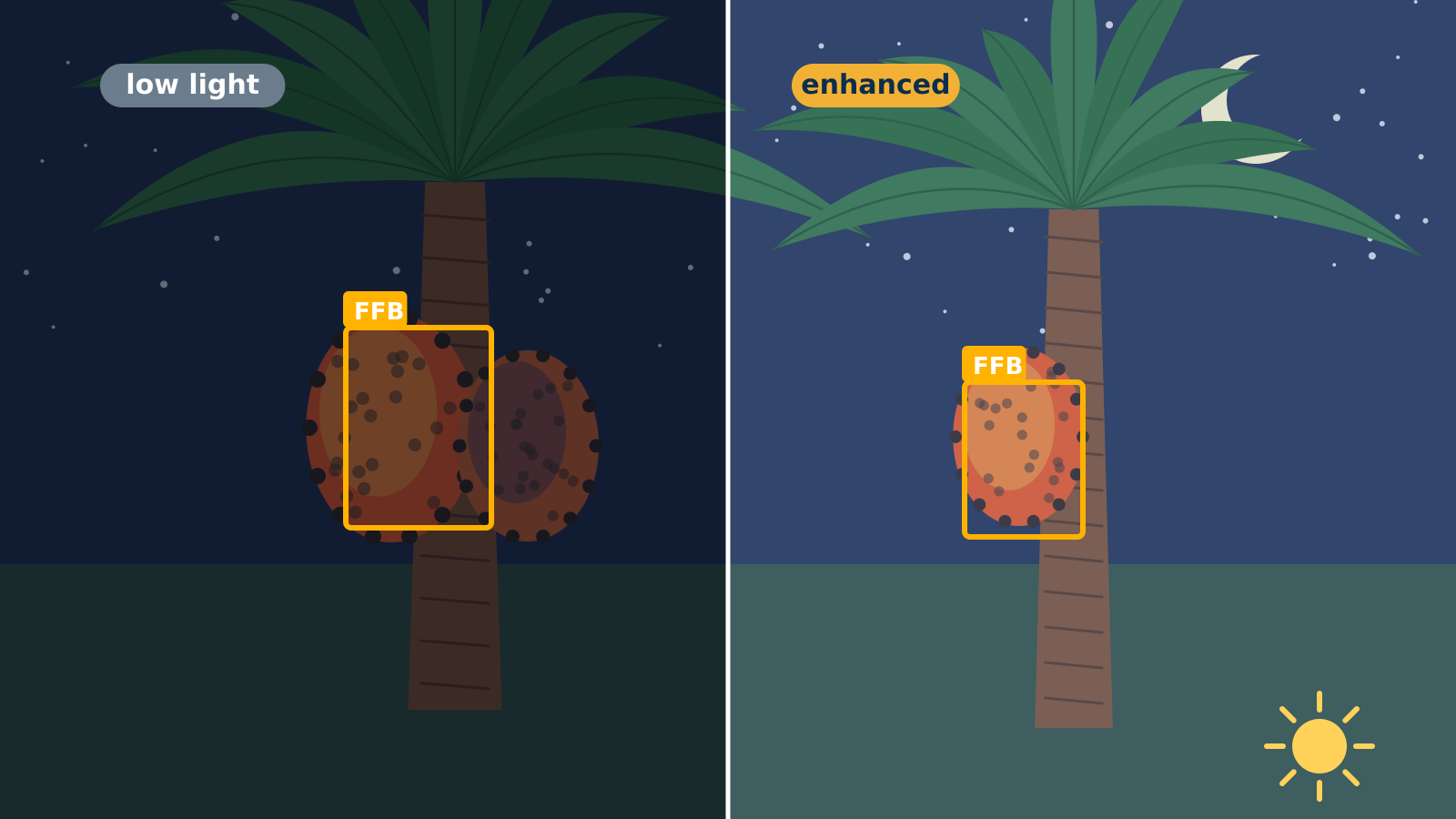
A plantation does not stay brightly lit all day. Clouds roll in, the canopy casts deep shadows, and by late afternoon the light fades. A camera that finds fruit bunches well at noon can struggle at those hours, yet harvest decisions do not wait for good weather. If a monitoring system only works under ideal lighting, it leaves large parts of the working day uncovered.
This study pairs a Single Shot Multibox Detector (SSD) with Single Scale Retinex, an image enhancement technique that brightens dark images and balances their intensity. The images were taken directly on the tree at a resolution of 1920 by 1080 and divided into three light levels: daytime at 1000 to 1600 lux, morning at 500 to 999 lux, and afternoon at 200 to 499 lux. Each level contained 104 images with 245 fruit bunches, so the three conditions could be compared fairly.
The enhancement is important because simply turning up the camera sensitivity is not a clean solution. A high ISO setting makes a dark scene brighter, but it also introduces noise into the picture. The researchers therefore tested a different strategy: keep the ISO low at 400 to preserve image quality, and let Retinex brighten the image afterward. They compared this with a high ISO setting of 3200 without enhancement, and also compared the Single Scale Retinex combination with the SSD paired with Multi-Scale Retinex.
Precision stayed between 98.55% and 100% across the three light conditions, and the F1 score ranged from 90.87% to 92.07%. Recall was lower, between 84.08% and 85.31%, which means some bunches were still missed. Using the low ISO of 400 together with the enhancement beat the high ISO of 3200 without it, with improvements of 16.75%, 48.2%, and 69.21% across the three light levels. The combination also outperformed the SSD paired with Multi-Scale Retinex.
This work connects to Sustainable Development Goal 8 (SDG 8): Decent Work and Economic Growth. Detection that keeps working as the light changes means monitoring does not have to be limited to the brightest hours of the day. For plantation workers and managers, that gives more flexibility in scheduling inspections and harvest planning.
Ultimately, this study shows that a smart choice of camera setting combined with a simple enhancement method can make a real difference in difficult light. It is a reminder that better results in the field do not always require a bigger model, but sometimes a better way of preparing the image.
Metadata:
Judul article: Integration of Single Shot Multibox Detector and Single Scale Retinex in Detecting Oil Palm Fruit Bunches in Low Light Conditions
Nama jurnal: IEEE International Conference on Artificial Intelligence and Mechatronics Systems (AIMS)
Penerbit: IEEE
Tanggal publish: May 2025
Tautan / Link: https://doi.org/10.1109/aims66189.2025.11229503
Contact:
Prof. Dr. Ir. Indrabayu, S.T., M.T., M.Bus.Sys., IPM., ASEAN.Eng
0811447755
indrabayu@unhas.ac.id